Better Backstitching

Almost ready for fitting!

Practice: that’s the key. That’s the only key. Just keep stitching…and eventually, the stitches will get smaller and you will get faster.

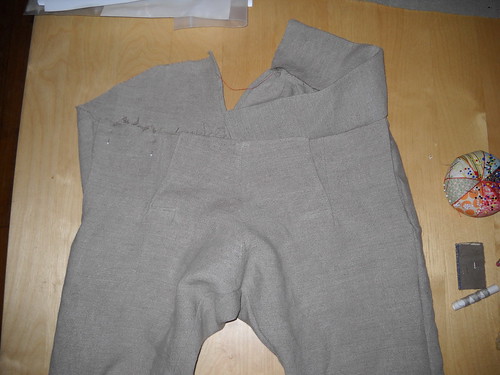
I spent the week transforming last Monday’s stack of pieces into overalls. This sewing business is amazing! Flat pieces turn into something wearable, and it’s all made out of string in various arrangements. (I may need to get out more…)

The pattern from Henry Cooke goes together very nicely. The pockets are a nice element, and their installation is simpler (I’d call it elegant) than other breeches or trouser pockets I’ve made thus far (this is pair six of breeches/overalls/trousers, pattern four).

That sounds like a lot, doesn’t it? Here’s the spool of thread I bought 18 months ago on the left, and the new one on the right. Along the way, I’ve also used up several spools of colored linen thread, a couple of silk and a few of cotton. The new spool is 1150 feet of linen thread, which seems like a lot to start with. It goes fast, though. The used-up spools were smaller, but when you aim for 10-12 spi, that’s a lot of stitches. Best not to count.
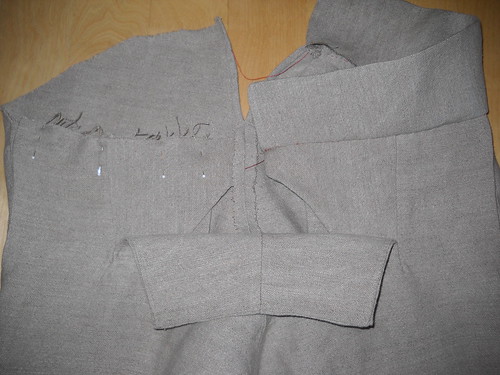
With the fall dropped, you can see the bearer/waistband connection

Very cleverly done, this pocket-bearer-waistband arrangement. My sewing has improved, and luckily for me, these are heavy plain weave linen (acting as osnaburg, here) rather than heavy drill. Heavy drill kills my hands, but this has been pretty pleasant to stitch thus far. Who’s to say what fresh hell the buttonholes will bring–but that’s another week away, at least.

And then it will start all over again on pair number two…but not before I’ve altered the frock coat and possibly breeches, made a jacket and a hunting shirt, and, I hope, a gown. Six weeks to go!

Three sticks, two kettles, no matches

Soldiers Cooking, 1798 National Army Museum (UK), 1983-11-63-1

Here’s some visual evidence for why we travel with three sticks, two kettles, and no matches. (We bring the sticks as we suspect the sites where we camp & cook don’t want amateur logging on their grounds.)  I stumbled upon this at the National Army Museum in the UK. Here’s what they say about the image:

Soldiers from an unknown unit attend to their cooking pot on a break from their duties during the Wars of the French Revolution (1793-1802). They are accompanied by their womenfolk. Although only a few men from each unit were officially allowed to marry and have their wives and families accompany them, women would have been found in almost every British military camp. Some worked as cooks, laundry women and sutlers (camp followers who sold provisions), while others were prostitutes.

One of the things one learns when reading about women who followed the armies of the Revolutionary War is that prostitution–at least for those following the American army– was not high on the list of occupations for women.

Why not? Lack of ready cash, folks.

Working for the Army would get you rations, and that literal meal ticket was desirable in a time of shortages and want. If you’d been burned out of your home or farm (I’m looking at you, 54th Reg’t of Foot, Aquidneck Island torchers) what would you eat? What would you do? It depended, of course, but one thing to do would be to follow your husband if he had enlisted.

I know less about the women who followed the British Army, but for a Continental Army start, I recommend the following books:

Belonging to the Army. Mayer, Holly A. USC Press, 1996.

Liberty’s Daughters. Norton, Mary Beth. Cornell, 1980. (My edition, 1996)

Revolutionary Mothers. Berkin, Carol. Vintage Books, 2005.

In Pursuit of Liberty. Werner, Emmy. Potomac Books, 2009.

The last title is about children in the time of the Revolution, not women, but considering who was left home with the children, and in trying to understand what the time might have been like for the Young Mr, I’ve given it a read as well.

As for the camp gear? We keep it at a minimum based on period images. We don’t all sleep in one tent, but we pack as light as we can. It’s nice when authenticity and ease are the same.

Bloody Overalls

Just started backstitching, already bleeding

But that’s still better than the story I heard yesterday about the incredibly authentic, effluvial-field dipp’d overalls that gave a mender dysentery…you come here for this, right, not the pretty dresses?

My thumb has split– yay, winter!–so everything will be a little trickier. Guess I’ll lay off handling white silk gowns at work, and documents, but the sewing will continue.

The Line of Truth

We went up to the Adjutant’s house yesterday, now that the roads are cleared again, and the lads got measured. Best of all, Mr S got fitted. He has what I ungenerously call “The Hump,” and what the Adjutant describes as “Shoulders Roll Forward.” The Adjutant has tact; I’m the wife, I calls it like I sees it.

It was really helpful. I knew the coat was too big (Mr S is built more like an 18th century soldier than a 21st century office worker), but I knew it had more wrong with it that too much fabric. At left, see the chalk line? The sleeve seam sits at the shoulder point, where I am told it will be uncomfortable as it rubs, which will also wear out the shirt faster. I knew what to do it the sleeve had been on a gown– unstitch it and re-align it under the shoulder strap, mark it and trim the excess off the head. In a way, that’s just what I will do here. There’s also excess to take out of the upper arm, but that’s not too bad for a garment that I made in a hurry and never really fitted to the wearer. And I have until mid-April to do it.

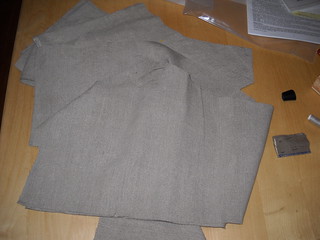
I have two of these greige stacks to transform.

At the same time, I also have to transform two of these piles of pieces into well-fitted, hand-sewn overalls. Despite the pride I’ll feel in accomplishing what I expect will, under guidance, be the best-fitted, most authentic garments I’ve made, saving my green checked apron, there’s a minor measure of terror mixed in to all this…hope those back stitches hold…

Veterans and Votes

20121127-080442.jpg
On Wednesday last, I met with two fantastic colleagues, one from my own house, and the other from the local living history farm/museum. We went over topics and themes and ideas about history, and we tried to stay focused…but it was hard, because really, all three of us think the 18th century is hot stuff, and the thing we most want to share with the rest of the world.

At one point, our farm based colleague reminded us that his people (tenant farmers) would not have been able to vote. And I realized, as the conversation quickly hopped to the westward migration of Rhode Islanders–some to take occupation and ownership of Western Reserve lands given as bounty for Revolutionary War service–that there were plenty of men who served in the Continental Army who, at war’s end could not vote.

Let that one sink in for a moment: in Rhode Island, only property owners could vote. A man who served with the Rhode Island Regiments who did not own property fought, in some cases for eight years, but at war’s end, could not vote. They could not participate in the democracy they might have sacrificed not only time and profit but their own bodies to achieve.

One man, one vote was not the law in Rhode Island until after the Dorr Rebellion of 1841, when white male property owners AND men who could pay a $1 poll tax were granted suffrage.

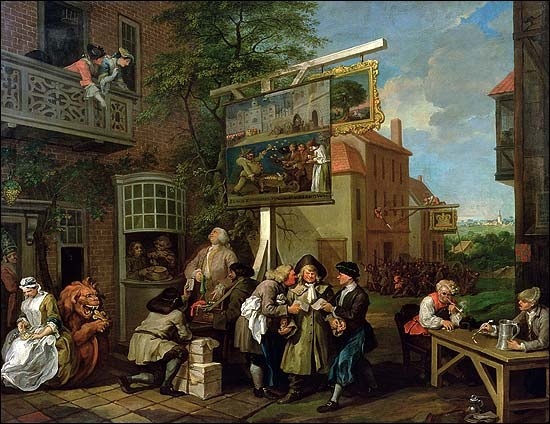
Universal suffrage rights aside, what did voting mean to the men who fought in the Revolutionary War? How did the people of the late 18th century understand their rights, and they role in democracy? It was far different from what we take for granted in America now, which is different from how democracy was understood just 100 years ago.

Again, we could delve into how Senators were formerly not chosen by popular vote or argue about the electoral college, but what I wonder now, as I ponder the men who portray Rev War units, is to what degree those men understand how very different the men of the past were from the men they are today. It is not just breeches and “Good Days” that make us different. The way we think– how we see the world and how we see ourselves– is fundamentally different.