Fun and Feasting in Cambridge

Well, we didn’t feast, it was too hot. But I helped make a feast. I didn’t document it with  photos because I didn’t think my companion would appreciate it. But here’s what we did.

General Washington was set to dine with the gentry, so a repast needed to be made. The captain’s wife volunteered to provide the meal and I served as scullery maid, a role I do find comfortable. (Anyone else identify with Daisy on Downton Abby? She’s the character I feel most like.)

The menu:

Salmagundi
Onion Pie
Bread & Cheese
Pickles
Fruit
Ratafia Cakes
Claret

We worked in the NPS staff kitchen in the carriage house behind Longfellow House: air conditioned, but the kitchen is in a former bathroom. Still, there was a sink and some counter space, so we were set.

A salmagundi is a kind of mixed salad, by which I do not mean tossed. It is perhaps most similar to a chopped, layered salad today. Colonial Williamsburg has an adaptation here, and that formed the basis of our creation.

We used one bag of pre-washed leaf lettuce, one roasted chicken (I did not have to rip it up! I got to chop eggs instead), two tins of anchovies, a medium ham, a lemon, etc. Although we had wooden bowls for prep work, we ran out of places to put the chopped ingredients, so ended up using the NPS staff containers from the dish drainer. With a glass full of egg yolk, a bulk food container of egg white, a black plastic dish of ham and a plastic water cup of anchovies arranged on the crowded sink, we achieved a workable if slightly bizarre mise en place.

What’s astonishing is how much space all that food takes up. You think it’s not enough when it’s contained, but get it on a platter and wow! That’s a shockingly large amount of food. The captain and his wife will be enjoying that salmagundi all week, I fear.

The onion pie was pre-baked from the CW recipe as well. I favor Chesire Pie, and know it is a unit favorite (since four of us devoured one for breakfast at Monmouth…mmmm, pie….)

The pickles were amazing! Made from a 1747 Hannah Glasse recipe, pickled cucumber slices are pretty simple. You may, of course, wish to reduce the quantities:

“To pickle large cucumbers in ſlices. TAKE the large cucumbers before they are too ripe, ſlice them the thickneſs of crown pieces in a pewter-diſh ; to every dozen of cucumbers ſlice two large onions thin, and ſo on till you have filled your diſh, with a handful of ſalt between every row : then cover them with another pewter-diſh, and let them ſtand twenty-flour hours, then put them in a cullender, and let them drain very well ; put them in a jar, cover them over with white wine vinegar, and let them ſtand flour hours ; pour the vinegar from them into a copper ſauce-pan, and boil it with a little ſalt ; put to the cucumbers a little mace, a little whole pepper, a large race of ginger ſliced, and then pour the boiling vinegar on. Cover them cloſe, and when they are cold, tie them down. They will be fit to eat in two or three days.”

Read more at Celtnet: http://www.celtnet.org.uk/recipes/glasse-of-pickling-14.php
Copyright © celtnet

Ratafia cakes are funny little things. I only had one, when they came back from the table (I did mention Daisy, right?) but I might try them. They are not ideal for camp eating–in fact, they would be downright inappropriate–mostly because they are rather fragile and travel poorly.

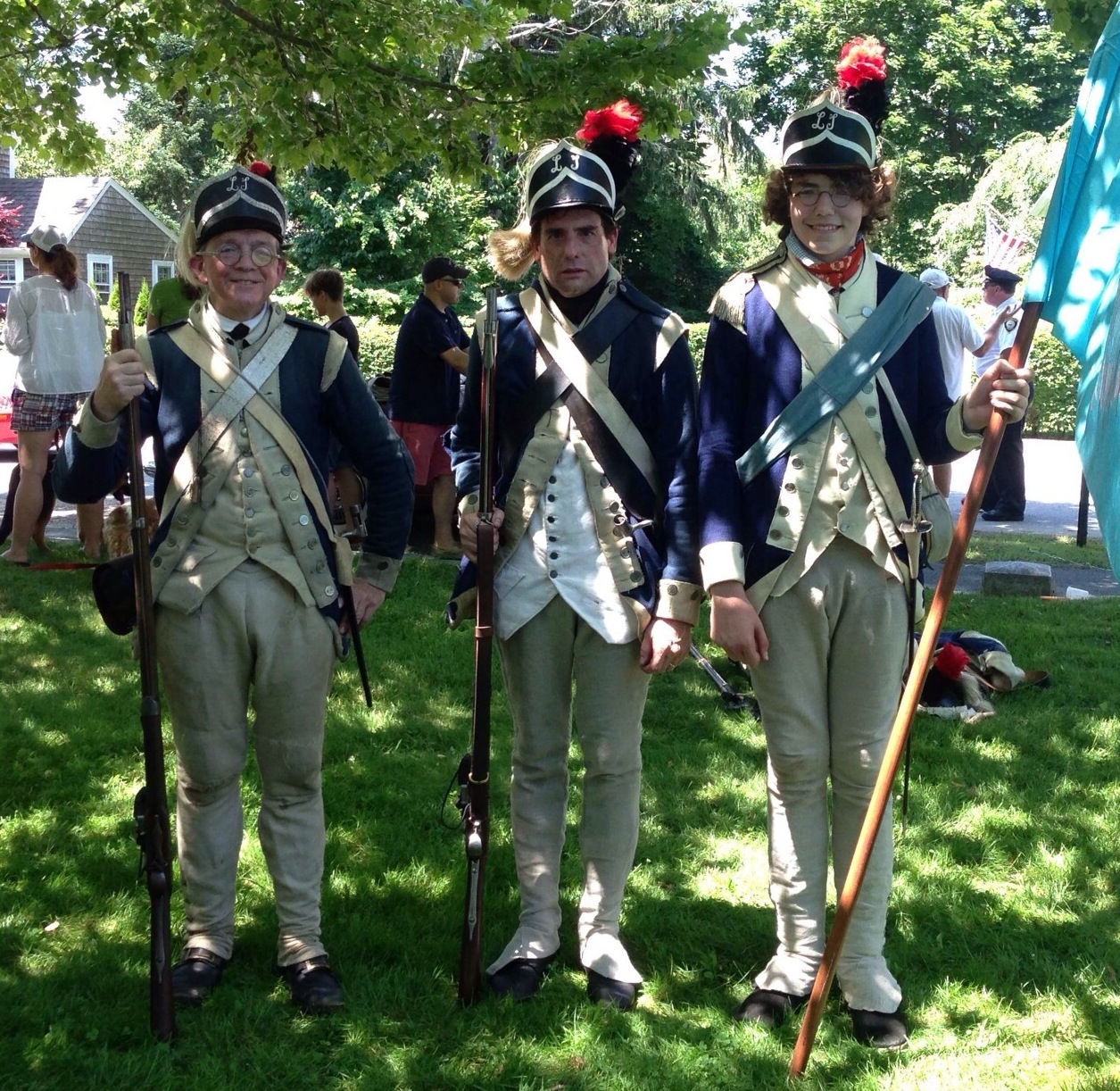
The rest of us–the privates and sergeant and the Young Mr, who was playing Washington’s aide de camp as a young scamp–ate bread and cheese and fruit in the shade of a tree. It was too hot to eat much.
Sewing for Zombies

Death by Fitting

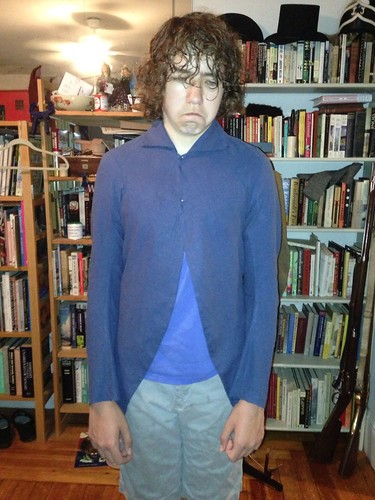
He doesn’t always look this horrible, but when the Young Mr sets out to look like death, he does it very well. Dressing 18th Century style comes at the price of fittings, and while we like to cut a fine enough figure at an event, we want no part whatsoever of the process. Even the promise of playing with a dog won’t get us to a fitting. And he dearly wants a dog…so you know fittings are a trial.

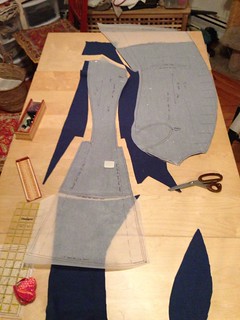
Cutting Out on Sunday

The pattern is by Henry Cooke, based on both a Rhode Island original in a private collection and a jacket in the collection of the Connecticut Historical Society. It is solidly 1770s-1780s, unlined, and both originals made up in brown linen. (From the pattern notes and what I know of the CHS jacket, accession number 1981.110.0; their catalog links are unstable, search for 1981.110.0.)

It goes together well; I started without directions, but as I am more idiot than savant, I got myself confused. I did have to alter the sleeve for the Young Mr, as he has long, thin arms. The rest of the pattern seemed to fit him pretty well, all in all, but a few untoward things happened between measuring, mock-up, basting and fitting. Still, it can be worn, with improvements made next week after he wears it in Cambridge this Sunday. 

Getting Better, and Giving Back

Mr Cooke, Mr S and the Young Mr.
10th Mass fittings: Mr Cooke, Mr S and the Young Mr.

There is good, if slightly terrifying, news about how to get better at sewing. It took me two years to get to a decent place, but this sped up considerably in the past year because of the weeks when I sewed for 30 or 40 hours a week. This business is about practice, looking, and patience … and also asking for help. Some of the help you can get online, some of the help you can get from whatever human is handy, and some you need a master for.

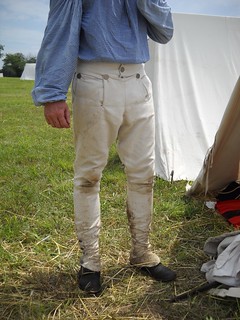
The Rhode Island pair, pattern by me based on Mill Farm breeches.

Online tutorials have saved my bacon: I make gowns with Koshka’s tutorial handy because after intensive menswear, I forget how this gown business works. The random human help I get comes from Mr S, who patiently takes photos as I try to fit backs or see what’s wrong. Trust me: you cannot see your own back in a mirror, so take a photo, or get someone else to. The masters who have helped me are Sharon Burnston and Henry Cooke. From both of them I’ve learned how to look and how to think about historic costumes. Sharon’s workshop really helped my sewing, and watching Henry has taught me a lot about fit. Also from both: patience.

When it came to Mr S’s overalls, I needed a professional bail out. Mr Cooke offered to help after watching me basting the things at MMNHP, and here’s what I wrote in reply:

[the] overalls have reached a rather bad place, and are now only half-basted on the legs after a third fitting attempt. He appears to have lost more weight. The fit in the seat confounds me, and when I get one leg right, the other twists. Your help would be deeply appreciated…

In the end, my basting was ripped out and Mr Cooke sat on the floor and basted the overalls on to Mr S. The process took a bit more than an hour, during which time Mr S became very familiar with the curtain material in Mr Cooke’s workroom, and realized that it was identical to the curtains he’s had as a child. This memory transported him back to a childhood trip to Williamsburg, when he yearned to be one of the costumed interpreters at CW. It was a transformative afternoon for Mr S and his overalls.

Now that they’ve been worn, I know that I need to:

  1. Adjust the waistband and seat
  2. Add a leather strap under the foot
  3. Finish the in-and out-seams (with fit proven, felling can begin)
  4. Switch ankle buttons from plain and RI mix to all plain or 10MA
  5. Take a pattern from the legs!

There is hardly any seam allowance over Mr S’s single-speed bike-riding-up-hills calves, so a pattern from the legs would make the next pair that much easier. He has two pairs, so why should I bother? Because he will undoubtedly wear these out doing as many belly crawls, stream fordings, nettle bush tangoes and other light infantry activities as he possibly can. At some point, mending will cease to be an option.

So how would I pass on the lessons I’ve learned? In some ways, by writing honestly about the struggles and successes in getting these things right, and to let you know that practice really does make a difference. It’s also become clear that maintaining an open, curious mind willing to accept criticism and new ideas will make you a better sewer, and maybe even a better living historian/reenactor…dare I say person?

Apprehending Chicken

Living History Chickens. Don’t mess with them.

I have written in the past about the Living History Chicken, ripped and delicious, and the joys of making such a creature fit into a cast-iron pot. While “chicken ripper” might be the appellation you desire, it’s not what I want to be known for.

Last time, I dissed the modern ham as an item ill-suited to camp cooking (tasty, but it doesn’t look right). I have also seen hams on a spit cooked slowly (too high above) a fire, and heard a rumour about a very authentic ham-dining experience with a very authentic digestive result. That’s taking things farther than I care to take any regiment, so what to do?

Continental Army rations included, among other things, a pound of flour and a pound of beef a day per man. In Rhode Island at least, that beef might also have been fish, and I have seen chicken listed, too, as it is, technically, meat. Not wanting to inflict our fishy Ocean State customs on all comers, I think I’ll spare the regiments a pound of fish a day. But chicken? What to do? Hope to cook it?

Or maybe we should eat more fruit.The Afternoon Meal by Luis Meléndez, ca. 1772. MMA, 1982.60.39

One option is to rip the carcass apart (see above) and boil it. That would get the job done, for a bone-in chicken stew. However, I am thinking of string roasting chicken (or cornish game hens, since modern grocery store chickens are awfully large).

To be quite technically correct, I could only cook chicken for the Second Helping Regiment. They had a documented poultry thief among their number, one John Smith, who apprehended poultry if it failed to give the correct countersign when challenged. However a chicken is prepared, it will be a messy business, as we have no forks. It’s fingers, knives and spoons for us, as we have no forks. That does increase the appeal of boiling, since the meat would come off the bone more easily.