
Hunting Frocks, Again

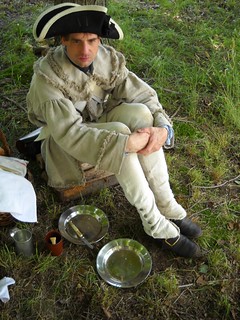
They’re not Mr S’s favorite thing, and I can understand why. Hunting frocks lack pizzazz, buttons, tape, lace, lapels, skirts and all the things that make him so fond of the Ugly Dog Coat worn by the 10th Massachusetts in 1782. (I think these are the coats captured from British supply ships and dyed at Newburgh and West Point in tanner’s vats.) But what he has right now is a hunting frock.

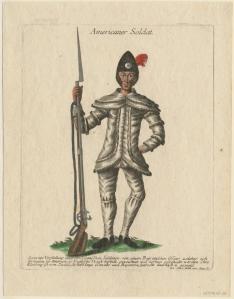
Here’s the kid in his new hunting frock, and a hand colored copper engraving by Johann Martin Will from 1776.
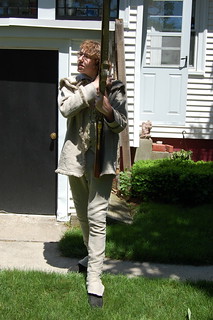
You gotta hold your tongue just right when you drill.
Americaner Soldat, Johann Martin Will. Ann S. K. Brown Collection, Brown University.

And then there are the colored and plain engravings, “1. Americanischer scharffschütz oder Jäger (rifleman) 2. regulaire infanterie von Pensylvanien,” engraved by Berger after Chodowiecki.
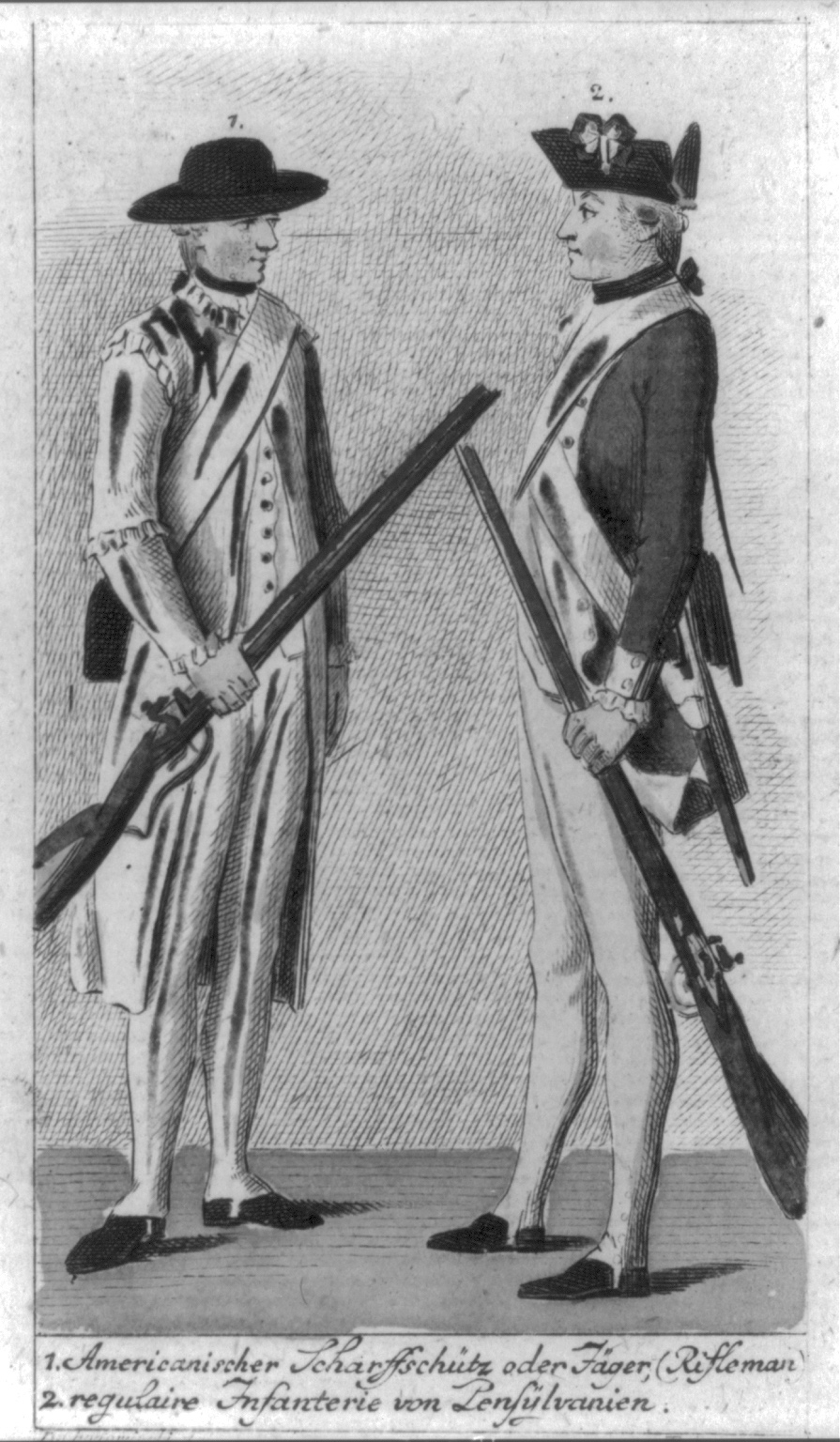
 Library of Congress
Library of Congress
Berger after Chodowiecki, Ann S. K. Brown Military Collection, Brown University
Ann S. K. Brown Collection

I started thinking about these again because not only am I reading Hurst’s thesis, but I’m fresh from helping the guys get dressed and arrange their capes and straps. I have been doing that as long as Mr S has been wearing historic clothing.
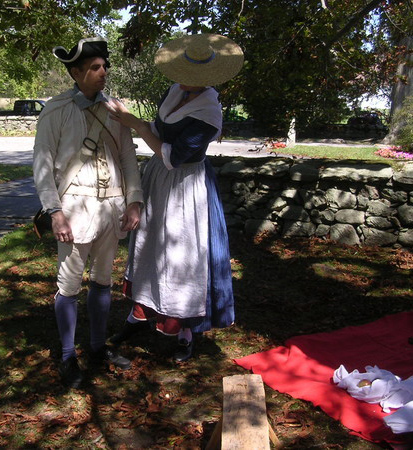
Early days of draping

Drapey capes

The hunting frock drifts if it does not have some kind of fastening at the neck. The two halves migrate in opposite directions, and while belts help, the light infantry bayonet shoulder belt does not contain the hunting frock as well as one might like. So the thing to do, I think, is to attach a loop and button at the neck to hold the garment in place. From the period engravings, I think that’s acceptable. The garments all look as if they are closed at the neck. From the evidence in the field, and from the images, I plan to make loops and attach buttons, and hope that will limit some tendency to wander.

The image of the two soldiers together suggests another wrinkle in the hunting frock quandary, since the left hand soldier’s out garment looks like a long pocket-less coat with applied fringe and only a very small cape at the neck. Thank goodness that soldier is a rifleman, and thus outside the realm of immediate relevance. (And on a side note, I know a gentleman who very much resembles the Pennsylvania infantry man: identical calves, and even a similar face.)

Authenticity: Sources II, or, Stripes!

In any decade, I love stripes.

Stripes. I love them, really, I do. Gowns, petticoats, cats. Why do I want to use them so much?

For the guys, because I can document what they’re wearing, at least based on their current state of residence and their current nominal “home” unit with the BAR.

Here’s why:

1777 Oct 22
An inventory of Searjeant George Babcock’s
Wearing Apparil who was Killed at fort Mercer
Octor 22d 1777 Belonging to Capt Thos Arnold’s Comp’y in Colo Green’s Regemt

Two Check Linen Shirts
one Pair of Striped Linen overalls
one Striped Cotton & linen Jacket without Sleeves
one flannel Jacket without Sleeves
one home spun Woolen Jacket without sleeves
one Linen & Worsted cotee
one Kersey outside Jacket Lined with flannel
one beaver Hat & one Pair of shoes
one Pair of blue worsted stockings
one pair of thread ditto
one pair of blue yarn Stockings
one Linnen Handkerchief
one knapsack

(Clothing inventory, Capt Thos. Arnold, Col. Christopher Greene, Rhode Island Regiment
RIHS MSS 673 SG 2, S1, SSA Box 1 Folder 13)

From RIHS MSS 72, Preserved Pearce papers,  Tailor's and Tavern account books, 1778-1781.
From RIHS MSS 72, Preserved Pearce papers, Tailor’s and Tavern account books, 1778-1781.

This inventory has formed the basis for many of the clothing choices I’ve made for Mr S and the Young Mr from their check linen shirts to their blue stockings. I was criticized for the size of the checks of their linen shirts (too small! I heard), but feel vindicated time and again by the extant garments I’ve found (aprons, mostly) in this period. The checks are small.

The best piece of evidence I found was serendipitous: whilst going through tailor’s books Thursday, looking for stays, I found a scrap of blue and white checked linen used as a binding. The biggest lesson from that scrap is that I need a deeper, more indigo-rich blue and white to begin with.

The “Striped Linen overalls” in the inventory are definitely on the list of things I’d love to make, along with the “Striped Cotton & linen Jacket without Sleeves.”

One of my favorite garments of all time. Boy's frock, ca. 1760-1770. RIHS 1959.6.1
One of my favorite garments of all time. Boy’s frock, ca. 1760-1770. RIHS 1959.6.1

There are extant Rhode Island garments from made of blue striped linen, documented to the period we interpret, and another one, recently acquired (coming soon to a database near you!) from which a pattern has been taken.

After a while, though, blue stockings and checked linen shirts seem…ordinary. Common. You might start to wonder if they’re just another re-enactorism, they’re so ubiquitous.

It’s worth checking again to see that these are, in fact, common garments, probably as prevalent then as they are now.

Tentage

Scene of the Camp on Hampton Green, 1781

Like many other reenactors/living historians/suckers for wool in summer, I’ve been following the First Oval Office project with interest and envy. Imagine my delight upon finding this blog by Tyler Rudd Putman, who is working on that and many other projects of interest.
The common tent project l is one that I really do hope to take on someday, though I doubt I can ever achieve a tent of this level of quality. (Reader, I cannot weave.) But I can aspire, at the least, and I see that a hand-sewn tent is something even I can achieve. It won’t get done by me in just one day, but over the course of several weeks I could get one done as long as I cleared the downstairs of all our furniture, and put up with a cat sewn into a seam. (My assistant has been lying down on the job, melting in the heat.)

The Howling Assistant Lies Down on the Job

I’ve been thinking about tents since the after-dark hilarity at Monmouth setting up an unknown tent in the dark with a brittle pole that had to be repaired with string from a pasty wrapper, and the later perhaps over-zealous cleaning by Mr S of the tent abused by a cat and identified on the NJ turnpike’s extended play of “What the Hell’s that Smell?”

I’m not sure why we’re allowed to remain in our regiments, really, I am not. But I suspect that an ability to produce Chesire Pork pie is a factor in our favor.

We’ll be setting up tents at OSV in just about a week, broken pole and all, and looking ahead to that, I give you the following links for further reading on tents.

John U. Rees on tents in both armies of the Revolution.

How to fold a tent.

Period (British) images.

Even more documentaton: scrolling down, Rhode Islan had a return of 147 tents in May, 1781– that’s about 882 soldiers, at 6 men per tent, a max of 1029 at 7 men per tent. (At least one is always on duty, so there would not be more than 5 or 6 sleeping at any one time).

Amazing and image-rich essay, The Tent Article

Lochee, Essay on Castremetation, which I read and forget by the time it is dark and some man is trying to reason with me about how a camp should be arranged, when all I want to do is sleep. With that in mind, a brush arbor is starting to look good…

Washington’s Army En-scamp-ment

It is known that the troops serving as the Army of Observation in the months after Lexington and Concord lacked discipline. General Washington found them sorely wanting when he took command of what became the Continental Army, superseding General Artemus Ward. You can read the measures Washington put in place here, from Artemus Ward’s orderly book in the collections of the Massachusetts Historical Society.

This lad became Washington’s Aide-de-camp, scampering out of trouble…barely….

When you have this kind of documentation, it makes recreating an event that much easier, and more fun. (We did note that sometimes striving for authenticity makes us behave very seriously; perhaps a little more fun is in order.)

Luckily for us, the Young Mr was assigned to be General Washington’s aide-de-camp. Aide-de-scamp would be more like it. He thoroughly enjoyed carrying the General’s equipment and accouterments, handling the items with obvious care and confusion–he was clearly impressed by what he was carrying, acted (rightly) as if he’d never seen things so fine, and then proceeded to place them carefully on the ground outside the general’s tent…respectful but not quite right, thus a little disappointing, but setting the proper tone.

After lunch, the sergeant standing guard caught the aide-de-camp stealing fruit from the general’s table. This made a fine show with the sergeant yelling at the aide-de-scamp and shaking him by the scruff of his jacket (the sergeant being shorter than the scamp). The scamp continued to eat the peach, but it was ripe, and part of it went flying off the pit, fortunately not into the sergeant’s face. All were pleased by this little scene, no one more than the scamp.

The Lexington Training Band was busted for card playing, and for drying their dirty laundry on the general’s tent. The scamp was accused of stealing stockings, and chased, in another very satisfying scene. Next weekend, he’ll have General Gage to reckon with. I expect to find him in irons.