Interpreting Bridget

Shirts? What shirts?

This weekend, we’ll be at the Brigade of the American Revolution’s School of Instruction, taking anxiety to the Hudson Highlands as I give a presentation on interpretation. Sure, it’s part of my day job to interpret objects and documents and even, sometimes, to do costumed interpretation, but experience has never prevented me from worrying. It has allowed me to focus my worries more productively and specifically. One of the things we’ll be trying, or attempting to try, are vignettes based on the shirt-stealing and selling ring of 1782.

Events from Captain Abbot’s Orderly Book for interpretive vignettes

Soldiers Steal a Shirt and dispose of same (~July 13-14, 1782)*
Cast: Two soldiers, officer who catches them
Props: shirts

Court-Martial July 15, 1782: Paul Poindexter and Titus Tuttle, for theft of a shirt
Cast: Two soldiers, accusing officer, three officers of the court
Props: Shirt; table and seats, orderly book (optional)

Discovered buying a shirt (~July 21-22, 1782)*
Cast: Bridget, soldier selling shirt, officer who catches them
Props: Shirt(s), money

Court-Martial July 23, 1782: Bridget tried for buying a ‘publick shirt’
Cast: Bridget, accusing officer, three officers of the court
Props: Shirt & money; table and seats, orderly book (optional)

Insolence to Officers of the 10th Mass (~July 23-24, 1782)*
Cast: Bridget, officers (two preferable, one adequate)
Props: None required, large stick probably handy

Court-Martial July 25, 1782: Bridget tried for insolence
Cast: Bridget, accusing officer, three officers of the court
Props: Table and seats, orderly book (optional)

Expelled from camp, July 25, 1782*
Cast: Bridget, drummer, officer(s), jeering onlookers; Francis skulking at the edge
Props: Drum, Bridget’s chattel

* Events are extrapolated from the Orderly Book as things that must have happened to cause the events that followed.

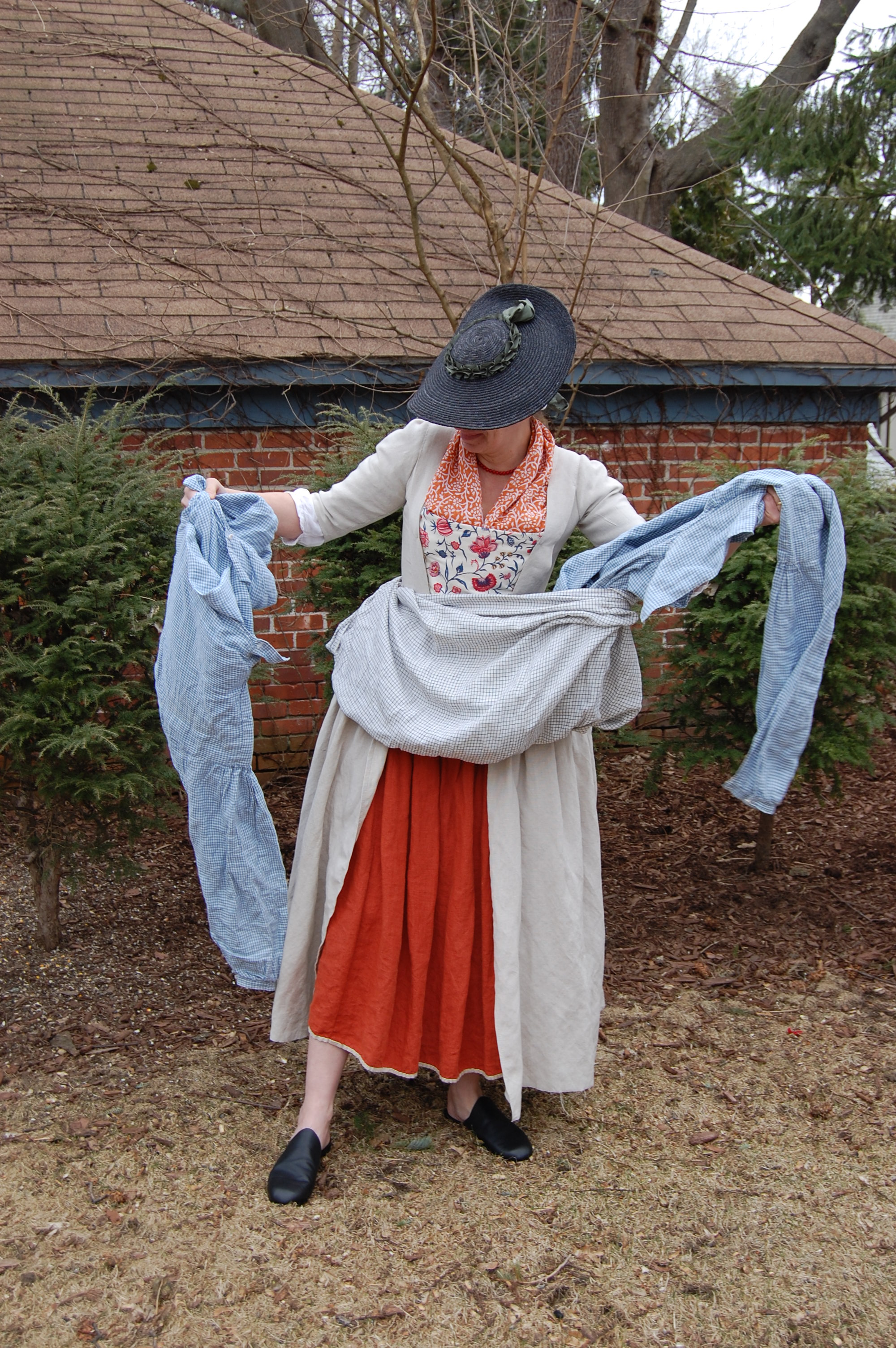
We’ll see…in the meantime, I’m finishing up a shirt for the Young Mr, so that his small clothes will no longer be too-small clothes, and so we have extra shirts for this black market ring.

Visual Illiteracy

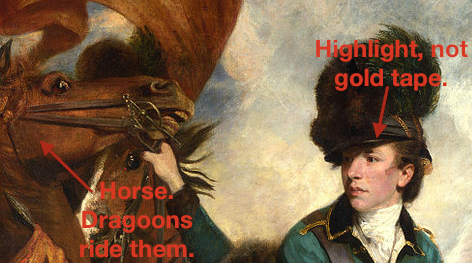
Banastre Tarlteon by Joshua Reynolds
Portrait of Sir Banastre Tarleton (1754-1833) by Joshua Reynolds, 1782. National Gallery (UK)

See update below!

By 9:00 on Sunday, I was asleep and missed “Turn,” which Mr S wasn’t even watching because, as he declared, “It’s just a bad show.” On Monday evening, I made it through the opening of the show and gave up for good. But those minutes made me think of the Banastre Tarleton portrait by Sir Joshua Reynolds, and the suggestion on Twitter that “Turn” had no historical consultant.

It occurred to me, as I stared at the rather curious headgear worn by Captain Tallmadge (I think it’s stretch lycra over a “Roman” gladiator costume helmet glued to a baseball cap visor and edge-taped with gold foil) that perhaps the people doing the costumes simply lacked visual literacy. This could explain the refugees from Fort Lee who looked like they stepped out of an Emma Lazarus poem, and it could explain the very unfortunate helmet.

Tarleton_notes

Let us look at Banastre Tarleton, hunky bad boy of the British dragoons: he came to mind on Monday night, and what visual relief he is.

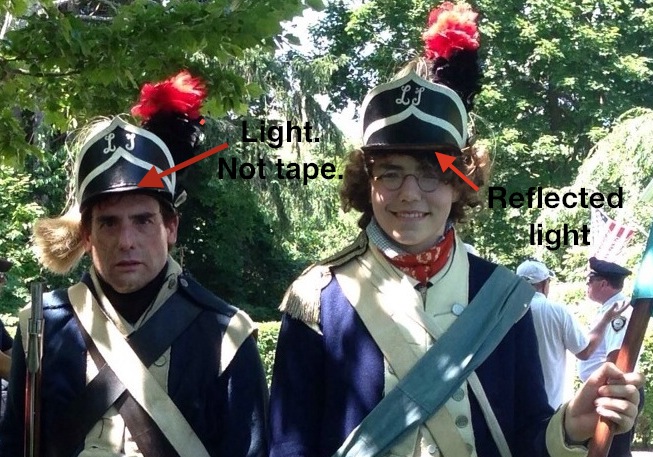
Note the light edge of the visor: this is a highlight. The leading edge of a polished surface will shine, and helmets, even of leather, will be reflective. Over time, the edges will polished by wear if not on purpose. I cannot speak to the helmet habits of the horse-mounted, but I know from paintings, and that edge is a highlight.

The Boys last July. Look, shiny, not-taped visor edges.

Reynolds painted what he saw, and just as the Young Mr’s cheekbones are reflecting light off the underside of his visor and Mr S’s helmet edge is shining in the direct light, so too is Colonel Tarleton’s helmet edge shining.

(Yes, there are both mounted and unmounted dragoons within a unit; but I just can’t help feeling that an officer would be mounted more often than he has appeared to be thus far.)

ETA: Heather has graciously pointed out a very nice blog on Turn, which is doing a far more even-handed and informed job of watching and commenting on the show. Thank you, Heather!

Not in Defense of ‘Turn’

John André’s self-portrait, 1780. George Dudley Seymour Papers, Manuscripts and Archives, Sterling Memorial Library, Yale University

Like all the other history-obsessed Rev War reenactors with basic cable, Mr S and I have been watching ‘Turn’ on AMC, and like some other reenactors, I’ve been lurking on the fringes of the Facebook feeds trashing the show, but hoping a contrarian view would be possible, just to keep things interesting.

So we watched last night with the best intentions: I would not think about shoulder seams, drawstring-neck shifts, circular caps, obvious mascara, white linen shirts on farmers, shirts with neck bands but not collars, a lilac silk cloak on a farmers’ wife, the amazing amount of light candles throw, beards on smugglers who look like they escaped from a spaghetti western… Mr S has learned to live with this and I have learned to keep quieter. He learns best visually, so he really had hopes for this show. I think we all did, even given what we know Hollywood does to historical realities.

Mr S keeps asking, “Where’s the war? Where are the soldiers?”

I keep asking, “Why is Tallmadge allowed to be on his own for so long, and what the heck is wrong with his uniform facings? And he’s a dragoon, where the heck is his horse?”

The low shoulder seams on Woodhull’s leather(?) jacket still make me nuts, though I think Anna serving in the tavern in a pristine white apron over a cranberry silk button-front gown really took the cake last night, costume-wise.

The dialogue howler I enjoyed the most (i.e. caused the final outburst) was Major Andre and his “player” girlfriend who is so not pumping him for information (horrid pun intentionally retained).

If you were the suave Major, you would respond with complete candor to the charming (mascara-eyelashed, obvious foundation-wearing, look out for the lip-gloss) woman’s question: “You will tell me where you’re going on your next secret mission, won’t you?” “Why, sweetie, yes, and let me use my time machine to bring you the Enigma machine and a smallpox vaccination.”

I expect and grudgingly tolerate:

  • Bad costuming
  • Odd set dressing (highly suspicious table in the church-stable; suspect it would be happier in Amistad)
  • The incredible candlepower of candles
  • Non-18th century speech rhythms
  • Changes to actual events for increased drama

But patently absurd, asinine dialogue on top of all that goes beyond my patience.

I should give it up: Two Advil PM at 8 and I’ll no longer spend an hour every Sunday night performing mental alterations on TV costumes. (Those shoulder seams really annoy me, and could someone try pressing the facings?)

But no; next week, Fort Lee should fall and chances are good Mr S will lead the screen-shouting…

tite Dressed

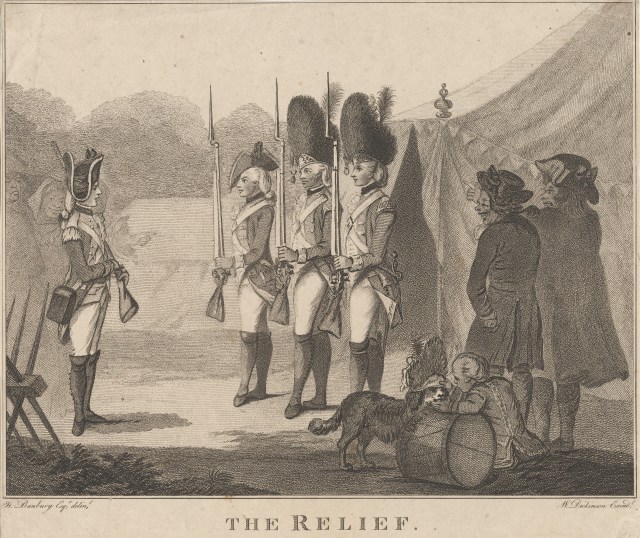
William Dickinson, 1746-1823, The Relief, 1781, Stipple engraving and etching on moderately thick, slightly textured, beige laid paper, Yale Center for British Art, Paul Mellon Collection

Reading the Abbott orderly books takes some patience, even though they have been transcribed. As with so many 18th century texts, punctuation is unreliable and open to interpretation. Here’s an entry from July, 1782, on the subject of uniforms, guard duty and fatigue duty.

July 22 1782
The Greatest Care and aten
tion is to Be pade to the preservation of the Mens
Clothing and to keep the Cloth Clean.. As
the Guards are always to Be fill Dressed in
uniform they are not while on that Duty to be
put on Ferteeg or any kind of Meaniel service
but to appear Clean, tite Dressed and In a
Soldierly manner when any parties for
Ferteeg are Necesery they are not to be applied for
and Sent in there undress or Ferteeg Clothes
this order to be Strictly observed

Which seems in more sentence-like form to be:

The greatest care and attention is to be paid to the preservation of the men’s clothing and to keep the clothes clean. As the guards are always to be full dressed in uniform, they are not, while on this duty, to be put on fatigue or an kind of menial service, but to appear clean, tight dressed, and in a soldierly manner. When any parties for fatigue are necessary, they are not to be applied for, and sent in their undress or fatigue clothes. This order to be strictly observed.

Here’s what I think it means:

Pay attention to the men’s clothing and keep it clean.
Men assigned to guard duty are always to appear in full uniform. When on guard duty, these men are not to be assigned to fatigues or menial duties. They should instead always appear clean, neatly dressed, and solider-like. When fatigue parties are called, the guards are not to be assigned to that duty, so that they do not appear on guard in their fatigue or undress uniforms. This order is to be strictly obeyed.