Looking for a Ship

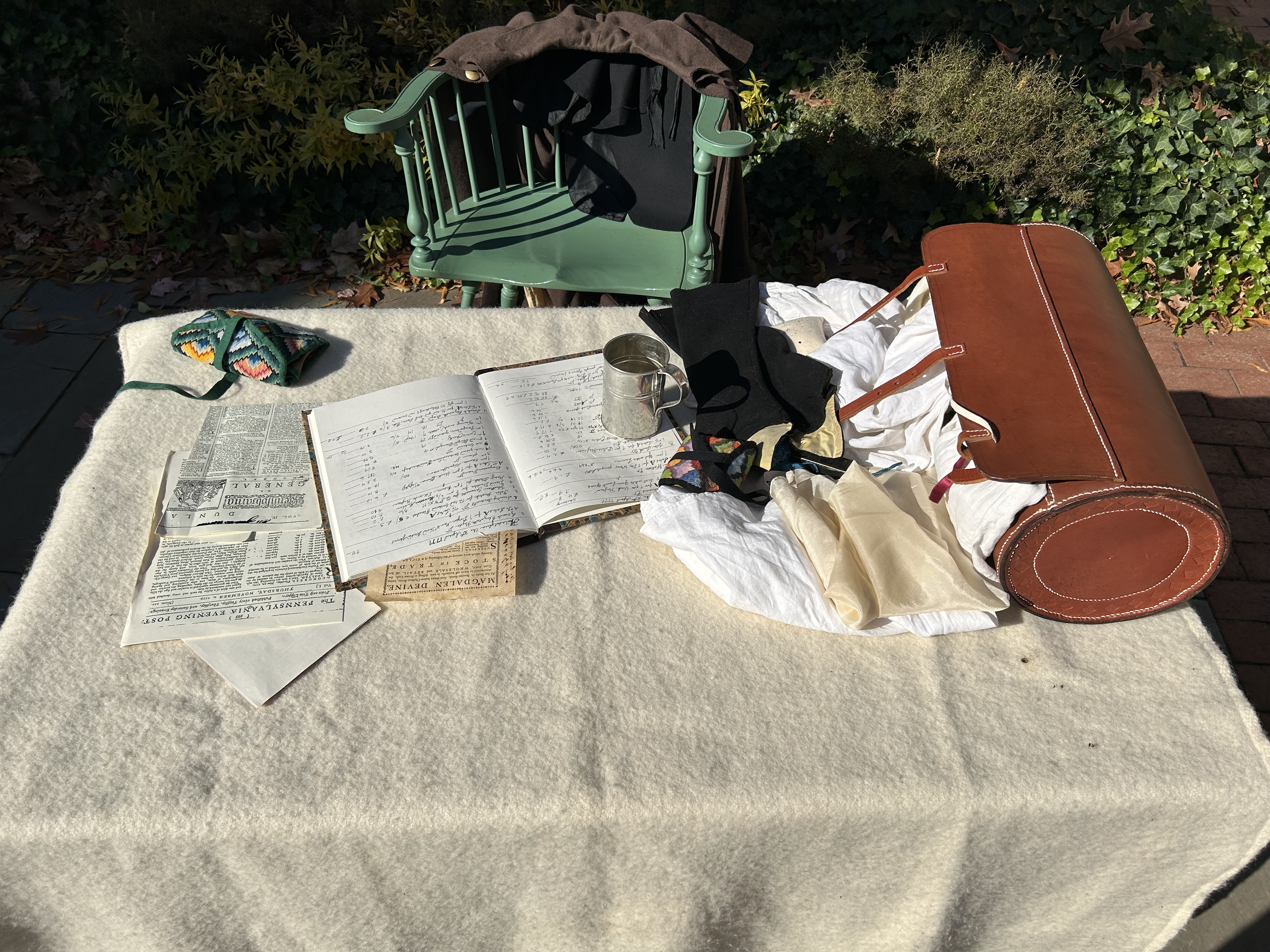
a table covered by a blanket with reproduction newspapers, a ledger book, and a leather bag
Collecting debts and packing up.

This past weekend (November 1-2) at the Museum of the American Revolution’s Revolutionary City (Pre-Occupied) event, I was pleased to represent Magdalen Devine, a feme sole trader in Philadelphia who ran a mercantile business between 1762 and 1775. Devine’s situation in 1775 reflects the tensions and uncertainties felt by many at the start of the American Revolution, and continues to resonate today.

a printed broadside advertising textiles for sale by Magdalen Devine in 1775
Broadside, Magdalen Devine, printed by John Dunlap, n.d. [1775] Historical Society of Pennsylvania, Ab[1780]-16

In 1775, Magdalen Devine, “being determined to leave off business,” advertised that she was selling “at Prime Cost, for CASH ONLY, WHOLESALE AND RETAIL, all her STOCK IN TRADE.” Devine first appeared in a Philadelphia newspaper ad in September 1762, selling imported goods with her brother, Frances Wade. By the following spring, the siblings had dissolved their partnership, and Magdalen had set up her own shop in Second Street between Market and Chestnut.

Devine’s ads reflected a keen sense of merchandising, including woodcuts illustrating printed and check fabrics and tightly wound fabric bolts. For more than a decade, Devine imported and sold goods on Second Street, eventually moving into a house she owned that was equipped with “two show windows with very large glass,” probably among the first instances of London-style shop windows in Philadelphia. 
Fire Insurance Survey, “A house belonging to Magdelane Devine.” Insurance Survey S01561

For more than a dozen years, Devine traveled between Philadelphia and London, selecting, importing, and selling “a large and neat assortment of European and India goods.” The chintzes, linens, cottons, and woolens that Devine imported represented the wide range of textiles available, many with specific applications from jean cloth for clothing enslaved workers, tickings for mattresses, and hair cloths for sieves along with the chintzes, taffeties, and superfines that dressed the city’s elite. 

By April 17, 1775, she had “determined to decline business, as she intends for England shortly” and published ads in the Philadelphia newspapers calling in debts. Although she initially gave debtors two months (until mid-June), in August she was still in the city and advertising her intention to put debts “into a lawyer’s hands” if not paid within two weeks. An August 30th paper reprinted her ad of August 1, suggesting that the debt collection was not going as she’d planned in April, and the weeks and months kept stretching ahead. The ad placed on August 30th suggests she planned to leave not later than September 15th.

This slideshow requires JavaScript.

Unfortunately for Devine, mid-September saw a slowdown and stoppage of ships coming in and going out of Philadelphia. By September 18th, no ships were reported outward bound from the city. Magdalen Devine was stuck. 

A woman in a brown eighteenth-century dress with a straw hat and a white apron, standing in front of a painted door set into a brick wall.
“Magdalen Devine” dressed in brown silk with a new straw hat.

Did she get out on an early September ship bound for Cork or Dublin, and make her way from there to England? Perhaps, but it seems more likely that she miscalculated and was caught in the city as insurers, shippers, and sea captains struggled to make sense of the news from Boston, Providence, and London. Newspapers published English threats to burn all the port cities of the American colonies, and warships plying coastal waters from North Carolina to Maine surely made sailing seem unwise. 

Why did Magdalen Devine decide to close her business and leave Philadelphia for England? Just one year before, in 1774, she had acquired the shop with the “two show windows.” What made leaving a good idea? The threads are hard to find, let alone pull, but perhaps her childhood and young adulthood in Dublin suggested that the violence the British were willing to use against a rebellious colony. Famines and strikes in the 1740s prompted British reprisals against a country that served as a laboratory of colonialism.
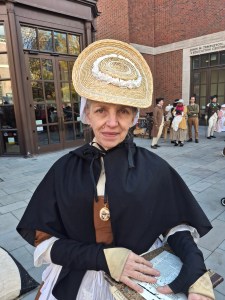
a woman in a straw hat and short black cloak
With my ledger in hand– and a fabulous new hat.

In the absence of passenger lists, it is hard to know whether Devine made it back to England in 1775, or whether she had to wait until 1783. We know she made it to London, because her death is recorded there in late 1783. 

Resources on the English in Ireland 

http://www.sneydobone.com/webtree/history-ir.htm

https://www.tcd.ie/news_events/articles/2023/how-ireland-served-as-a-laboratory-for-the-british-empire/

https://www.nam.ac.uk/explore/timeline-ireland-and-british-army

https://daily.jstor.org/britains-blueprint-for-colonialism-made-in-ireland/


The Colour of Things to Come

I have a thing for hats– well, for bonnets, really. I know I made stays and a shift before I made anything else for the 18th century, but I might have made a bonnet before I made a proper gown. It’s a condition I inherited from my grandmother, and a great aunt who was a milliner, so there’s little to be done about it– except to dive in deeper.

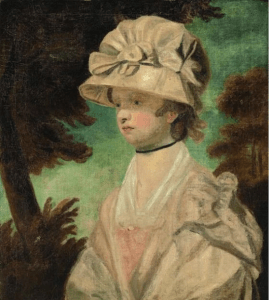
Miss Theophila Palmer (1757-1848), oil on canvas, attributed to Sir Joshua Reynolds ca 1770. Pretty sure that’s a white “whalebone” or “skeleton” bonnet.

As people do more research and generously share it with me, I’ve come to realize that I need to synthesize what we are seeing. It’s a tricky thing, what with that single (known) extant bonnet at Colonial Williamsburg and only prints and images to go on. What I’ve done to compile a stack of references from newspaper ads (primarily Mid-Atlantic and New England colonies at the moment) and interfiled them with images. This has given me a much better sense of  the change in shapes and construction over time, as well as the range of colours– yes, colours, available and popular.

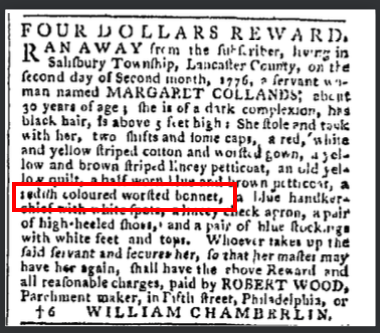
It’s not just that wool bonnets are a thing– there’s the ““a reddish coloured worsted bonnet” in the April 8, 1776 Pennsylvania Packet an ad for runaway Margaret Collands, and the “black durant” recommended in Instructions for Cutting Out Apparel for the Poor– but close reading shows that the colors are more varied than we’ve accept lately, but they vary by region and time period.

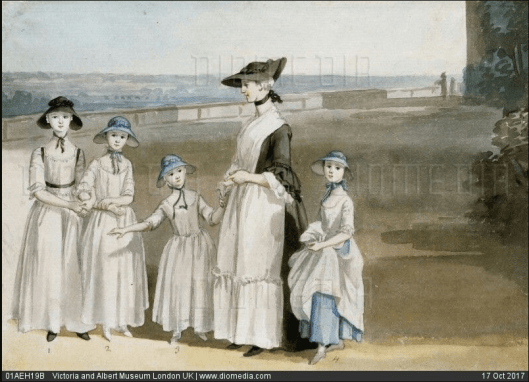
The Misses Waldegrave. Are blue bonnets *only* for children? Maybe.

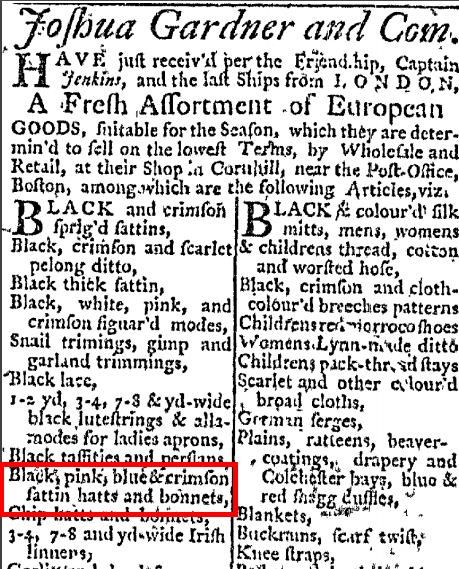
There’s been a rule that “all bonnets are black silk,” which is too broad a statement. Most bonnets are black, that’s true. But in 1768, in Boston, a place where folks would have you think that black is the only colour bonnet you can ever have, you can have “Black, pink, blue and crimson sattin hatts and bonnets” (Joshua Gardner and Com. ad, Boston News-Letter, November 24, 1768).

Heck, if you shopped at Caleb Blanchard, you could have a green bonnet, too! Blanchard advertised “black, blue, green, white and crimson Sattin bonnets” in the Boston Gazette on December 18, 1769.

What does this mean? My SWAG is that roughly 60-70% of bonnets should be black. After that, blue, white, red and green would make up the balance. In Philadelphia, green bonnets– and green flowered bonnets– last longer in the ads. Philadelphia is also where I see more white bonnets, a brown silk bonnet, a diaper bonnet, a “queen’s grey” bonnet, and, in Trenton, a “lye coloured” bonnet. In Rhode Island, there’s a blue stuff bonnet. So yes, bonnets should mostly be black. But they can also be other colours.

Clear and Present Danger

A Female Philosopher in Extasy at Solving a Problem. London, England; about 1770 Mezzotint and engraving with watercolor on laid paper
Colonial Williamsburg Foundation

Scandal and outrage rock the reenacting world as reading comprehension lags and The Gentle Author is accused of presentism– or, at least, that’s the most reasonable translation I have for comments made about me last night on social media, including:

Yeah- she’s got great stuff. But I feel awful that she fell into a modern-think trap.

and, my favorite,

I’d say its a post modern Critical Theory think trap. Frankfort [sic] School is gushing from the pores.

Let’s take this apart, shall we? The Frankfurt School (not this place) was a social and political movement based in Frankfurt am Main in the immediate post-World War I years. After 1933, the school, formally known as the Institute for Social Research, moved to Columbia University in New York city. Being insulted by association with the likes of Walter Benjamin and Theodor Adorno is a new experience for me; I’m more usually associated with the ideas of Mary Daly and Jacques Derrida but I’ll take backhanded intellectual flattery where I can get it. (Also, thanks for thinking of me, but Kitty does not require your pity.)

More seriously, the postings last night (which happened while I was in class and have been deleted) brought to mind two powerful issues in living history and the reenacting community: Presentism and Feminism (with its unholy shadow, mansplaining).

Let’s go over these:

Presentism: uncritical adherence to present-day attitudes, especially the tendency to interpret past events in terms of modern values and concepts.

Feminism: The radical notion that women are people. the theory of the political, economic, and social equality of the sexes.

My recent post about MoAR’s Occupied Philadelphia event was accused of presentism, or “falling into a modern-think trap” and a “Critical Theory trap.” Here’s how that post came about:

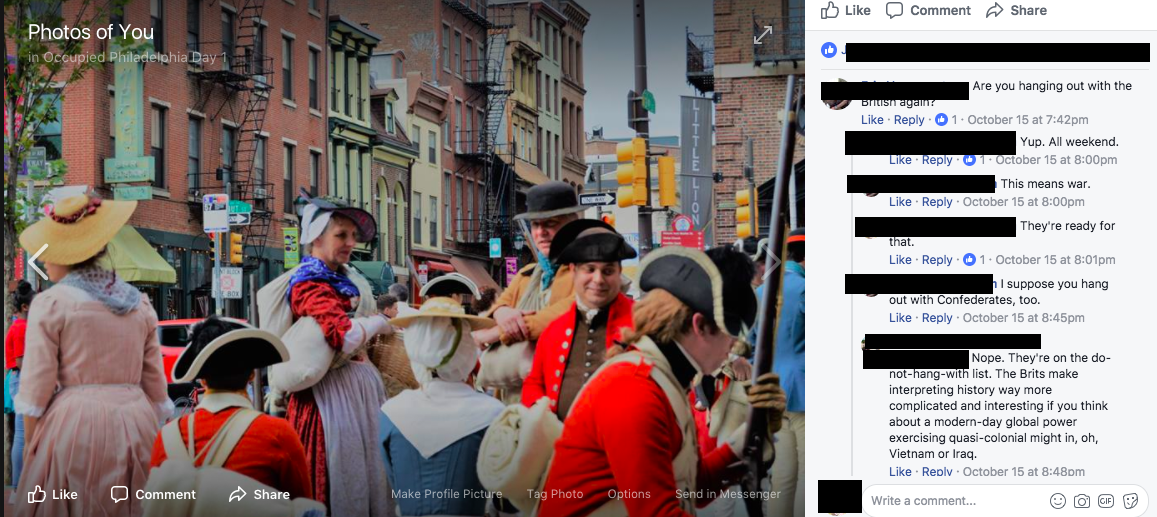
Images were posted to Facebook, and I was tagged in one that showed me in the midst of a crowd that included members of the 17th Regiment of Infantry, one of the forces that occupied Philadelphia in 1777. My cousin, ever the wag, commented:

click to enlarge in a new window

“I suppose you hang out with Confederates, too,” had some bite. What surprised me was my well-educated and thoughtful cousin’s facile conflation of Confederates and British. Is the world that easily black-and-white, good-and-bad, Manichaen? Not usually, and certainly not usually to my cousin. Explanations seemed in order. Why had I done what I did, and what did I do? What was Occupied Philadelphia about?*

To me, it offered the chance for some complicated interpretation that’s more readily accessible via living history than by exhibit panel, or at least significantly more engaging than text. How do you elucidate the complexity of the American Revolution? How do you get people to think about the past in the past’s terms? How do you get them to query and interrogate their accepted understandings of history?

Apparently that position towards living history– that it is complicated, worthy of criticism, can be used to create a complicated look at the past, and can be understood through cultural criticism– is deserving of the dog-whistle scorn of men hiding behind false names on social media. It elicits from them suggestions for interpretation that include impressions already being done, and referenced in the original post. It elicits suggestions based on 1811 paintings of Philadelphia, because of course, nothing helps illuminate 1777 Philadelphia like a genre painting made 34 years later.

If anything, I was suggesting that complicated interpretations (that is, showing how an “occupying force” might be “good” for the population) can further an understanding of the past that helps us understand the present. Isn’t that the mission of most history organizations? Understanding the past to illuminate the present and shape the future? It’s unsettling to realize so immediately how people who practice history use it to reinforce the status quo, and use misreadings of interpretation to further their own sense of superiority.

That’s where feminism comes in: suggesting “new” roles for women in living history (Laundry? How ’bout being a Quaker?) on a page dedicated to women’s history is a dizzying feat of sexist thinking. It is particularly delightful given that the Gentle Author and her associate, Our Girl History, are among the people who have suggested new roles for women, and have organized events that included suggested roles, and in fact required them. But please, tell me what to do. Belittle me by association with some of the leading critics of the 20th century. Because when you do, you reveal yourself not only to me, but to others.

Sarah Churchill, Duchess of Marlborough. Oil on canvas by Charles Jervas.

As Our Girl History wrote recently, women’s voices in living history are too often silenced in the present by excuse of the past. That anti-feminist approach was on view last night, and continues to be the default setting for many men in living history. It reflects a persistent bias against intelligent, educated women, like the Female Philosopher.  It reflects a persistent position that women should “know their place:”

The greatest sin a woman could commit was to participate in any sort of public life, be it theatre, politics, or social causes – this made her immediately ‘difficult’

Margaret Perry on “difficult” women in the long 18th century.)

It will not remain a viable position for long.


*Brits-as-Nazis is not my origination, but the distillation of a comment made about the dedication of a monument at Guilford courthouse and subsequently reported to me. Despite a commenter’s attempt to attribute the equation to me, it is not mine, as should have been clear from “in certain circles.” Not my circles, not my monkeys.

Occupation as Liberation

Philadelphia Ledger, October 10 1777

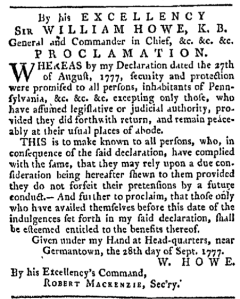
240 years ago, Philadelphia was occupied by British forces under the command of General Howe; the city was taken after a brutal campaign through the outskirts of the city, as you may recall from a few weeks ago— and this is after the Battle of Princeton, with the accompanying ravages upon the populace. This past weekend, interpreters at the Museum of the American Revolution brought the issues of occupation to life for visitors. But what struck me the most when we got home, was my cousin’s comment on this photo:

Hanging with the British and Citizens of Philadelphia

“I suppose you hang out with Confederates, too.”

Ouch, dude. That’s my partner you’re impugning.

Occupation of town/homes.

I understand that, in certain circles, British troops in North America during the American Revolution are equated with Nazis, and I understand that it’s easy to see the world in Manichaen terms (though my cousin usually does not), with good guys and bad guys. But after watching Ken Burns’ and Lynn Novick’s Vietnam War series, I am reminded how (grossly speaking) “one man’s terrorist is another man’s freedom fighter,” and while, as an America citizen, the “good” or “righteous” side should default to the Patriot/Whig cause, interpreting the other side offers room for people to question how they would have behaved in the past, and more importantly, to understand the actions of their country in the present.

There is no right answer.

Studying the past allows us to see the present through new eyes: Philadelphia in 1777 is occupied by a colonial power attempting (in part) to retain control of natural resources. Which side will you be on when the moment comes? Will you side with law and order, or will you side with natural freedoms and the rights of man (some exclusion apply; not all rights are right for you, and do not apply to African Americans, women, or American Indians, or non-property owning white men, etc. etc).

240 years later, what is the point of this hobby, these funny clothes, wandering around outside, talking to strangers? The point is that the past is always present. If we can understand the choices people faced in the past, we can understand our own predicaments better, and one hopes, analyze our options to choose better this time. We operate from a place of self-interest, even when we wish we could be idealistic, honorable. From the outside, actions aren’t always what they seem.

On Sunday (though I have found no photos thus far), I was arrested by the 17th for peddling a calico gown stolen from a room on Hamilton’s wharf, and alleged to be part of the Captain’s baggage. I tried to run, but was caught by two soldiers, and dragged away. From the outside, this looked like something bad: soldiers roughing up a woman. But I wasn’t innocent, and that’s the point: what looks like a bad thing may be a good thing. Costumed interpretation liberates us from the exhibit label, and allows us demonstrate a complicated past more quickly than a text panel can be read, and more engagingly.

When we assume that all Americans are “good,” we gloss over realities of people trying to get by when work, food, and money were scarce, and how “good” people do bad things. To play that well, you need both sides of the story. And that, dear cousin, is why I hang out with the Brits.