Les Oublies

Les Oublies. Le Bon Genre Plate 79: three ladies and a child look at a sundial in a garden, watched by a man. August 1815 Hand-coloured etching. British Museum 2003,U.14

I was first attracted to this image by the gentleman and his shapely legs, as you might expect, since tight buttoned gaiters or overalls do turn my head. This plate doesn’t make much sense to me: I can’t really grasp the satire, I can only guess. The explanation given for the series doesn’t help immensely. “The series is devoted to costume, mostly set in fashionable interiors, but the plates are treated in a semi-caricatural, humorous way that links them with French social satire.”

My best guess is that this plate from 1815 is showing off the latest filmy white fashions and tiny pink Spencers in contrast to the forgotten origins of the classical influence, personified by the gentleman in common dress at left. His hat and the gaiters suggest the French revolution, now forgotten (see “oublier” though the reference is also to the small cakes being eaten by the woman under the tree). The clock provides a reference to the passing of time, and forgetting, but I don’t think it is actually a sundial. The strap makes it look as if the man can carry it, and that’s a needle, not the fixed vane of a sundial.

Whatever it all means, I do find this more interesting for the man’s clothing than the women’s; after a while, the subtle differences between white columns is lost on me, but that’s a pretty interesting buff-colored waistcoat.

The Checkered Past

Some gentlemen I know should consider what they might want to do to avoid (or alternately, encourage) having this coat made for them. It’s really a lovely thing, found as the best things are, while looking for something else.

It reminded me, too, of the textile sample book at the Met, currently on display in the Interwoven Globe exhibition. (No, I haven’t seen it; I’m going to try, but…).

Wm Booth has a new linen coming in the winter, and as the men in my house have outgrown or outworn their shirts, I am thinking of making new check shirts. I did finish a white shirt at Fort Lee, which will go to the Young Mr (his small clothes being now his too-small clothes). I will have to make Mr S a white shirt for best wear, but they could each use a second working shirt. At least with checks you get “cut here” and “sew here” lines.

Last week, I found a weavers’ book in the Arkwright Company Records (Box 1, Folder 1, 1815). It’s a slim, blue paper-covered volume with small samplers glued in to the pages, and full of checks and stripes. Blue and white, red and blue, checks and stripes were prevalent in the late 18th and early 19th centuries. The more I look at extant garments, sample books, and ads, the more I think the streets must have been a vibrant, if grimy, visual riot.

Book Review: Book of Ages

Book of Ages, by Jill Lepore.

This is a book about reading and writing as much as it is a book about Jane Franklin, Benjamin Franklin’s little sister. Book of Ages has been reviewed elsewhere, and Lepore wrote a really lovely piece in the New Yorker called The Prodigal Daughter that is unfortunately behind a subscription firewall, but which I have read on actual paper. If you can get hold of it, I do recommend reading it before you read Book of Ages. It makes the book all the more poignant to know something about Lepore’s process.

This is, in many ways, another book about mud and misery (see the best bits of Longbourn). Because Jane Franklin Mecom (her married name– she married at 15) left behind so little, Lepore builds much of her story out of the context of Boston and New England in the mid-18th century.

It’s not exhaustive in its detail, and that’s fine: the book is an easy, comfortable read that still provides well-researched information about the lives of women in the 18th century. I finished it over a week ago, but details still remain (and that is a testament to Lepore– these could have been supplanted in my mind by details of exterior water meters, skunk removal techniques, or indexes for early vital records). Among the details I recall: Funerary and mourning customs, from published sermons to the distribution of mourning gloves and rings; soap making and trades practiced by small holders in home workshops; Jane Franklin Mecom’s wartime flight to Rhode Island; the power and practice of extended family networks.

It also reminded me of the differences in educational methods or standards for boys and girls, which helps remind us all of the importance and significance of the ideal of free public education for all. (We had some early proponents here in Rhode Island.) What might Jane Franklin’s life have been like in other circumstances? Honestly, even if she’d been well-off and well-educated, as as woman in the 18th century, she would never have had the same chances as her brother, no matter how evenly their intellects might have been matched.

If anything, that’s reason alone to read Lepore’s book, to celebrate the life of a woman who was both ordinary and extraordinary, and to recognize how much closer to all the anonymous, disappeared women of the past we can get through this example.

What (Cheer) to Wear?

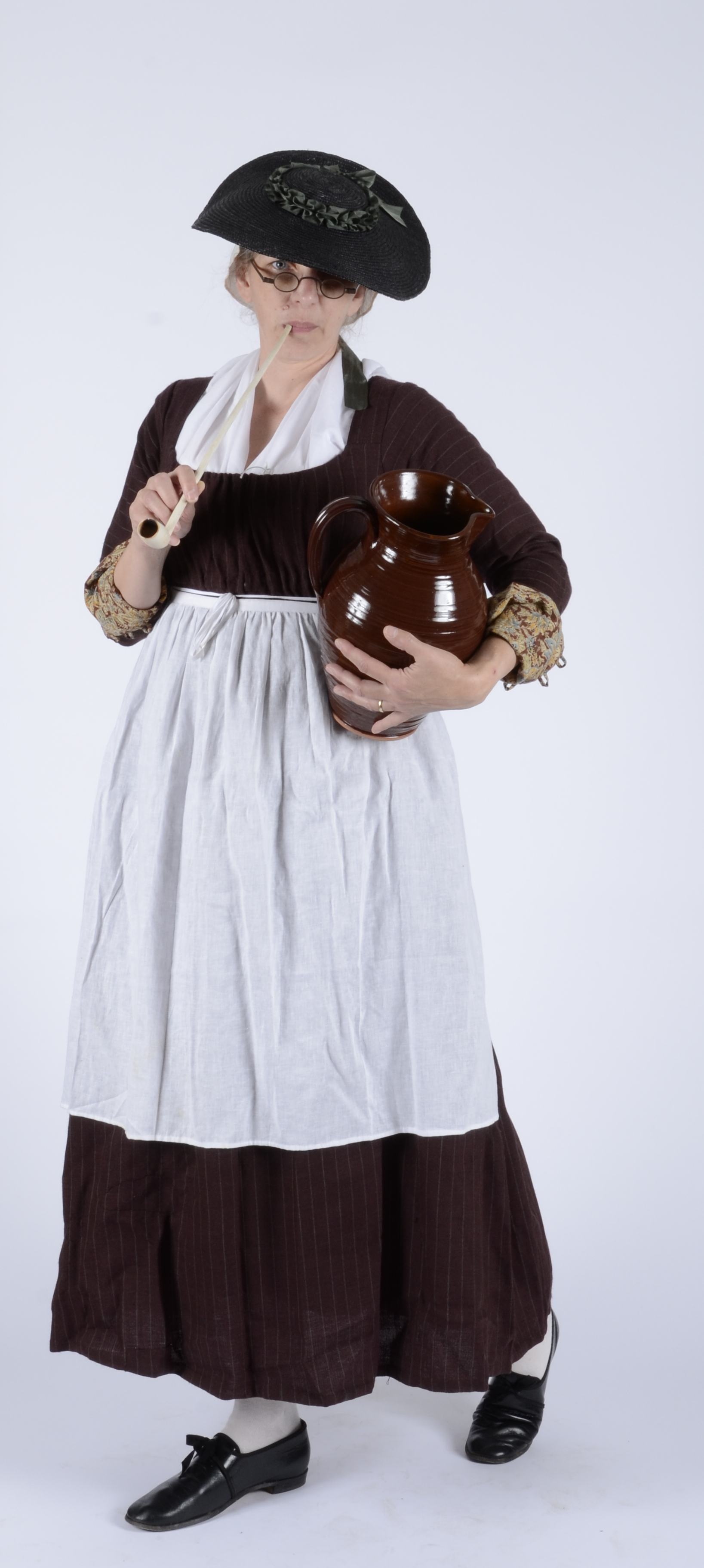
JBs HousekeeperIt’s 1800. Do you know what your housekeeper is doing? I don’t. Or, more accurately, I can’t decide.
I’m hung up on stays, and not wanting to make another pair. I’m indecisive about style, and though Mrs Garnett has her charms, it’s her bonnet I love more than anything.

Here’s what I’ve found, in servant-land:
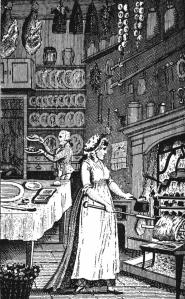
18th-century-kitchen-servants-prepare-a-meal-jane-austen-cookbook-cover-page

Note that this woman is, in the kitchen, wearing an open robe and quilted petticoat.The style of her bodice–which looks  like a cross-over bodice–and the train of the robe suggest the 1790s. Score one for style.

That open robe, where have I seen that before? Why, yes, Mr Sandby showed us that style for a nurserymaid. (It’s interesting, too, that both images show women with their hair quite visible under their caps, and not pulled up and out of sight.)
20130109-061710.jpg

Why does “robe stye” matter? Because I only found 3 and a quarter yards of a brown fabric I like, and even with the most careful cutting, that’s unlikely to make a full gown. However, I have some lightweight black wool that will make a decent petticoat. The bodice style is a bit of a stumper, though: the wool has good drape, so it might work for something other than the usual bodice I make. I did consider whether a very smooth, edge-to-edge, front-closing style of the 1780s would be more appropriate, but I think that I can move the bodice style forward, style-wise, and be correct.

138263

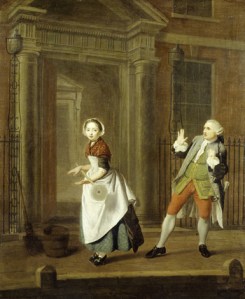
Brown gowns are a fine tradition in the sartorial habits of questionable servants. This young housemaid twirls her mop dry while wearing a brown gown over what could be a dark blue or a black quilted petticoat. The red “bandannoe” is a nice touch, though I don’t think I’ll wear one myself for this event.

In all this there is a compromise: using fabric I like, in a style I know I can make and document, perhaps even without having to make new stays. That would be ideal, because although it’s four weeks to the event, I’ll lose a week of sewing time to other commitments. Three weeks to pattern and hand sew a petticoat, gown, apron and cap seems just manageable.