Measure for Measure

or, a boiled Flour Pudding in two tries.

Alone in my Ossining ca. 1962 kitchen, I decided to tackle Amelia Simmons. The first task seemed to be to establish measurements, and then proportions, so I took stock of the tools and containers I would have in a typical camp. Spoon, mug, half-pint: these are plausible items, though we have tin cups that hold exactly 8 ounces, so the measure is unnecessary. The spoon was cast from a 1780 mold, so it seemed like a reasonable place to start for “how much is a spoon?” It will hold exactly one tablespoon if you scrape it flat across or are measuring liquid. Handy to know.

Next, I checked the recipe again.

A boiled Flour Pudding.
One quart milk, 9 eggs, 7 spoons flour, a little salt, put into a strong cloth and boiled three quarters of an hour.

This is not a popular receipt, so you won’t find it on History is Served, nor will you find this version on other popular sites; you can find a boiled pudding with suet, but that’s not what I’m after: I’m after a receipt that starts with a portion of the ration of flour soldiers received, and adds only eggs, milk, and available seasonings.

You have to remember that Simmons corrected the 7 spoons to 9 spoons of flour and increased the boiling time; you also have to remember that eggs were smaller then.
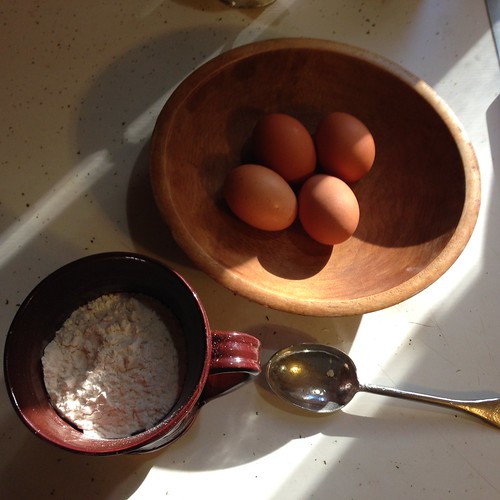
redware mug and wooden bowl with egggs
Halfsies.

I thought I’d try a half receipt first. There are no directions as we think of them– American Cookery sometimes has that “put your lips together and blow” feeling–but this is not too complex. The eggs and milk must be beaten together, and then combined with the flour. For this first attempt, I got it a bit backwards, adding the spices to the eggs, which I beat in the large wooden bowl.

That left me scooping the egg-and-milk with the measure into the flour, which I had in a smaller wooden bowl, remembering too late the method for scones.

egg and flour mixing in wooden bowls
Fuzzy photo, fuzzy logic.

And then it was really too late: I added just too much egg-and-milk, and it became more like batter than dough. This was not correct, and I knew it, but I didn’t dump it and I didn’t add more flour. Now it’s clear that 7:00 AM is not my best time for baking experiments (it was also quite early the day I made gingerbread without any eggs).
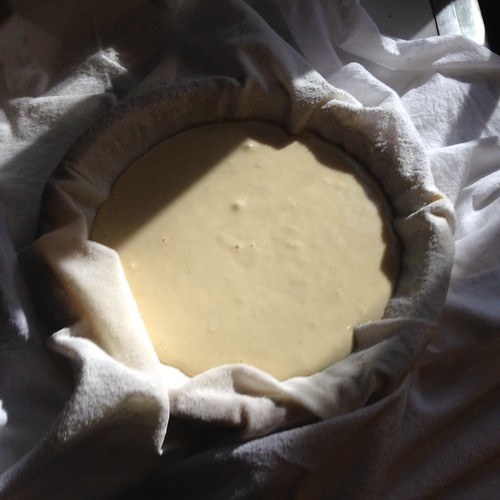
pudding mixture in cloth
Well, it took a decent photo.

I buttered and floured a cloth anyway, and poured the mixture into it. After tying the gathered neck of the cloth with string, I boiled the whole business for 45 minutes.

I did not take a photo of the mess I found when I unwrapped the bag. It wasn’t pretty, and it was clear that while some portions of the pudding were ‘done,’ they constituted about 5% of the whole, which otherwise resembled steaming cottage cheese. Really, truly, awful.

But from time to time I am undeterred by my failures, and instead of consigning the mess to the trash and sticking with store-bought bread*, I rinsed the cloth and regrouped.

This time, I went smaller: 1 cup of flour (about five spoons), two eggs, and a scant two spoons of milk. I also managed to put the flour, salt, and allspice in the regular sized wooden bowl, crack the eggs into the mug and beat them there with the milk. When I mixed the egg-and-milk into the flour, the mixture was far too stiff, so I added more milk, but kept the mixture stiff.
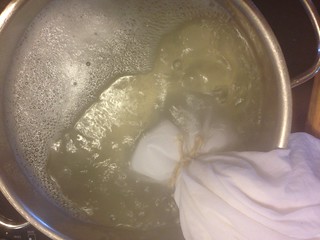
pudding bag in boiling water
Patience is required for pudding

Once more into the buttered cloth, once more into the water, once more boiling for three-quarters of an hour. This time was better, though. The results actually looked and tasted much more like what I’ve had before.
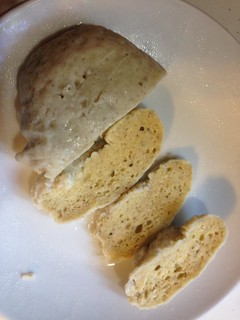
sliced boiled flour pudding
A boiled Flour Pudding

So, where does this leave me? Knowing that I’m the only documented fan of this in the regiment, I’ll stick with the smaller receipt: five spoons flour; two eggs, beaten; and three or four spoons of milk.

My plan is to boil this in whatever stew or stew-like device we have for supper on Saturday, and then eat it sliced with the stew. The plain flour-egg-milk mixture will pick up some of the flavors of the stew (think dumplings), but these could also have been served with a sauce, if made at home.

I’m also going to go back to the Experienced English Housekeeper, and see what she has to say.

* Years in ceramics classes taught me to knead all the air out of plastic material, so my bread tends to be better for building than eating. Even the dog wouldn’t eat the biscuits I made while in grad school…

Hand-woven Linens by Subscription

In the few short years I have been doing costumed interpretation and living history, I have made three shifts and four shirts and am making up a fifth shirt, with a possible sixth needing to be made, as well as four aprons. I’m not crazy, I just sew that way…for three people (one still growing) who dress for the decades between 1763 and 1812.

linen sample
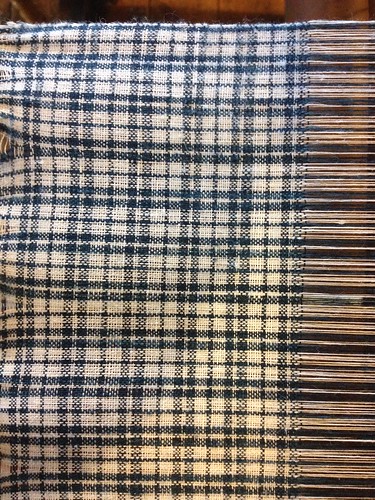
Hand-woven linen: the top edge is the selvedge

There are several annoying factors when sewing historic clothing with modern materials– mostly that the modern materials aren’t quite right, and can be quite wrong. As Sharon Burnston explains on her website, much of this has to do with selvedges— which are not hard, and rarely tucked, now. The other trouble is width: many fabrics now come 54 to 60 inches wide, which means that you have to cut them down when making shift.

There is a solution: hand-woven, period-correct linen, available now by subscription from Justin Squizzero [email to order: justin(dot)levi(at)ymail(dot) com].

Mr Squizzero will weave both plain and check to the width you want: 3/4 (27″), 7/8 (31.5″) and yard (36″) widths, perfectly correct for period clothing.

Hand-woven checked linen

The prices are $130/yard for plain bleached, $160/yard for checks– and what checks! Indigo dyed blue and white check in a pattern documented to New England at the turn of the 19th century? Oh, yes, please: I must save my allowance and sew only from my stash.

Although we debated fabric weights this past weekend, here’s what I think, and have found through wearing: shirts for soldiers and artisans– but not the elite–can certainly be made of the white and the check; I would made a shift from the white, but I prefer how my heavier shift body feels and behaves under stays. The check would be ideal, too, for an apron, which would require only one yard.

If you’re wearing a coat made from $120/yard wool dyed with documented colors, shouldn’t you wear the most correct shirt possible underneath? Entirely hand-woven (and hand-dyed in the case of the checks), you’re buying art– but isn’t that what you’re making and creating when you hand-sew your clothes and step into the past?

The Taylors’ Instructor

Title page, The Taylors' Instructor
Title page, The Taylors’ Instructor

So who else was wondering what Mr Cooke meant by Lapsley and Queen? Wonder no longer, frustrated toile-makers and cuff-detail mavens, it is available on the vast interwebs of knowledge.

Go! Download the PDF and immerse yourself in an 1809 American tailors’ manual published in Philadelphia, with Eight Appropriate Engravings. We may note that there was excited squeaking when I located this, altering my nearest companions to A FIND, and letting them know that yes, I am back, and probably will continue to squeak on and off for some time to come.

From the introduction:

“…there is no situation more awkward than that of a TAYLOR who has cut and mutilated his own or his employer’s Cloth which will frequently be the case when a man has nothing to depend upon but the poor resource of chance or hope, that his clothes will fit.”

The Taylors' Instructor
The Taylors’ Instructor

I can tell from the text on Coats that my subjects will have to be further apprehended and measured, even against their will, but the results will undoubtedly be better than before.

Happy Reading, Historical Sewing Enthusiasts, and a big thank you and hat tip to Henry Cooke for the reference.

Frivolous Friday: Footwear

Shoes, 1810-1820. Gift of Miss M. Lee. T.385&A-1960, Victoria & Albert Museum.

Like my grandmother, I love shoes. Also like my grandmother, I have “problem feet.” Finding a pleasing ladies’ shoe in a size 11 narrow is no mean trick, and with arthritis and activity, fit becomes ever more important. Standing all day in ill-fitting shoes will not improve your ability to interact with the public in a pleasant way, nor will it improve your stamina, which you will need if you are cooking for a motley assortment of ‘gentlemen.’

Many reproduction historic shoes (and most contemporary shoes) just don’t fit me, so I can’t order from common suppliers and I can’t alter affordable fashion shoes. Like Cinderella’s stepsisters, the shoes don’t fit.

Robert Land's Regency Lady's Shoe
Robert Land’s Regency Lady’s Shoe

That means that sometimes my shoes are not quite-quite correct. For 1799-1800 events, I wear Robert Land’s 1812 shoe, which is modeled on a shoe in the V&A collection. I find Land’s lasts are long and narrow, he makes my size, and lo and behold! Last time I ordered, the shoes arrived in four weeks. My mileage has varied in that regard, and yours may, too. They aren’t cheap, but they are well-made, straight-lasted, and most importantly, they fit. (I’ve been wearing them to work this week, because their flatness is more comfortable than my modern shoes.)

Shoes, 1810-1829. Probably British. MMA 2009.300.1471a–d

Do I wish they came in silk? Yes. Do I wish he’d make ladies’ 18th century shoes? Yes. But I have a workaround for the 18th century that I debuted on Flag Day: Mules. They won’t work for every event– I don’t think these are the shoes for climbing Stony Point in July–but they have their benefits. For one thing, you can take them off. Barefoot is best (maybe not in Boston), and not having to wear stockings when it’s 80+ degrees is nice, though only permissible if you’re named Bridget and have a shirt problem.

Burnley & Trowbridge men's mules
Burnley & Trowbridge men’s mules

Burnley & Trowbridge shoes also run narrow, and their men’s mules work for me, because I like a very low, flat heel. In winter, wool stockings make up any size differential, and in summer, these flats are pretty comfortable and even walkable. They may not be perfectly correct (though documented here), but comfort plus documentation goes a long way in my book.

What I’d really like, at least for late War interpretations, are a pair of these red velvet shoes at the MFA. Latchets for buckles, low heels, and they’re red? While I wonder about the date, the features I like might outweigh any misgivings– except that I cannot afford Sarah Juniper‘s work, and I can’t make my own shoes (yet).

Pair of women’s shoes, 1780s. MFA Boston, 44.493a-b