Drapers, Sutlers and Other Sources

Shopping with swatches: it’s what I do.

The biggest difference between sewers is location: I have access to resources here that people in the Midwest don’t, but friends in New York have the garment district, which is just a little too far for me.  For a lot of my projects, I’m buying from the reputable sources we all know about: Burnley & Trowbridge and Wm Booth Draper. They’re supplying people who want accurate fabrics, they do their research, and the goods are well described. But how to choose among the offerings? And where else can you go?

Wools
The creme de la creme are Kochan and Philips wools. I have some bottle green I haven’t cut yet, which I got from Roy Najecki because he’s local, he’s got the stuff, and he has other stuff my household uses (like cartridge box clasps and quarter-inch mohair braid).

Wm Booth and B&T’s wools are also good, and you can get samples. What you buy will be dictated by what you are making. Broadcloth for suits and cloaks, stuff (worsteds) for gowns and waistcoats. Buy the best you can afford: this is an investment. Divide the cost of the fabric by the number of times you’ll wear a garment, and look at the per-wear cost, the way you might look at a suit for work. (I have no regrets about that Saratoga coat, which has now been worn on at least 5 separate occasions, making the per-wear cost $25 after 18 months, and I know it will be worn again.)

Once you’ve felt and seen good-quality, period-correct wools, shopping locally is easier. Take a swatch with you and compare to what’s in the stores and you’re likely to find yourself shopping online. You’ll want 100% wool, and that’s expensive pretty much everywhere. Here in Rhode Island, I do have access to mill stores and remnant tables that make a difference in my costs and allow me to be a little more frivolous in my sewing. Sewfisticated in Framingham and Somerville and Lorraine Fabrics in Pawtucket both have remnant tables with reasonably priced goods with pretty accurate fibre labels. They’ve been the source for many a garment, but have no online sales. I don’t recommend JoAnn’s wools: they’re not as tightly woven and they’re over-priced. Wm Booth and Burnley and Trowbridge are a better value.

Silks
Here again, it’s unfortunate, but my local sources come into play. Artee, Sewfisticated and Lorraine all have both discounted taffetas and tantalizing remnant tables, but Wm Booth and Burnley & Trowbridge have fabrics the local shops do not carry. I don’t have a local source for what Booth calls “persian,” but taffeta can be found– though color choices can be limited.

The trick with silks is slub. Much of what is sold today is silk dupioni. It is not universally bad for all historical applications, as by the 19th century, silks were being sold in several grades. If it’s right for your impression (i.e. not upper class), and you can find a pretty fine dupioni, you can use it. But the really slubby (bumpy) stuff should remain in this century.

Crisp taffetas from the bridal department can be your friend, though home decorating can also yield good results. Some higher-end home dec departments do stock wool, linen and silk fabrics, as the best designers and manufacturers use them. You’ll pay for it, but again: it’s an investment you’ll enjoy over time. Online, there’s Hyena Silks, too, which has supplied some friends. But my silks are pretty much locally bought, at $9/yard.

Cottons
Here’s the biggest trouble spot for a lot of people. The mantra is that today’s quilting cottons are nothing like the cottons of the past, and while that is true in part, it is not the whole, or nuanced, truth. Quilting cottons are stiff and crisp, and generally do not drape as well as apparel fabrics. But what’s more correct is to say that the range and hand of cottons available today in historically correct or acceptable prints do not come close enough to the cottons of the past. Still, you can find good analogues for late 18th and early 19th century cottons (1750-1825) if you’re careful.

Aside from Wm Booth and Burnley & Trowbridge, I buy from Reproductionfabrics.com. She has been a good source for Indian print cottons. Time Travel Textiles no longer has a functioning web store, but the articles are still there, and useful.
Regency Revisited sells via phone and Facebook now, and has an interesting range of prints, though I have not bought from them…yet…as I am trying hard to sew down the strategic fabric reserve.

But again, I buy locally from the bargain loft at the mill store where I can feel the goods. It’s worth ordering some swatches from Burnley & Trowbridge just to get a sense of the hand of different goods. That, along with printed resources, can serve you well in an actual store (presuming they still exist near you).

Linens
Again, much of my trade is with the main two sutlers, but I buy linen in quantity from Fabrics-store.com. It’s not the best of the best (see the main two) but it gets the basic job done.

For really nice and perfectly correct linen, in every sense, Justin Squizzero’s hand-woven linens are the way to go. I’ll get a hand-woven neckerchief one of these days– actually, I want one for February– but have yet to make the leap to buying hand woven linen shirts and shifts.

Fabric Selection Resources: Printed & Online

Jackie asked about fabrics: how do you choose?

I’m going to start with prints, cottons, linens and silks; the second part will cover wools and sutlers.

There’s no substitute for feeling up the real thing, or samples, and while I do not have the book, I’m told by a very reliable source that it is worth buying Swatches from Wm Booth or from Hallie. I also order Burnley & Trowbridges swatch sets, which are often  more extensive than what’s on their website. Those samples help me gauge fabrics online– comparing the actual square with a thumbnail online is helpful.

Barbara Johnson: a typical page
Barbara Johnson: a typical page, this from 1803

Where else can you look for guidance? One of the best books that spans a wide range of living history time periods is the Barbara Johnson book of swatches. Owned and published by the Victoria and Albert Museum, A Lady of Fashion is out of print, but the pages have been scanned and are available online. The print version is better– it’s big!– but you can download the images and get a better sense of the scale of the samples.

What is particularly useful is that Barbara Johnson dated the samples, and wrote down how they were used. You can’t get better than that!

Susan Greene’s Wearable Prints is neither small nor cheap, but it is extensive, covering 1760 to 1860. This is a very hand book to have to help sort out typical looks for different time periods, and the likely range of colors.

Textile Sample Book, 1771. Metropolitan Museum of Art. 156.4 T31

Other museums have digitized sample books: the Met, for example, has multiple images of woven fabrics from a 1771 sample book online.

What you need to remember here is fibre: those homespuns at JoAnn will not behave the way linens behave, even if they look the same. Hand and drape are everything, and cotton, or cotton-poly will not do want linen does. Buy the linen, it’ll look, feel, and wear better.

There are many more sample books, but you have to be careful: some are dated only “19th century.” Great. That’s where Susan Greene and Barbara Johnson can help you sort out which *part* of the 19th century you’re looking at.

Swatch book, 1763-1764. Victoria and Albert Museum, T.373-1972

For silks, you can see a very specific and detailed range of silks in Selling Silks, which reproduces another sample book at the Victoria and Albert. Not all samples are 1763-1764; you will need to read the descriptions, but this can be helpful in figuring out how to use fabrics. I have come into some red silk damask that I can make into a gown; it’s vintage silk from France, probably pre-World War II. The pattern is large, replicating a 1740s fabric, but when I make up my gown, I think it can be 1760s, but not a lot later.

Part of looking and buying is understanding how textiles might be bought, saved, made up, reused and repurposed over time.


Scabbers Paints

Perhaps you know him as Timothy Spall, but the actor playing Mr Turner is best known in my house for his role as Scabbers, AKA Peter Pettigrew, in the Harry Potter films.

I am anxiously awaiting the release of Mr Turner, and have watched the trailer multiple times in anticipation of material for the authenticity and accuracy fires.I’ve also watched The Power of Art again, because I love Simon Schama as the David Attenborough of fine art, and I’ve enjoyed the way that Mr Turner’s titles appear to use a similar color-into-liquid trope as TPOA’s bleeding titles. Just go watch it.

Why am I so excited to see Scabbers paint? Because the trailer looks so damn good.

The color, the set dressing, the intensity of the colors, all suggest that the film team paid close attention to the material culture of the past, and to those tiny details that create a satisfactory, accurate closed world that helps us achieve experiential and even transcendent authenticity.

Of course I enjoy costume drama: you’d expect that, right? And messed up costume and material culture details can wreck a film or TV program for me, but what you might not expect is that there are some films I enjoy despite their apparent inaccuracy.

Take the Muppet Christmas Carol. That’s one of my favorite adaptations of the Dickens’ work, because it creates a world true to itself filled with believable objects and characters (even the ones I can’t stand), and returns authentic emotions. Scrooge’s headmaster was never an enormous eagle muppet: but the shabby school room works, much the way Beatrix Potter’s anthropomorphic tales work.

In The Pie and the Patty Pan, Duchess can’t bake– what dog can bake? But we can believe that Duchess is a greedy eater, and might well think she swallowed the patty pan. The touch of hypochondria in a greedy dog is intensely satisfying, I think.

Cat and dog at a tea table
Where is the Patty Pan?

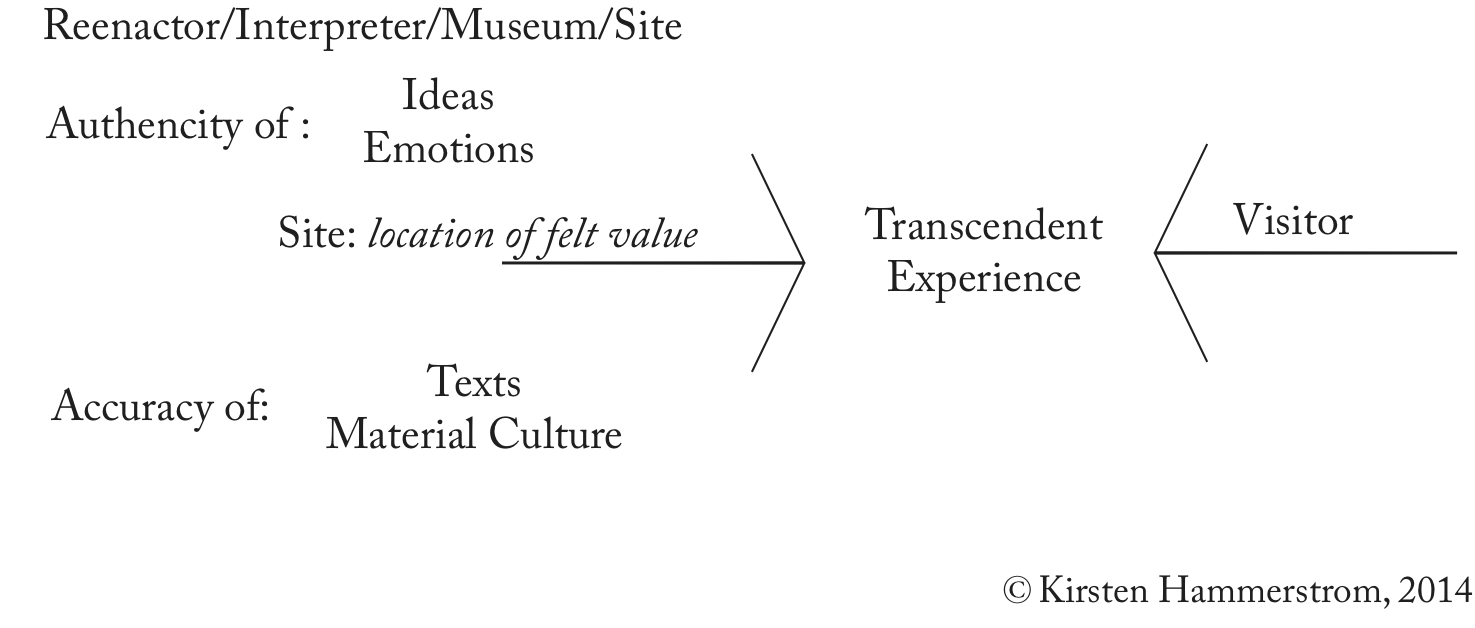
What does this mean for historic house and living history interpretation? It means furnishing a believable world with accurate clothing, goods, and accouterments, based on primary sources with characters who convey authentic emotions and ideas to create a transcendent learning experience.

I even have a diagram:

The experience equation

And that’s why I want to see Scabbers Paint. Because anything that creates a believable historical experience is worth learning from.