Mourning Embroideries

As a rule, I dislike samplers. Sacrilege, I know, but the rows of letters and numbers and tidy stitches seem to me like running in place, instead of running to get somewhere.

But I do like pictorial embroideries, and on this day, posting about a frothy bonnet in a painting in a Sotheby’s catalog seemed…well, too trivial. So instead, here’s a fantastic mourning picture from the Met. By Charlotte Brown, of Rhode Island, it memorializes Salome Brown and her husband Moses Brown, though not the Moses Brown.
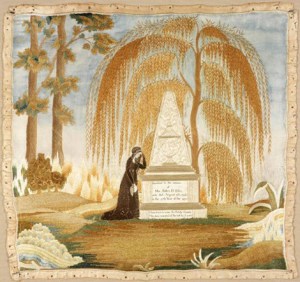
Just because I’m not a fan doesn’t mean I don’t recognize types. In a google image search, I found this item, and knew immediately it was Rhode Island. Made in 1808, it lives at RISD, and a textile designer has done wonderful things based on it. Both RISD’s and the Met’s have the weeping woman, the weeping willow, the urn/cenotaph feature, the pastoral landscape.

But wait…the provenance of the Met’s picture is minimal: “Once property of the late Florence Maine, antiques dealer of Ridgefield and Wilton Connecticut. (Advertisement of embroidery in August 1953 Antiques magazine.)” So I started searching for Moses Brown and Salome Brown in the Rhode Island Historical Cemeteries Database, and I came up empty.

Yes, there are Moses Browns. There is no Salome Brown. But I can’t find a Moses with these dates. That doesn’t mean he didn’t exist, or that this isn’t a Rhode Island sampler; not every cemetery has been transcribed and not every headstone survived.  There is one Charlotte Brown with a date worth considering, and she is the daughter of Thomas and Rebecca Brown, and would have been 7 when this was made. Not impossible, but I’m not fully sold yet. I now have more questions about the one at the Met, and about the people memorialized. Those questions may well be answered in an accession file at the Met, but sitting on the public side of the catalog record, I have questions that only research can answer, and that I hope will one day be done as part of the Sampler Archive Project. 

For now, I think I’ll enjoy a sense of visual literacy in Rhode Island imagery, the lasting beauty of these memorials, and let it go at that.

Feeling Shifty

It’s clean now, but in the photo you can see some of the abuse a shift takes in a day or two of real wearing. This shift was made from the Kannik’s Korner pattern. The first shift I made is now on a mannequin at work; I used Mara Riley’s Instructions, and they worked, mostly, with some operator error. I’m tall, and that means that proportions for my clothes sometimes have to be adjusted. The third shift I made was a late-18th century version, adjusted for the change in style and my height, and it is by far the best one yet.

So now I know I need to make another mid-18th century shift, what will I do? The first place I’ll start is with Sharon Burnston’s awesome article, The Cognitive Shift. This is one of the best pieces I’ve read on costume history and the logical, methodical approach is one that not only explains her process, clarifying objects and construction, but also sets a standard for how other garments could be considered.

Among the points Sharon has made over time is the lack of decent linen available for making shifts and shirts. What we can get today is too heavy, too coarse–it lacks the hand of the linen items made in the period we’re reenacting, and not just because the objects have been washed. The fabric is simply different, and unavailable. What  I think I’ll try (having exhausted whatever shift linen I bought from a sutler) is this light weight linen, not softened. I have some that was used for a cap, and so far seems to be working out. Once it is washed, it seems to have a decent drape and appearance.

My impression is not of a fine lady, and that is at least a saving grace. I don’t want to go all the way down the social ladder to wearing an oznabrig shift, but I do want to be as accurate as I can be–and as comfortable.

A Box in a (not quite) Day

Since I made a new knapsack based on the example in the Fort Ticonderoga collection (see also Henry Cooke’s work, or The Packet III, page 28), I had paint. When you have paint, you want to put it on something. I put mine on a box.

Ikea had ‘Kartotek’ birch ply boxes one year, and the Young Mr was using some as treasure chests in his room, but now that he’s growing up a bit, he was willing to have one remodeled. The lines were pretty basic and the construction simple enough that I thought we could do a kind of recon on this box. (Recon is Library Lingo for “retrospective conversion.”)

First, I took it apart and sanded it. Don’t forget to cover work surfaces and expect to sweep/tack cloth up dust from both the box and everything around the box. Mr. S helped me out by drilling out the riveted handles, and re-drilling holes large enough to take the rope we had. It smells like hemp, but I have no idea where it came from–perhaps a Christmas tree excursion.

All good so far, sanded, drilled, and ready to take the paint. I thought one coat would be enough, since I had the red stain underneath, and wear and tear make things look better, so, fantastic! Time to put it together.

Hold on there, pilgrim. I looked at the screws. They were Phillips head, and not really brass. That’s not right! I’ve crawled under enough old tables to know that screws are flat, slot-head, and made of brass in this time period. With the rise of the screw gun/cordless drill, this kind of screw is no longer easy to find. They’re all Phillips at the big box hardware stores, and our little speciality store recently downsized and rearranged.

Was I really screwed? No, thanks to the interwebs. Slot-head brass screws are still used in marine applications, so I was able to order a bag from Amazon–the local chandlers seem to have given way to WestMarine, and they seemed only to have stainless steel screws.

The package came on Wednesday, I got out the screw driver, and after what totals up to a day’s work, we have a box for the Young Mr S to stash his stuff in when in camp. I expect the box to soon contain one book about dragons, several sticks and rocks, a tangle of fishing line, an empty candy wrapper, and an apple core. Also, homework that counts towards his grade.

Runaway Styles

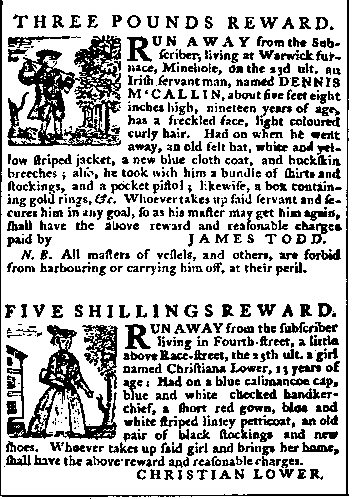
Many thanks to Becky Fifield (The Still Room Blog) for revisiting the article she published last year on her amazing Runaway Clothing Database (RCD). It is available now as a downloadable PDF from the publisher’s website. I devoured it for its systematic look at classifying–cataloguing, really–not just the runaways themselves, but their articles of clothing.

What Becky did with nearly 900 ads was to create catalog records for each woman who ran away, as well as her clothing. It’s a phenomenal project, and one that works well now, in an age of computer databases and improved cataloguing nomenclature. It is also a testament to dedication and love: the amount of time to construct the database and enter all the records is significant. That’s hours, tens of hours, of work before the fun part of analyzing the data can begin.

Kudos to Becky, for hard work and inspiration!