There are some interesting topics in the list– brewing? I certainly enjoy the results of brewing. Dairying? I like cows and love the local dairy farm. Language and speech patterns? I could certainly do better. Professions? Hmmm….I’ve considered several. Much to love in this list, and I’m looking forward to learning more.
Lately, I have felt like a street preacher exhorting people to change their ways.
Feel the power of the primary source.
Behold the possibility in the unknown.
Surrender to uncertainty.
It’s not for everybody, I know. But rethinking reenacting will change not just you and your appearance, but the way you “do” history. The more you dig in, the more you question and change, the more engaged you’ll be—and the more engaged your visitor will be. The more fun you have, the more fun the public will have.
“That’s great, Aunt Kitty,” you say. “But how am I supposed to do that? I’ve already learned rabbtre sous le main and buttonholes and pinning my stomacher and making soap. What more can I do?”
Stop asking how. Start asking why.
Look, I get it. Those 18th century skills are hard to acquire. Tons of people have better skills than I do, and I willingly and happily admit my general incompetence.
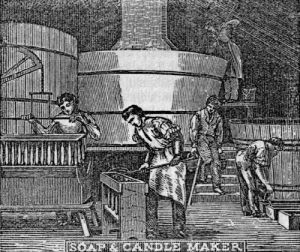
The Soap Boiler and Candle Maker. Popular Technology or, Professions and Trades.
Take soap. I cannot make soap. I know that it takes lye and tallow and heat. I know it is slimey and hot and dangerous and vaguely disgusting. (I’ve done my time with tallow candles, thanks.) So I respect the soap.
But honestly, so what? is the question I ask when y’all tell me how to make soap. I want to know why you’re making soap.
Are you selling it? What will you wash with it? How often do you do laundry? Do you share the soap? And if you’re selling soap, how do people know to come to you? Why is your soap better than, say, Bono Brown across the river? He’s cheaper by a penny, why is your soap so special? If you do sell it, what do you do with the money? Are you married? Does your husband drink the profits?
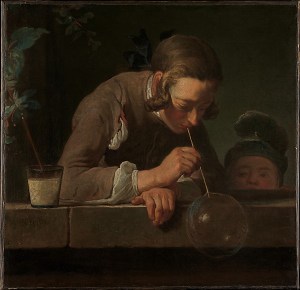
Jean Siméon Chardin Soap Bubbles, ca. 1733–34 The Metropolitan Museum of Art, New York, Wentworth Fund, 1949 (49.24) Soap bubbles I can do.
Tell me a story. Tell me why you’re doing something, or why it was done in the past, not just how. Then I might give a damn. But telling me only how a musket works, and not why you have it and where you got it and what you’ll do with it and whether the sergeant yelled at you the last time you failed to clean it and the punishment you got when you failed AGAIN to clean it…. Well, you see what I mean.
Change the question, change the answer, change how people see history.
Sometimes I think I’ll forgo the dressing up and going out in public, and just do the research; the world that exists in my mind is pretty satisfactory, and within it, Boston doesn’t have the GPS-killing skyscrapers of the financial district or the motor-powered vehicles that seem bent on killing pedestrians. Instead, it has horse-drawn vehicles, equally ready to run you down.
But: in thinking about the people on the margins, the people in the backgrounds of images, the people casually mentioned– “so hard to find a cook when you need one”–in letters, I’ve been looking at even more images. Here, a mountebank, illuminated by a torch, performs on a washtub outside a tavern (Good eating every Day) for a crowd of men, women, and children. Much texture here, and many people one could aspire to be.*
Is that a snarl or he is just happy to see the mountebank he can bash over the head with his prodigious stick? He’s carrying the obligatory lantern, here apparently made of tin with horn, glass, or mica windows. It looks like he’s slung it over the stick, where it is caught by by the knob to keep it from sliding.
It’s a Great Coat, really: the button-embellished flap (pocket slit?), the deep sleeve cuffs, the taped buttonholes all serve to make this coat impressive and intimidating.
On his head, a rakishly angled black wool hat worn over…a cap? Help me out here, gents. It looks like a linen cap that covers the very crest of his ear. Is that possible? Or he is tonsured? If so, you’d think he’d want a cap for the cold…
Next up: the girl with a basket. She raises a lot of questions for me when I zoom in close. Yes, Virginia, she really is wearing a cast-off regimental under a short red cloak. I’ve never understood how women came to possess these coats, but look closely and you’ll see the blue cuffs and plackets on the sleeves, the pocket flap sticking up just below her basket, and the long skirt of the red coat. (That’s a dog, not a killer shrew, between her feet.)
Her hair is a mess, too; we can speculate on reasons for that, but let’s go with a long, busy day as a servant, and not freelance corner-based activities.
What’s in the basket? A bottle? A decanter? A funnel? Hard to tell. Is she someone’s serving girl, sent out to the liquor dealer? If she is, why that coat? Is the man in red next to her grasping her elbow? Possibly…(and doesn’t he have a nice red double-breasted coat?)…and if that’s a uniform he’s wearing, is that her connection to the coat she is wearing? So many questions.
In the center background, there’s a young woman escorting a male child; she may be an older sister, but I think it’s also likely she’s a nursemaid. In the background at the left, two ladies are seen from the back, clearly wearing neat caps and jaunty hats. They’re moving away from the mountebank and the crowd, probably on their way home, respectability leaving the dangerous streets.
It’s as much a mix of people as you might find outside the Pret a Manger on State Street today. Somewhere in that crowd, there is someone to be.
*In a nod to riots recent, let us note there are 5 or 6 women shown here, 14 men, 5 children, 2 dogs and 1 monkey. That’s a 40:60 ratio of women to men. Children are, in general, grossly underrepresented in living history. Let’s talk about that someday.
Spencers are not unlike bonnets, in my mind. They’re more work than a bonnet, sure, but compared to the layer cake that is an English gown, a Spencer is a batch of cupcakes.
I’ve fondled more silks than I may care to admit (oh, remnant table, how I love thee), and often picked up and put down a small length because it was patterned. Not enough for a gown, just enough for a Spencer. But Spencers are always solid.
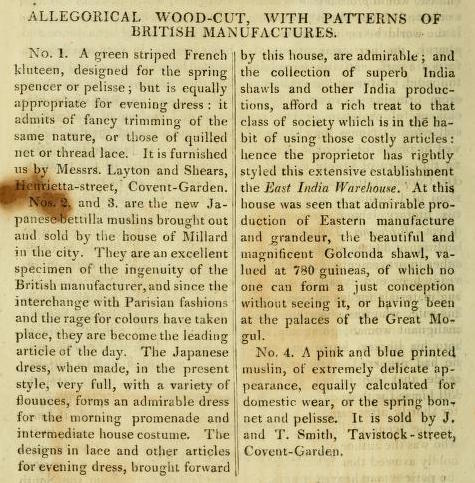
Allegorical Wood-Cut, with Patterns of British Manufactures. May, 1815. Ackermans’s Repository of Arts, etc. Volume 13.
It’s a Homer-quality forehead-slapping moment.
Caption, Allegorical Wood-Cut of British Manufactures. Ackermans’s Repository of Arts, etc. Volume 13, May, 1815. page 298
Not only are there extant cotton roller-print Spencers, and wild printed cotton Spencer ensembles in North American collections, there’s print evidence of patterned silks for Spencers. Somehow, until I came across this plate and the description in Ackermann’s, I could not make the leap from cotton to silk.



 Kirsten Hammerstrom
You must be logged in to post a comment.