
Fashion Plates & Subject Headings

Women_17901799_Plate_009Ah, the Met. You have to love them, so much wonderful material available online, and free. Collections of immeasurable depth and wealth, an incredible professional staff–this is the pinnacle, right? And yet…

They have a weakness. It’s a weakness shared by many places, but it is a major one, for the online user. It’s the lack of subject headings or dates assigned to their Library’s Digital Collections. They use OCLC’s ContentDM which has a pleasant enough interface, and fields that, in the Met’s Costume Institute Fashion Plate Collection, include Thumbnail, Title, Subject, Description, and Date.

They’re only putting data in Thumbnail (see image; I love that dress), Title, and Description. Description is what I would call Credit Line, and contains the donor name.

Title is a trifle vague. The image above is “Women 1790-1799, Plate 009.” No date, no subjects. The date is October, 1791, right there in the image, but not searchable, not sortable.

Women_17901799_Plate_049 Catalogers, I implore you: subject headings. If not subject headings, the date, please, when it is on the item. That makes the collections not only sortable, but searchable.

Enough with my lunch-too-late commentary! I’ve been immensely grateful to have a new digital plaything while waiting for the lunch room to clear, and this plate is delightful: April 1797, which was certainly blustery, if not cruel.
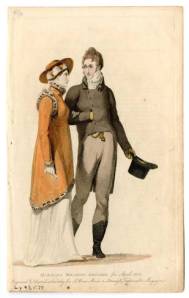
Mens_Wear_17901829_Plate_002And, since we’ve been on the topic of men’s wear, here’s a well-dressed gentleman and his lady in Morning Walking Dress for April 1807.

This weekend, I am off to the Farm for the Christmas Sale. Not such a pretty dress as these, but one I am pleased with nonetheless, and which (with wool petticoat, stockings, and cloak) should keep me warm–I do expect to be quite busy.
Evenings by the Fire

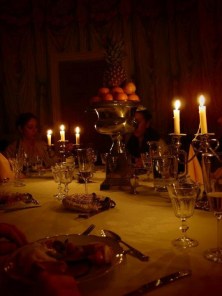
I am chasing two things at once these days: late 18th century high-style table settings, and late 18th century life after dark. They’re related topics, but in a way they’re not.

Setting aside the table, for I have diagrams and dishes and silver service identified and am down to questions of exact napkin folding and placement, how did people spend their time in the 18th century? We assume life was more tuned than ours to diurnal rhythms ( see Circles and Lines) but was it always?

There were differences between the days of servants, slaves and masters, and one good place for resources on those differences is Colonial Williamsburg. Like OSV, CW has placed some of their research papers online. For the house where I work, the Daily Schedule for a Young Gentry Woman is very helpful:

“From about 8:30 p. m. until 10 or 11 p.m. she, members of her family, and guests socialize at home or with neighbors. Their evening activities include conversation, toasting friends, singing or listening to music, reading aloud, playing cards or board games such as backgammon, dancing, and taking moonlight strolls. … “Kate read the Vicar of Wakefield to me this evening and highly entertained me” (Robert Hunter journal, 1786).  … “We play’d whist from 9 to 11. Capt. Clopper & myself, Mr. Harris & Munroe” (Ruth Henshaw Bascom diary, 1802).”

These observations of Virginia pastimes coincide with how we know Providence residents spent their evenings in the late 18th century. How late people stayed up was determined in part by need: was there work still to be done writing a sermon? was a family member ill? and in part by access: were there candles by which to work or read?

Fun to think and read about, but for now, I must put it aside. Fort Lee is tomorrow, and I have mending to do or we will all be cold. It will be an early bed for us all tonight, since we are driving down tomorrow morning. Photos on Sunday, as long as I remember the camera.

Light, or Lack of It

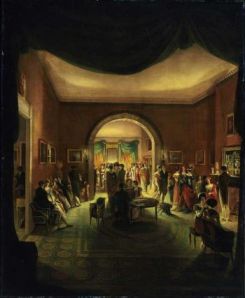
The Tea Party, 1824, MFA Boston

On Saturday evening, we drove up to Old Sturbridge Village for their “Evening of Illumination” tour. The village is by no means as fancy as the house depicted at left, but the gentle quality of the candlelight captured by Henry Sargent reminds me of the evening. I took no photos, because I just wanted to enjoy the experience…and learn from it.

Candles used in New England were usually home made, dipped, and of tallow. (See here for one reference.) The Browns of Providence had a spermaceti candle manufactory, and people in cities and towns often bought candles–by the pound, not by the stick. Spermaceti supposedly burns brighter than beeswax or tallow, but the only spermaceti candles I know of are accessioned museum objects and will never be lit.

In thinking about upcoming programs at two different sites, I’ve been thinking about what it was like to live in the dark, and to work mostly within the sun’s hours, and then judiciously by candle light. Sharon Burnston says, “Sew by daylight, knit by candlelight,” and if you think about process, you can imagine that  in low light, even the fine thread of sock knitting is far more manageable than fine sewing.

Large fireplaces provided both heat and light, and candles are surprisingly bright. I suspect that an evening by a fireplace, reading aloud by candlelight while a friend or sibling knit, was pleasant enough in a wool gown, or with a shawl over muslin. The trip to bed would have been another matter, and getting up something else indeed.

It is also well to remember that class difference would have created comfort differences: a servant would have been colder getting up than the master, for the servant would rise in a cold room and be expected to light a fire in the master’s bedroom. Rural workers would also have risen in a cold room, to cold or frozen water.

These are some of the things I’m thinking about as I read and look and get ready for programs, and for winter.

Universal Suffrage

A Squelcher for Woman Suffrage“How can you vote if the fashions are wide and the voting booths are narrow?”

The 19th Amendment (6/4/1919) gave American women the right to vote, and with that, a kind of political power they had never had before.

On this Election Day 2012, if you’re an American, please vote. If you’re an American woman, thank the women who organized parades, tableaux and demonstrations to force the passage of the 19th Amendment.

Some of the images look almost silly now, but scanning the images at the Library of Congress (search term=woman suffrage) gives you a sense of the size of the demonstrations that they staged. This was massive, street theatre, direct action, unabashed politicking. In heels and hats, and even furs. Vote, and thank the women who came before us.