Smibert Smitten

John Smibert made me laugh. He’s been dead since 1751, so it wasn’t easy.

The day I went to the MFA and walked into the gallery with Mrs Tyng on wall, I laughed, and said, “I know her!” while my son died a small interior death. Then I pulled up the record and image for Mrs Browne, and showed him how I knew Mrs Tyng.

Follow Smibert’s pictorial advice if you’re reenacting an American woman of means between 1729 and 1732, and you’re wearing blue silk. You may have a red silk wrapper/shawl. Your shift will show at the center front and sleeves to show off your fine linen. You look like you might be a little cold, but perhaps that explains the “I store oranges in my bodice” look.

See for yourself:

MMA, Mrs Brinley & her son
MFA, Mrs MacSparran
RIHS, Mrs Browne
MFA, Mrs Tyng
MFA, Mrs Dudley
Smith College- Mrs Erving


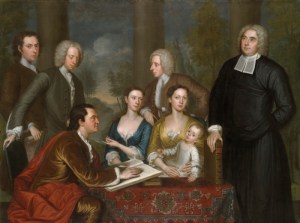
Yale- The Bermuda Group

After a while, you start to wonder if there was only one woman in the colonies in 1730… And then you wonder how she got into every painting

I know, style and conventions helped create these portraits as much as Smibert’s skill. And the portraits only get weird when you do the thing that was never supposed to happen. We were never meant to see all of these portraits all together, all at once, anywhere.
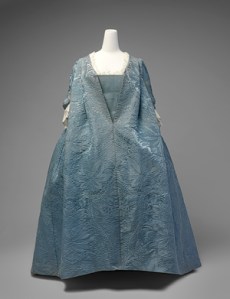
h2_2010.148-1 So, what’s she wearing? Probably this dress. No, not this exact dress, though if it was same woman in all those paintings, maybe the Met does have her actual dress. (Sometimes I have these weird museum-y ideas, and that’s generally when I need a vacation or come up with a new program idea.)

The robe volante shows up in paintings of women dressing, and in informal scenes, as below. She’s clearly wearing stays, which is helpful to know, because while I knew the women in the Smibert paintings ought to be wearing stays, and they had conical torsos, the orange-smuggling look was confusing.
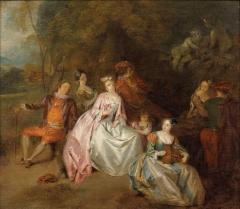
Galerie Dreyfus- Scène galante dans un parc, ca 1725

In fact, it confuses me still.

Seriously, the 18th century was a pretty sexy place, if you like oranges and silk.

Yale- Mrs Tyng
Yale- Mrs Tyng

Look, there’s Mrs Tyng again! She’s left the MFA and taken a chair at Yale.

Linings, perhaps not Silver

MMA, 2011.104a–c, Silk & linen suit, 1780-1790

The house is cleaned up for Christmas, which means all the sewing things have been put away, which is rather sad. Cassandra is banished to the basement, fabric stashed and stacked. It’s only ten days: better if I don’t count all that lost time when I could be pleating! Better to finish up some portable plain sewing, like shift and shirt.

On Friday, I spent part of the morning in the Cave of Wonders known as Textile Storage with a historical costume expert who specializes in men’s clothing. He had already promised to leave and sworn not move in before I opened the door, and that was probably a good thing. But I got a chance to ask some questions and here are the answers.

The frock coat tail linings of calendered linen: Nancy wanted to know if they didn’t stick to men’s breeches, linen catching on broadcloth, in the plainer suits. No, my source says, because the linings were slick. That was the point of the glazing. When it was new and fresh, it was much slicker than it is now. After 220+ years, slickness will fade. Calendered fabric has been pressed and heated, and that process makes it slick. If you’ve ever pressed a wool dress with too hot an iron, you might have achieved a glossy, slick finish that you weren’t expecting. Calendering is similar, but on purpose.

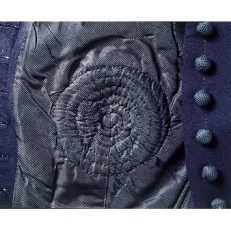
Incroyable-No3-detAnd then there’s padding. Sabine made an amazingly beautiful jacket based on an original. The lining is really interesting, because it is padded. Well, that padding is about style. In the plate at left, the shoulder line of the jacket is high, and the collar rises up as well. The chest is rounded, as we can see along the side. The way to achieve that look is through tailoring, including the use of padding.

The militia jackets in the collection at work include one with some pretty intense (several inches thick) padding in the front. That was for line, not repelling bullets, or even so much for warmth. The padding we find in men’s and women’s tailored clothes is about style, and maintaining a line. You’ll see this often in women’s riding habits or “Amazones.”

V&A T.158-1962
V&A T.158-1962
V&A, T.158-1962, overview

On pages 160-161 of Nineteenth-Century Fashion in Detail, there are two examples of padding used to shape garments. The first is a riding habit, seen here in detail and in overview. (Click for the record & larger views.) The padding here has been used to create the smooth, conical silhouette.

Those English Gowns…

GMFS2At the V&A, a fun interactive exhibit on 18th century costume allows you to turn the costumes around and zoom in for a better view.

V&A Screenshot
V&A Screenshot

My favorite, because I need to start making something like this, is the Gown made from a Shawl, about 1797.
There’s a good description of the gown, and you can always search the collections for the catalogue record and more non-turnable images. This is a good thing because the 3-D image player requires Flash, so it doesn’t work on an iPad.

I found the viewer helpful in understanding the sleeve-collar relationship, which was confusing to me with the contrasting colors. The description in the catalog record helps, too:

“An open robe with a medium high waist, the material stitch is pleated down the back, and then flowing into the skirt. The sleeves are of white satin, trumpet shaped, with a short green silk oversleeve. The oversleeve is bound with cream ribbon, and the undersleeve at the wrist where it fastens with three pearl buttons, with metal shanks, has a narrow green ribbon turn back cuff. There is a shaped falling collar of green silk bound with white, and a green ribbon binds the front of the gown. The bodice is lined with linen, and extends in front to cover the bust. The sleeves are lined with white linen.”

Fairfax House
Fairfax House

The oversleeve makes me think of this Fairfax House dress. I’ve not been able to find a larger image so I can’t get “close enough” to determine how it all goes together. Time to collect images of extant examples and fashion plates in a Pinterest board, and start comparing them. And time to think about whether or not this is a style seen in New England…and time to get ready for work.

Domestic Bliss

Museum of London
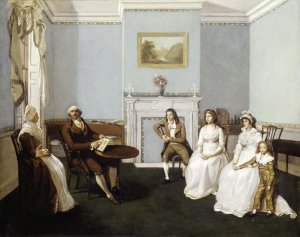
Museum of London, John Middleton &tc

I’ll come back another time to John Middleton & His Family, 1797 from the Museum of London, but today, this group portrait represents one of the online galleries at The Geffrye Museum of the Home in London. Their website has some nice features, and while I did get distracted playing the Topsy-Turvy Timeline game, what I really like playing with exploring is the Life in the Living Room 1600-2000 gallery.

The Geffrye Museum

This has proven useful in keeping on (slightly distracted) track as we polish silver and think about lighting, entertaining, and the ways rooms were used in the past. In particular, since we settled on the idea of setting a formal table for the “holiday themed tours,” and on the After Dark tours, I’ve been thinking about lighting.

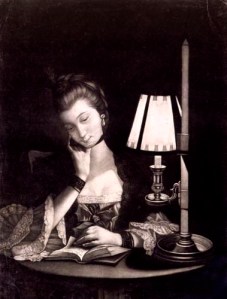
Not only is it clear that the expansive use of candles represented expense and disposable income, it’s also clear that it was uncommon. Special occasions on high-style homes: yes. Everyday use in middling homes: no. Even the charming and well-dressed lady reads by just one candle (though that is also a composition choice, and not purely documentary).

More hilariously to the point, this satirical engraving from the Lewis Walpole Libary:

The Pantry Apparition
Lewis Walpole Library, The Pantry Apparition