Light & Night

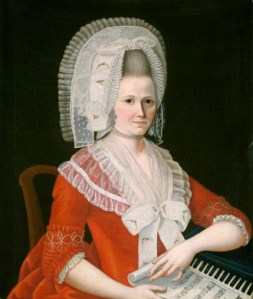
Morland: Woman Reading by a Paper-Bell Shade: YCBA

Winter’s hard for me. I don’t like the lack of light, I don’t like the shortness of the days and how the sky is pale and stretched in these months. But this is a good time to think about basic needs, like light and heat and warm clothing.

The New York Times came to my rescue this morning with the article by Holland Cotter (and others) on “Artworks That Shine in New York Museums.” Cotter is one of my favorite critics and writers, and he, along with Karen Rosenberg, Roberta Smith, and other NYT critics, have selected some interesting pieces.

De La Tour: Penitent Magdalen, MMA

Ken Johnson leads with Georges De La Tour’s Penitent Magdalen. It’s earlier than my usual era but I was attracted to the image of the flame in the mirror; it’s not just a lighting device, of course, it’s a metaphor, but the rendering of the candlelight, and the use of the mirror to boost that light, tells us about how 17th and 18th century painters saw light, and how light was manipulated. We know from our simple experiments at work that mirrors really do amplify light, and that large stately rooms would only glitter with lots of candles and lots of mirrors. Light gives us a window on economy and wealth, as a precious commodity that cost money or labor to have.
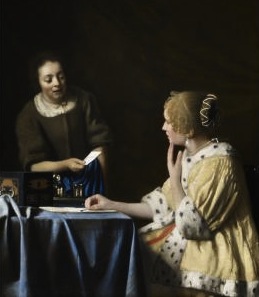
Vermeer: Mistress and Maid, The Frick

Cotter looks at Vermeer’s Mistress and Maid at the Frick, and notes the lack of obvious natural light or other light sources, and the overall dark mood of the scene. But Cotter’s writing shines, as he concludes the little essay: Whatever Vermeer’s anxious thoughts, light stayed on his mind. It scintillates in the pearls the woman wears in her hair and shines in the butter-yellow silk of her jacket. And the blacked-out space the women occupy turns out to have sunlit windows after all. We see them reflected in glassware on the writing table as tiny lozenges of light, far in the distance, as if at the end of a tunnel, but there.

Writing like that is its own kind of light, a joy to have in the daily newspaper on a cold, short day. In all, four critics look at five paintings each from a range of cultures and time periods. It’s enough to make one want to hop a train south.

What Pinterest Can Do, or, Asher Durand

BRM-Landscape, Wood Scene

At the Brandywine River Museum, I saw an Asher B. Durand landscape and said, “I haven’t thought about Asher Durand in a long time.” My mother, ever the realist, muttered just-loud-enough, “Well, why would you?!” She studied art history for real, me, I only went to art school. It’s a wonder I can even feed myself.

Getting my stimulating-image fix last night on Pinterest: lo and behold, Asher B. Durand! Buddy! Good to see you! Even better, the side of Asher Durand you never get in those American Art History classes taught by a disheartened adjunct on a three-year contract trying to beat Manifest Destiny into you.

If you’re like me, Asher Durand’s the original Jersey Boy member of the Hudson River School, all Thanatopsis and metaphors, machine-in-the-garden, acolyte of Thomas Cole. But it’s better than that–he’s also Mr. Awesome Portrait.

MMA-Mrs Winfield Scott

Thanks to Cassidy, Mrs. Winfield Scott gazed calmly from the screen last night, lovely in her golden silk gown with fine silk over sleeves not even as heavy as butterfly wings. Lovely Mrs. Scott, against a backdrop of a…finely painted river scene, highly detailed and with a looming cloud… That painter guy seems to know what he’s doing, why, Asher B. Durand, you scamp! You worked landscape magic into the background of that money-making, pay-the-bills portrait.

Grey Collection-Summer Afternoon

Cows won’t pay for portraits of themselves, so the history and landscape painters of the past generally had to shill the portraits (G.C. Bingham did it, but without Asher B’s grace). Lucky for us, they were good at people, too, though I think you can tell their first love is landscape.

PAFA-Creek & Rocks
PAFA-Creek & Rocks

Art History Secrets Revealed: I have a friend who paints rocks in streams (and other things), but Ken’s paintings of rocks are incredibly beautiful. He studied at the Pennsylvania Academy of the Fine Arts, which is home to…did you guess? Asher B. Durand’s painting of rocks in a stream.

So while Pinterest can be home to horrors (go see for yourself, I’m not looking), it can lead you to places you didn’t expect to go, or back to things you’d forgotten about, like Asher B. Durand. He was useful to know about when I worked in the Midwest, photo editing a history journal.  I’m glad I’ve met him again.

Portrait of a Waistcoat

RIHS-Robert Jenkins

Meet Mr. Jenkins. There are references to a Robert Jenkins, Vestryman of Christ Church, Boston and merchant of Salem, MA and Newport, RI. A Robert Jenkins married Elizabeth Champlin of Newport, and we have a pendant portrait of Betsey Jenkins, suggesting stronger ties to Newport. The records are confusing, but one thing is clear: that’s his waistcoat and he’s happy to have you see it.

This 1748 portrait by John Greenwood shows a man associated with a port city, perhaps connected with shipping and mercantile trade (see the ships in the background), and who has made enough money to a) commission a portrait and b) either own that sweet silk velvet waistcoat or to have one painted. It is entirely possible that he owned it.

Met-Waistcoat

And it probably looked a lot like this 1750-1755 one from the Met, but without the sleeves. There is fragment (two fronts) of one very like this in the collection at work. It’s not Robert Jenkins’, but it is Rhode Island, so we know these kind of garments were available and worn. The last piece to track down would be an account book, to get some idea of what this might have cost.

What I like in particular about the Met’s waistcoat is the cuff detail. The sleeve, which would be heavy if fully made of velvet, is not. Only the cuff is the velvet, while the sleeve itself is lighter weight silk.

Caps and Randomness

NGA- Lady Wearing a Large White Cap

Sweet cap, right? It all started because it’s cold this morning here in RI and I thought about skating when I went out to get the Times, and that led to Gilbert Stuart, which led to the National Gallery.

They have a fun search option, similar to the Tate Britain’s subject-search, but not quite as elegant.
You can start with a subject search, and then add a sub category. Results (stability not guaranteed) show you things you would not have otherwise expected, and that’s one more reason to love online catalogs & databases.

NGA Screenshot
NGA Screenshot

The results give you little unexpected galleries, and the juxtaposition or similarities of the thumbnails help you see the work differently. Black dresses and white collars are prevalent on this page: why? Is this fashion alone, or are these mourning garments? they’re earlier than the Civil War, but maybe it’s time to re-read This Republic of Suffering.

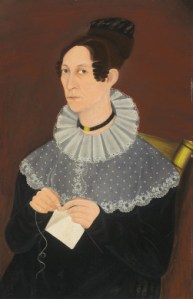
NGA- Sarah Cook Arnold knitting

But wait–who is this? It’s Probably Sarah Cook Arnold, Knitting. (Probably is not her name, smartypants, it’s an adverb.)

She’s knitting in the round, by the way, on three incredibly tiny pins from an invisible ball of yarn, possibly swallowed by the cat hidden in her skirts. (I know a woman who can knit with these skinny quadruple-ought pins, but they are a hazard in my hands.)

I would not have found Sarah Cook Arnold knitting without using the random subject search, nor would I have found Fabulous Cap at the top. Sometimes you need to enjoy the journey as much as the destination.