In the Pink

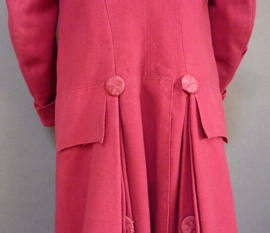
Detail, back pleats
Detail, back pleats

I swear I try to be positive about the mistakes I make. But not only did I discover this morning that I had lost my struggle with spacial processing, now I have found clear imagery to show how I should have handled the pleats on the Zombie Coat. Live, learn, unstitch and restitch: that’s all I can do. Now I have only to decide whether to do the unstitching this weekend, or next week. It will have to be done: now I know the way I’ve done it is wrong, and the master’s eye will be on that mistake and then he will know, and I will know that he knows, and it will just go on from there to tired shame.
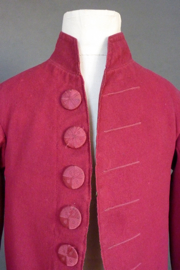
Man's wool  coat, 1770s. Meg Andrews.
Man’s wool coat, 1770s. Meg Andrews.

My favorite part of the description is this:

Either the coat was altered for another man or the wearer got fatter! … There is a half moon insertion under the arms… There’s no detail photo of that half-moon insertion, but I do so wish there was. The description notes additional changes: “If you look at one cuff you can see a lighter part of a button shape next to the seam. The cuffs have been removed and then added to the edge of the cuff to lengthen the sleeve.” At least we know garments in the past, even ones as lovely as this, were altered and changed.
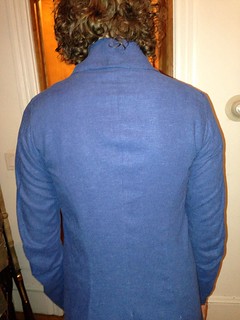
Puckering on the Zombie Coat. It’s still a nice blue, and you know what? It fits me, so maybe he’ll lose it to his refugee mother.

I will probably be inserting shapes of various kinds into the Zombie Coat, since I do now have a diagnosis for this puckering at the shoulder blades. “Viewed from the back and sides, it appears that the sleeve is binding on the front of his shoulder, causing pulling across the back shoulders – the puckers are caused by the stretching of the fabric across the rounding of the back and shoulders. If you make the top of the upper sleeve wider, or raise the shoulder cap it will create more fullness over the top of the sleeve and reduce the binding that is translating down the sleeve and across the back.”

By the time I make the changes I need to, the Zombie Coat will have acquired its own pre-history.

One Hot Banyan

Prince of Wales' banyan, ca. 1780. Royal Pavilion & Museums, Brighton. ID CT002728
Prince of Wales’ banyan, ca. 1780. Royal Pavilion & Museums, Brighton. ID CT002728

Alert! This item is currently on display at the RISD Museum of Art in Providence, through August 18, 2013. I have been to see it twice now.

As much as I am itching to get this on a table and investigate it, I am limited to craning my neck and squatting in front of the case. Awesomeness in cotton, this banyan has a five-button mariner’s cuff with a double arc like a broken pediment on a chest-on-chest. It would be a crazy thing for a Continental private to come strolling out of a tent in, not to mention impossible to make before the next camping excursion, but holy cats! that’s one fine banyan.

The RISD Museum is free on Sundays. You, too, can entertain the guards by craning your neck–photography is not allowed. Next visit: sketchbook.

There are a lot of other wonderful things to see, too–silk jersey breeches I expect to see on a colleague at some point, an indigo silk frock coat, the greatest great coat ever, and Fred Astaire’s tails, as well as a small section that I think does everything PUNK wanted but failed to do.

The Drowsy Dame

The Drowsy Dame, 1769. LWDL, 769.00.00.11+

Like many people, I could sleep better. Lately, the middle-of-the-night waking has been caused by the Young Mr sneaking down the creaking stairs at 2:30, ostensibly to get a drink. Sounded more like a snack to me, but either way, I was awake at in the middle of the night and am yawning this morning.

The 18th century prints are full of domestic details not always found in formal portraits– and certainly this is  an image never to be found in a formal portrait. Prints gave artists a chance to play with light in a different way; lithographs, by their nature, allow this kind of chiaroscuro imagery and informality.

knittingNeedles 1768

On the table next to the “Drowsy Dame” is what really caught my eye: the stocking. This print, from 1769, goes very nicely withWm. and Joseph Russell’s ad in the Providence Gazette and Country Journal, 1768. That ad included knitting needles.

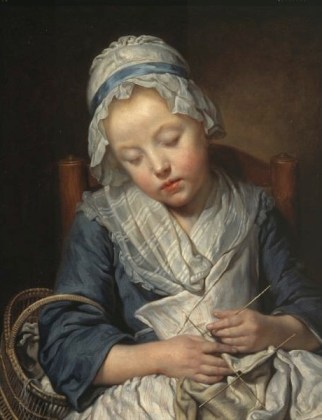
Young Knitter Asleep, Jean-Baptiste Greuze, ca. 1759. Huntington Museum, 78.20.8

At this time, needles are slender steel rods, not bamboo or wood or anodized aluminum (or plastic) we use today. Hand knitting is done in the round, as you can see in the hands of this sleepy young knitter. (Is it the repetitive nature of stockings that lulls these knitters to sleep?) For more in historical knitting, there’s Colleen Humphrey’s blog, Mara Riley’s website, as well as English sources. It’s not my thing–I’m able, but like these women, I cannot finish a stocking, though there are plenty of published patterns.

Aspirational Shopping

So, I always thought that window shopping was a product of the late 19th or early 20th century, the plate glass windows of the Bon Ton, and The Lady’s Paradise.

Providence Gazette and Country Journal, 4-18-1772

I was wrong.  Check out the last line in this ad from the Providence Gazette and Country Journal of April, 1772:

“Any Person not wanting to purchase, but having a Mind to see the greatest Pennyworths, shall be waited on with great Chearfulness, by their very humble Servant, PAUL ALLEN.”

In case we forget, the past is there to remind us that the consumer culture started much, much earlier than we think it did. Stop blaming Don Draper: I give you Paul Allen.