The Past Never Grows Old

It’s obvious that the people I know and associate with understand the genius of They Shall Not Grow Old, and the importance– necessity– of seeing it. This is a brilliant public history project in the most public sense of all– and not only because it’s a movie made by Peter Jackson, which one hopes will attract a wide audience– but because the mini-documentary after the feature lays bare the bones of the making. Jackson’s explication feels at times as if he is speaking to you through his laptop camera on the best Skype connection you’ve ever had. Despite the occasional weirdness of that, it’s worth staying for, because it makes clear what makes the film powerful: research and meticulous attention to detail (plus phenomenal computing power and the genius of WingNut productions).

Royal Irish Rifles, Battle of the Somme

This film rests on research: 100 hours of footage from the Imperial War Museum, 600 hours of oral history audio. Jackson and his team immersed themselves in the media, and it shows. Their intention was to create a generic experience of the common soldier (I may well have teared up at that), so the description of the assault is generic– is it the Somme? Vimy Ridge? Ypres? It is all of them and none of them.

Now the magic of that choice is not that we hear anything about how a Lee-Enfield works, but rather about the minutiae of getting ready to go over the top. We are in the soldiers’ world, and that world is made up of mud, bread and jam, and tea. Yes, there’s talk of the packs and what they carry, but the descriptions of what the waiting was like, how the officers behaved and gave their orders, are what make the moments so immersive. The words match the abject terror on one private’s face, caught in a grimace more rictus than smile. At the same time, we do get descriptions of the logic of the shelling, what the shells contain, and how the mines work. Matched to footage showing what the veterans describe, we come to understand how terrifying those moments were– and then we hear how, once you go over the top, fear disappears as you walk towards the German lines. (The walking always astonishes me: but that’s how they did it, lines of soldiers walked towards the machine gun nests.)

But it’s the details of the getting ready and the tension of the waiting that make the assault so much more intense, as contrast always will. The assault itself, for which there is no footage because it was too dangerous to send cameramen over the top, is depicted with halftones from The War Illustrated, selected for their realism and lack of heroics. (Published in Britain, it was as much a propaganda tool as a documentary publication, though accuracy improved over time.)

We don’t get the “glory” of a battle. We don’t get heroics. We get descriptions of the most terrifying and dehumanizing “job of work” people (mostly men) are ever asked to do. And we get the aftermath, rendered small. In detail. The descriptions of wounds and deaths are moving, and the tireless work of the doctors, but then there is the desire for a cup of tea. Tea threads through the film, seeping into every aspect of the war. It is, after all, men living daily lives in the most outrageous conditions, where every banal desire– dry feet, strawberry jam, a safe place to defecate–is thwarted by the conditions that make those desires so achingly large and yet dismissable. You have to enjoy what you have and can achieve and laugh at what you cannot, or you won’t survive. No one can ache endlessly.

What makes this film really work is the hyper-attentive focus on detail, on getting everything as right as possible, from the color of the uniforms to the accents giving the soldiers voice. The point of the research is not detail for details’ sake, but immersion. Only when there is nothing to notice– nothing that seems amiss, an entirely seamless world–can we fully enter the other, another time, place, culture. That is what we are seeing: another culture, with its own language, mores, habits and taboos.

This is what we are trying to recreate when we reenact the past: we are reviving a lost culture. To do that correctly and well, we need to apply the same level of care and understanding and empathy visible in Jackson’s film. We need to make sure that the details are correct not because the public will call us out on errors, but because the oversights are disrupting. The difference between a well-researched, highly detailed impression that does not focus on “Want to know how a musket works?” and one that’s musket-centric and approximates the past with “If they’d had it, they would’ve used it” is not actually of quality or necessarily or care. The difference is that one allows both the enactor and the audience to more fully enter the past. It’s like a bubble of time we can step into, one where we get as close as we can to how the people of the past saw, thought, felt, smelled. The other, often excused with “The public can’t tell the difference,” remains performative and distant, only half-reaching the past.

The public can tell the difference. They can tell when what they are seeing comes closer to the past, engages with the material in detail and in attitude, and creates attitude, worldview, empathy rather than a recitation of facts. To reenact the past, we must inhabit it, from the color of the wool to accent of the speech, to the taste of the food. The moments we recreate are specific in time, and, when they embody everything you can know about that moment, help us reach across time to understand both the past and the moment in which we stand.

Vera Brittain and her brother, Edward, in 1915. Testament of Youth was my gateway drug to World War I.

I am the last person to tell you I get close to this ideal of detail. I strive for it, and do the best I can to be whatever character I’ve selected. I write this not from the position of someone who has mastered the past, but as someone who has seen technique and principles applied to one medium– film– that are applicable to living history, exhibit design, public programming, and writing. Jackson’s film illustrates the power of knowing details and the power of caring about those details not for trivia’s sake but for the Tommy’s sake. Those specific details serve to create the “everymen” of the War. The research to find which regiments are shown, to get the shoulder badges right, to find how what speech an officer is reading, prove the power of the archives. The past is there, waiting for us, in acid free boxes. We can restore the dignity and humanity of the people of the past by reading their words. Specificity creates archetype.

At the end, Jackson encourages the audience to ask their family members about their history, to find out what stories there are, to find out how the Great War touched them. He reminds us that those memories die with the people who carry them, unless we ask and write them down (or record them). That is perhaps the greatest public history lesson of all: that the past touches us all through the people we know and love, and that by knowing those stories, we can understand not only our family stories, but the history we all share.

Turn Me Round

Gattinoni red brocade party dress, Rome, 1950s Augusta Auctions Lot: 155 October 24, 2018.

One of the best things about auction sites (when compared to museum sites) is that you get far more images of the objects, and often from unusual but helpful angles. This is true for furniture– good auction sites will post photographs of the undersides of sofas and desks, a level of detail museums simply lack the time for. For clothing, construction details aren’t always noted in the record, so we rely on images. This is where the auction sites can really be a boon: turn me round, baby.

Interior, showing black mesh boned corset w/ attached black petticoat. Gattinoni red brocade party dress, Rome, 1950s Augusta Auctions Lot: 155 October 24, 2018

I don’t know if I’d go as far as “boned corset” (well, I wouldn’t) but the boned bodice provides a lot of interior structure to this gown. The box pleats give the brocade skirt structure and fullness, but rely on the petticoat for the full silhouette. The interior structure probably didn’t provide enough support to allow the dress to be worn without additional undergarments– bra, panty girdle, even another petticoat– though it’s hard to say without knowing the original owner and feeling the dress. (Think of the boned bodices in late 19th century bodices: we know those weren’t enough to create the proper silhouette.)

It’s a wonderful look at the interior of a vintage dress, though, and one that makes replicating this garment (and look) so much easier.

Auction Season: The Holiday Sales

Screen Shot 2018-12-05 at 6.34.13 AM
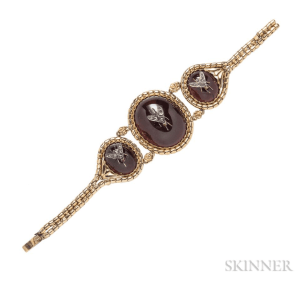
Lot 1159 Antique Gold, Carbuncle Garnet, and Diamond Bracelet. Yes, those are rose-cut diamond flies.

First come the jewelry sales, the big guns like Sotheby’s leading the way with sales as crazy as Marie Antoinette’s jewelry (Royal Jewels from the Bourbon Family of Parma, technically, though it sounds more like a delicious lunch than a sale), but the smaller houses play, too. Skinner’s sale closed December 5, Freeman’s earlier, but later than Sotheby’s. These are not sales I bid in, but they are places to see things you’d might not otherwise see. Garnet bracelets with rose-cut diamond flies? Not something I see gracing the wrists of my fellow Metro riders or grocery shoppers.

Screen Shot 2018-12-05 at 6.41.39 AM
Lot 7, Contemporary painted tin hat trade sign, 20th Century. 7″ x 13.25″

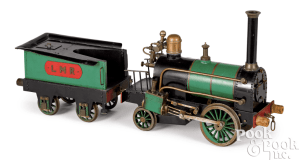
Once the serious stuff has sold, the fun begins: the toys! Pook and Pook’s two-day toy sale begins December 7th, and you might call it whimsies and toys, since it begins with shop signs. Who doesn’t want an enormous tin hat? What’s the point, you ask? Why look, if you don’t collect? Because you can collect– information, screen caps of reference images, ideas for things to make, and a visual reference library to fill in the blanks of what you read. The steam engine that breaks in The Railway Children seemed crazy to me as a child, and I assumed it was just a model of a steam locomotive. But no: there were steam toys and accessories, from lighthouses in moats with Indians in sailboats to working looms to….steam locomotives.

Screen Shot 2018-12-05 at 6.52.23 AM
Day Two, Lot 521, Large Bassett Lowke live steam train locomotive and tender, 3 1/2″ gauge, engine – 13 1/2″ l.

The darling thing even looks like Percy, filling in the gaps of the origins of Thomas the Tank Engine, Edwardian children’s stories, and the wonders of the steam age (which you can replicate, if you choose). Hard to believe, in our age of safety, that steam engines might be de rigueur in the parlors of well-to-do Victorian and Edwardian families. (Perhaps your childhood was not as full of E. Nesbitt, Kenneth Grahame, and Arthur Ransome as mine, but if your mother’s primary caregiver was born in late 19th-century Great Britain, you might grow up with an attachment disorder and a taste for fabulist literature of the early 20th century.)

Day One, Lot 230,
German dressmaker and milliners shop room box.

And then there are the dioramas or room boxes, many, if not most, German. These early 20th-century displays give us a sense of the kinds of craft or hobby activities people enjoyed, front-facing dioramas. I think you either “get” them, or you don’t; not everyone wants a miniature world to control or fantasize about, but from the perspective of someone trying to understand what the past looked like, these can provide a three-dimensional view of what are usually only black and white images. Are they perfectly correct? No. But they do give us a sense of the kind of visual stimulation people encountered and enjoyed shopping and playing.

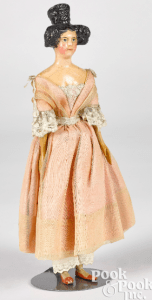
Day One, Lot 220, Papier-mâché milliner’s model doll.

There are dolls, always divisive (they’re creepy or cute, few folks fall in between) and they have they own usefulness. None in this Pook sale tell us much about early toys, but there are a couple of early 19th century examples to remind us of what children played with in the past, and how new fashions were disseminated. In the case of the milliner’s model doll at left, we get a good sense of the Apollo’s knot hairstyle, and a pair of red slippers I would love to have. The back view is equally useful, for it is only with three-dimensional objects (dolls or sculpture) that we can get a complete sense of a hairstyle or costume. With enough looking, you can extrapolate, but there’s nothing like being able to see the past in the round. That’s even better than the telephone-book-thick catalogs from Sears and J.C. Penney that arrived before the holidays in decades past.

Where You Come From

A selection from the box, mostly documenting the first two decades of my mother’s life

Mumblety-odd years ago, my first museum job was in a photograph and print collection, working as a photo researcher both finding and processing collections. There was a voyeuristic quality to the work, sometimes when going through a photographer’s more personal images, but especially when working on a family collection.

As I continued to work in the field, I started meeting with donors, and learned to talk them into giving their collections to the museum. It was easy enough to talk to them about making their memories tangible, creating and preserving a legacy of their lives so that others could understand the past and the contribution they, in particular, had made. How they typified an important part of a state or region’s history.

Susie the Cat makes many appearances

Sporadically, I organized my own photos and ask my mother for images of our family. I certainly took plenty of photos of my own son, but as time went on– and whether this is due to smartphones or trying to live in the moment, or not wanting to break the magical spell of an experience– I stopped taking pictures. I could still talk people into donations, and still enjoyed going through their family albums, but recording my own life didn’t make much sense to me, and I began to consider pitching images and letters and postcards, especially as I packed to move south. Keeping photographs for myself didn’t make sense.

Federal furniture: always central in my family

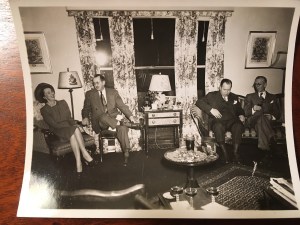
Sitting in bed on Friday night, Drunk Tailor and I looked through a box of snapshots my mother keeps in a fabric-covered box. He said, “Photographs are what you use to show people what you used to look like,” and to a degree that’s true. They are also proof that you had a life before this moment (think Blade Runner) and proof– perhaps– that you are who you think you are (think Blade Runner 2049). But even more like the Blade Runner movies, photographs of your past, or your family’s past, tell you where you come from, and where you might belong. Love them or leave them, you fit in somewhere in a larger story of people, and that shapes your identity, what you do, who you love, and how you live.

1936: My grandmother’s wedding.

As every year ends, I look back with some sadness at things I wish I had done differently, people I wish I had not hurt, people I wish I’d hugged more. The box of snapshots reminds me that I’m all too common, all too normal. Everyone has those pangs of nostalgia, the words they wish they’d said, the loss they feel as they lose the people they love.

Saint Lucia Day ca 1947

And that’s the point, I suppose: love one another. Be excellent to each other. Take the photos, label them (in pencil, on the back, listen to your archivist), and look at them when you can’t remember who you are, where you came from, or why you matter.