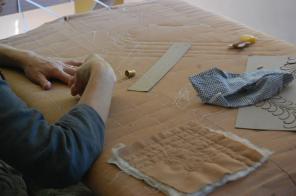
Just Keep Stitching

It is going to take a long time to finish, and longer because I’m doing it alone, have little room for the frame in our apartment, and have a family to sew garments for. But if I just keep stitching, it will get done.

The photo is from Sunday at Coggeshall Farm, and gives an idea of the set up. The frame worked well, though the pegs did fall out in the drier weather. No wobbles, though. It’s a little tricky to stitch from different angles and to maneuver around, but I’m accustomed to lap quilting even large pieces. This needs a frame, so I’ll just adapt.

The sandwich is comprised of a linen backing, wool batting, and a plain-weave silk and wool top. I’m quilting with some silk twist from Wm Booth Draper that matches pretty well. This is a compromise, given that I can no longer buy tabby and calamanco, or fine plain weave wool. The wool (calamanco/tabby) originals in the RIHS Collection are lined with wool, not linen (the silk petticoat that belonged to the Browns is lined in a fine white linen plain weave), but I could not find materials that satisfied my requirements for weave, sheen, color or fibre. The compromises I made I will have to live with—one hopes without recriminations—but they are balanced by the panels I stitched at about 13 to 13.5 inch intervals to match the dimensions of the originals. I’ve also laid the petticoat out in the same proportions as the originals.

Now all I have to do is keep stitching…

Mourning Embroideries

As a rule, I dislike samplers. Sacrilege, I know, but the rows of letters and numbers and tidy stitches seem to me like running in place, instead of running to get somewhere.

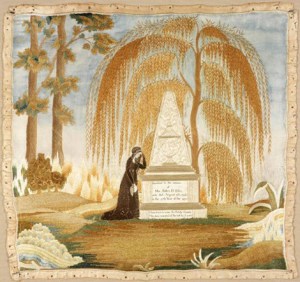
But I do like pictorial embroideries, and on this day, posting about a frothy bonnet in a painting in a Sotheby’s catalog seemed…well, too trivial. So instead, here’s a fantastic mourning picture from the Met. By Charlotte Brown, of Rhode Island, it memorializes Salome Brown and her husband Moses Brown, though not the Moses Brown.

Just because I’m not a fan doesn’t mean I don’t recognize types. In a google image search, I found this item, and knew immediately it was Rhode Island. Made in 1808, it lives at RISD, and a textile designer has done wonderful things based on it. Both RISD’s and the Met’s have the weeping woman, the weeping willow, the urn/cenotaph feature, the pastoral landscape.

But wait…the provenance of the Met’s picture is minimal: “Once property of the late Florence Maine, antiques dealer of Ridgefield and Wilton Connecticut. (Advertisement of embroidery in August 1953 Antiques magazine.)” So I started searching for Moses Brown and Salome Brown in the Rhode Island Historical Cemeteries Database, and I came up empty.

Yes, there are Moses Browns. There is no Salome Brown. But I can’t find a Moses with these dates. That doesn’t mean he didn’t exist, or that this isn’t a Rhode Island sampler; not every cemetery has been transcribed and not every headstone survived.  There is one Charlotte Brown with a date worth considering, and she is the daughter of Thomas and Rebecca Brown, and would have been 7 when this was made. Not impossible, but I’m not fully sold yet. I now have more questions about the one at the Met, and about the people memorialized. Those questions may well be answered in an accession file at the Met, but sitting on the public side of the catalog record, I have questions that only research can answer, and that I hope will one day be done as part of the Sampler Archive Project. 

For now, I think I’ll enjoy a sense of visual literacy in Rhode Island imagery, the lasting beauty of these memorials, and let it go at that.

Bonnets, buttonholes and boilers

When all else fails, sew! The Harvest Fair at Coggeshall Farm Museum approaches and quite aside from the real work that’s gone into a quilting frame, and buttons on breeches, it’s been an excuse for a new bonnet.

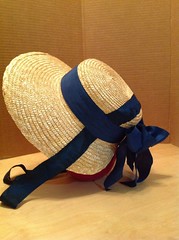
A few weeks ago, I found the modern, not-as-fine bonnet based on the KCI bonnet, and similar to one sold by Meg Andrews.

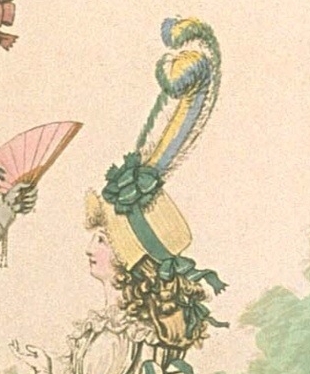
In a 1794 fashion plate, there is a similar bonnet with blue ribbons and an enormous feather. I don’t rate a feather as John Brown’s maid, or the Continental Army veteran’s wife, but blue ribbons seemed OK. Plus, I had them already.

The bows and the band and the strap don’t match, and my dress isn’t blue, but I think that’s all fine. The most I can say is that I’ve found two extant examples of this bonnet, and the fashion plate, which predates the farm’s interpretive year.

As a striving resident of Providence, Rhode Island’s busy port city, I’d have access to more goods than a Greenville woman. Bristol (where the farm is located) was also a thriving port, and again, boats from Rhode Island are sailing around the world bringing back china, silks, teas, spices, shawls and other goods, as early as 1787.

Now, pass me a boilermaker, please, because I’ll need a drink when the mechanical contractor tells me what the boilermaker will charge for a new Library boiler.


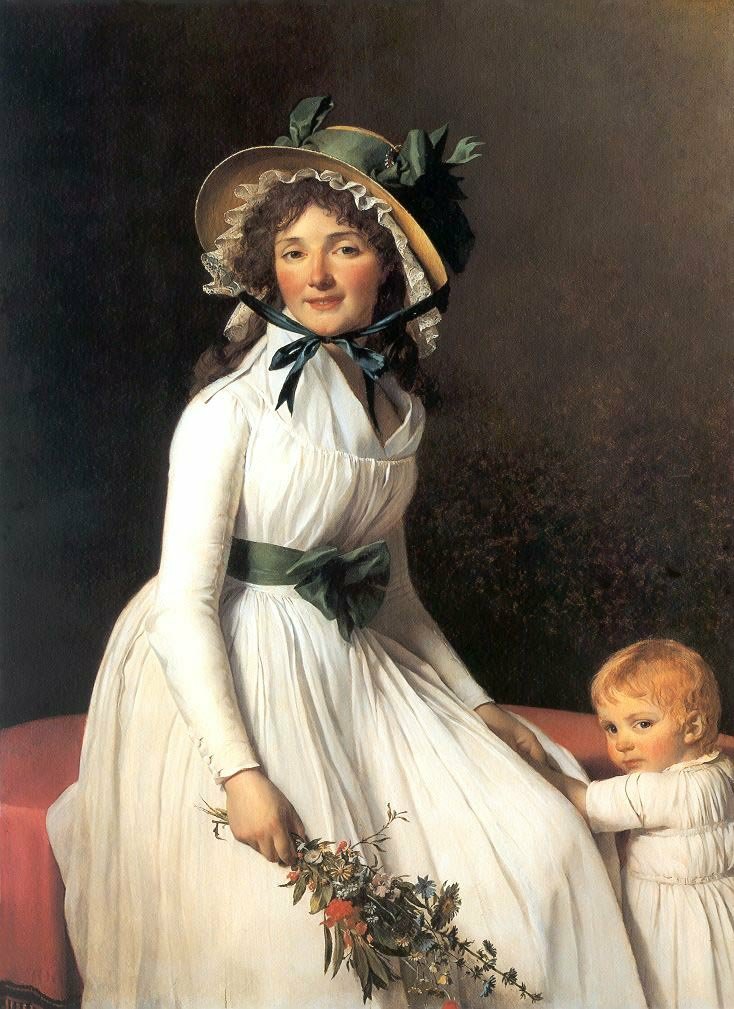
ETA: Aaand there’s this painting, Mme Seriziat, by David, 1795. Click for larger version, but she’s the reasoning behind the choice of blue ribbon.  The placement seemed to agree with the KCI and fashion plate ribbons, and joy! the color was in my ribbon box. I tried to get my ribbon to do what her ribbon is doing, but the bows and loops looked like sad blue silk dog ears– not so nice. So I switched them around to the back, based on the other images.


Some hat!

I was looking for something else, and found instead Sally Sanford Pert, 1790. That is surely a fantastic hat, but the painting itself is quite interesting, too.  I was chasing Sanford Mason, which is how Sally came up in my search, though she was painted by Reuben Moulthrop (1763-1814).

She’s on display at the Met right now, and if I had the time, I’d get on the Acela and see her myself. Is she really that blue? Does her hair really look like she made a wig from a grenadier’s cap? What exactly is happening with the gown? And who, oh who, is shown in the portrait miniature she proffers? I’d guess her child, perhaps deceased, but it is only a guess. If you click through to the Met’s catalog record, you can zoom in on the portrait. The neck of the gown seems to be edged in printed or embroidered fabric different from that of the gown itself. It isn’t really a zone gown, and the “flaps” or “lapels” remind me of the robings of earlier gowns, or even a robe volant typical of the early 18th century.

Atop this all sits the hat, with its corkscrew ribbon ringlet, the whole thing looking like it was made of paper. In a way the painting raises more questions than it answers, about dress, painting style, the artist, and who Sally was. The best projects seem to start with a question. I don’t know where Sally might lead, but I’m glad I found her.