
Those English Gowns…

GMFS2At the V&A, a fun interactive exhibit on 18th century costume allows you to turn the costumes around and zoom in for a better view.

V&A Screenshot
V&A Screenshot

My favorite, because I need to start making something like this, is the Gown made from a Shawl, about 1797.
There’s a good description of the gown, and you can always search the collections for the catalogue record and more non-turnable images. This is a good thing because the 3-D image player requires Flash, so it doesn’t work on an iPad.

I found the viewer helpful in understanding the sleeve-collar relationship, which was confusing to me with the contrasting colors. The description in the catalog record helps, too:

“An open robe with a medium high waist, the material stitch is pleated down the back, and then flowing into the skirt. The sleeves are of white satin, trumpet shaped, with a short green silk oversleeve. The oversleeve is bound with cream ribbon, and the undersleeve at the wrist where it fastens with three pearl buttons, with metal shanks, has a narrow green ribbon turn back cuff. There is a shaped falling collar of green silk bound with white, and a green ribbon binds the front of the gown. The bodice is lined with linen, and extends in front to cover the bust. The sleeves are lined with white linen.”

Fairfax House
Fairfax House

The oversleeve makes me think of this Fairfax House dress. I’ve not been able to find a larger image so I can’t get “close enough” to determine how it all goes together. Time to collect images of extant examples and fashion plates in a Pinterest board, and start comparing them. And time to think about whether or not this is a style seen in New England…and time to get ready for work.
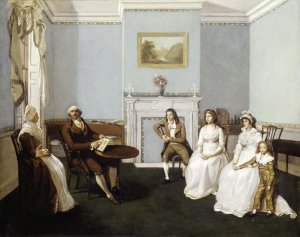

Domestic Bliss

Museum of London
Museum of London, John Middleton &tc

I’ll come back another time to John Middleton & His Family, 1797 from the Museum of London, but today, this group portrait represents one of the online galleries at The Geffrye Museum of the Home in London. Their website has some nice features, and while I did get distracted playing the Topsy-Turvy Timeline game, what I really like playing with exploring is the Life in the Living Room 1600-2000 gallery.

The Geffrye Museum

This has proven useful in keeping on (slightly distracted) track as we polish silver and think about lighting, entertaining, and the ways rooms were used in the past. In particular, since we settled on the idea of setting a formal table for the “holiday themed tours,” and on the After Dark tours, I’ve been thinking about lighting.

Not only is it clear that the expansive use of candles represented expense and disposable income, it’s also clear that it was uncommon. Special occasions on high-style homes: yes. Everyday use in middling homes: no. Even the charming and well-dressed lady reads by just one candle (though that is also a composition choice, and not purely documentary).

More hilariously to the point, this satirical engraving from the Lewis Walpole Libary:

The Pantry Apparition
Lewis Walpole Library, The Pantry Apparition

Fashion Plates & Subject Headings

Women_17901799_Plate_009Ah, the Met. You have to love them, so much wonderful material available online, and free. Collections of immeasurable depth and wealth, an incredible professional staff–this is the pinnacle, right? And yet…

They have a weakness. It’s a weakness shared by many places, but it is a major one, for the online user. It’s the lack of subject headings or dates assigned to their Library’s Digital Collections. They use OCLC’s ContentDM which has a pleasant enough interface, and fields that, in the Met’s Costume Institute Fashion Plate Collection, include Thumbnail, Title, Subject, Description, and Date.

They’re only putting data in Thumbnail (see image; I love that dress), Title, and Description. Description is what I would call Credit Line, and contains the donor name.

Title is a trifle vague. The image above is “Women 1790-1799, Plate 009.” No date, no subjects. The date is October, 1791, right there in the image, but not searchable, not sortable.

Women_17901799_Plate_049 Catalogers, I implore you: subject headings. If not subject headings, the date, please, when it is on the item. That makes the collections not only sortable, but searchable.
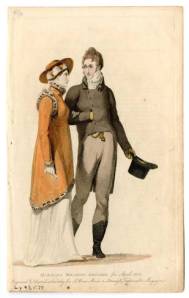
Enough with my lunch-too-late commentary! I’ve been immensely grateful to have a new digital plaything while waiting for the lunch room to clear, and this plate is delightful: April 1797, which was certainly blustery, if not cruel.

Mens_Wear_17901829_Plate_002And, since we’ve been on the topic of men’s wear, here’s a well-dressed gentleman and his lady in Morning Walking Dress for April 1807.

This weekend, I am off to the Farm for the Christmas Sale. Not such a pretty dress as these, but one I am pleased with nonetheless, and which (with wool petticoat, stockings, and cloak) should keep me warm–I do expect to be quite busy.

Fort Lee Surrealism

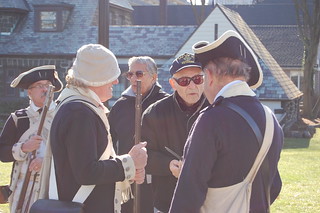
Surreal: that was the word for the morning at Monument Park. The RI Reg’t walked over the park instead of parading with the troops, because one of our members has not been well, and did not think he could keep up with the parade. It was odd to follow the reenactors in 18th century clothing under power lines and past high rise apartment buildings shouldering out old frame homes, but the surrealism really kicked in at the park.

Describing sniper fire in WWII to salsa music

There it became multi-sensory when the ceremony’s organizers turned on the music. It wasn’t exactly merengue, and it wasn’t exactly salsa…then the soundtrack switched to updated Big Band hits and finally landed on a strange, over-the-top, quasi-operatic version of “Battle Hymn of the Republic.”

So when you look at the photos on flickr, play some salsa or an album you might have ordered at 2 AM from a TV ad, and think about standing in 40F/4C weather eavesdropping on politicians talking about inching closer to universal health, and the lessons of Hurricane Sandy for high-rise dwellers, while squeezing up next to you for a photo op.

Later, at Fort Lee Historic Park, the artillery demonstration was loud and satisfying, but we got behind schedule and to the oddness of the morning was added rushing. It was capped off at the end by the order to fix bayonets, which led to bayonets being caught in branches.

Bayonets fixed, Capt. Becker takes measure of the trees

Finally, for me, the day nearly foundered when I pulled my phone out of pocket at the end of the event to check the time, and saw my boss had been texting me all afternoon over a non-crisis. Part of why I love re-enacting and living history so much is that it takes me so far away from myself and from my daily existence. It’s related (slightly) to my work, but to be so far away in place and time and effort is a delight. I can’t just throw the phone away or not take it along: I am supposed to be on call, all the time…but it’s history, not a hospital, and if budgets change, so should expectations.