Dressing and Undressing in Newport

A lady and her maid
The Ladies, Dressed, in Newport

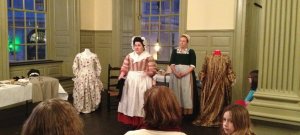
Last Thursday evening, my friend and I went to the Colony House in Newport  for the “Undressing History: What Women Wore in the 18th Century” program presented by the Newport Historical Society.

There were excellent questions from children (I loved, “What would you wear for pajamas?”) and adults, including:

If you were not a wealthy woman, or you were an enslaved woman, what did you wear on laundry day?
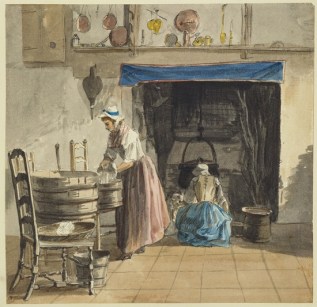
At Sandpit Gate, Paul Sandby, 1765. RCIN 914329

The image that sprang into my mind was Paul Sandby’s women at Sandpit Gate, doing laundry work. They’re wearing their shifts, stays, petticoats, neck handkerchiefs, caps and shoes. (I particularly like the woman working at the tub; you can see the angle of her stays diverging from her spine as she bends forward; it’s a fine little detail and very accurate.)

So women wore one of their shifts, their stays, petticoat(s), stockings and shoes.

And that brings us to the question, How many shifts did they have?

Several months ago I had the luxury of doing some research in the manuscript collections at work, and found MSS 957, the Stafford Family Papers. In those papers there is an undated estate inventory, thought to be from ca. 1780-1799. It’s extensive, and while I have a hand-writen transcription of the whole, I’ll quote the most relevant entry:

5 shifts [illegible]

Yes, five shifts. A woman who owned five slaves had five shifts. They were not for her slaves (though that leads to yet another set of questions about people who were property owning property…and where might that be enumerated?). And if she was laid out in a shift, or wearing one when she died, was it counted, too?

With five shifts, this unidentified woman could have worn each for two days and managed a washing every week–or rather, managed for another day or two or three while her slave women washed, dryed, and ironed her clothing.

In The Dress of the People, Styles points out in Chapter 2 that the largest differences between what the rich and poor wore lay in “numbers, quality and value,” (p. 31) and tables in the back lay out the different number of shifts lost by different women in a fire on an afternoon in May, 1789, in Brandon, Suffolk, England. A blacksmith’s wife lost six shifts, the mantua maker lost one. We can’t know if that emphatically means the mantua maker had but two shifts, or if she saved more than the blacksmith’s wife; one servant lost seven shifts! What we can tell is that women had more than one shift.

We can’t take one undated inventory as typical of 18th century clothing inventories in Rhode Island, (more research lies ahead of me) but counting shifts would be an interesting exercise. Based on my own experience, I can verify that one wants more than one shift. I think it likely that inventories will turn up multiple shifts for women, and shirts for men, no matter where we look, and that this will probably hold true even for slaves. Styles reminds us that the differences are not just numbers, but quality and value.
Shoe Envy

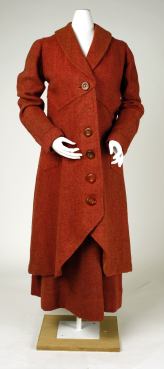
Suit, 1914-1918. MMA

Yes, I am as shallow as stereotypes might suggest: I see shoes, I often want shoes. Even my current co-workers know about the red leather Cuban-heeledAdrienne Vittadini pumps I passed up when they were on post-Christmas sale at Marshall Field’s way back in the Dark Ages. They would have gone nicely with this red wool suit from the Met.

There’s a Steam Railway in Essex, CT and when we went on Staff Day, we were told the train car was from 1914, an excellent year for fashion–at least before that August. It seemed like a great plan: make 1914 clothes and ride the train again next fall, possibly carrying vintage luggage or a basket with a delicious picnic. Really, who’s in? Let’s book it!

The World War I era has fascinated me for a long time, from Vera Brittain to Siegfried Sassoon,  from Wobblies (perhaps because I grew up in Chicago) to war memorials, so the Steam Train Outing in Period Dress was particularly tempting, and I started a board for early 20th century costume. Downton Abbey fans will enjoy it, too, and while I tired of Swedish murders and finally caved to Downton’s charms, my film choice for the period is Testament of Youth.

Libby Hall Dog Photo from flickr

When I saw the American Duchess pre-order for Gibson shoes, I was sorely tempted. (They’re quite similar to what the lady on the right is wearing.) Fortunately, I am saved by my pedal extremities, for which my size is not yet available.

But what really holds me back is the thought of sewing the corset. It’s like the hip surgery I don’t want to have: I know how painful it is, and how inescapable. There is no way to properly dress in the past unless you do it from the skin out. But shoes–and those fantastic Edwardian hats–might just get me to make that corset. Shallow, isn’t it?

Three sticks, two kettles, no matches

Soldiers Cooking, 1798 National Army Museum (UK), 1983-11-63-1

Here’s some visual evidence for why we travel with three sticks, two kettles, and no matches. (We bring the sticks as we suspect the sites where we camp & cook don’t want amateur logging on their grounds.)  I stumbled upon this at the National Army Museum in the UK. Here’s what they say about the image:

Soldiers from an unknown unit attend to their cooking pot on a break from their duties during the Wars of the French Revolution (1793-1802). They are accompanied by their womenfolk. Although only a few men from each unit were officially allowed to marry and have their wives and families accompany them, women would have been found in almost every British military camp. Some worked as cooks, laundry women and sutlers (camp followers who sold provisions), while others were prostitutes.

One of the things one learns when reading about women who followed the armies of the Revolutionary War is that prostitution–at least for those following the American army– was not high on the list of occupations for women.

Why not? Lack of ready cash, folks.

Working for the Army would get you rations, and that literal meal ticket was desirable in a time of shortages and want. If you’d been burned out of your home or farm (I’m looking at you, 54th Reg’t of Foot, Aquidneck Island torchers) what would you eat? What would you do? It depended, of course, but one thing to do would be to follow your husband if he had enlisted.

I know less about the women who followed the British Army, but for a Continental Army start, I recommend the following books:

Belonging to the Army. Mayer, Holly A. USC Press, 1996.

Liberty’s Daughters. Norton, Mary Beth. Cornell, 1980. (My edition, 1996)

Revolutionary Mothers. Berkin, Carol. Vintage Books, 2005.

In Pursuit of Liberty. Werner, Emmy. Potomac Books, 2009.

The last title is about children in the time of the Revolution, not women, but considering who was left home with the children, and in trying to understand what the time might have been like for the Young Mr, I’ve given it a read as well.

As for the camp gear? We keep it at a minimum based on period images. We don’t all sleep in one tent, but we pack as light as we can. It’s nice when authenticity and ease are the same.

Sandby’s Women

20130109-061710.jpgSara Hough’s date of ca. 1805 piqued my curiosity and Cassidy was suspicious, too. So I went looking into Paul Sandby a little bit more.

Many of us know him for the sketches and watercolors of working people in mid-18th century England. They’re oft-used references for people doing Rev War reenacting as they’re full of the kinds of details seen in the watercolor of Sara Hough. I hadn’t thought of Sandby for later 18th century references, which shows how little I was thinking.

Sandby: Figure with Lute & Tamourine, YCBA

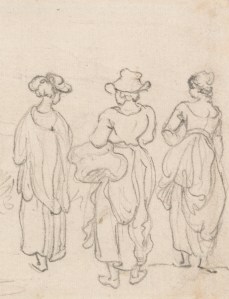
Thanks to the 18th Century Material Culture Resource Center, I found the Sandby “People and Places” presentation, which led me back to the Yale Center for British Art, and this image of musicians, horses and women. There’s no date in the record, though the presentation calls it ca. 1785. There seems to be a series or portfolio of Sandby sketches similar in size and type from about 1785, so it’s a reasonable assumption…with the usual caveat about assumptions, but no aspersions on the compiler of the presentation.

Sandby, detail, YCBA
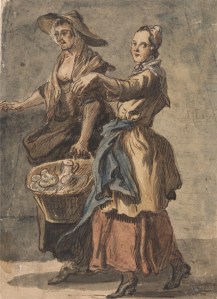
Sandby: Two Women and a Basket, YCBA
Sandby: Two Women and a Basket, ca. 1759 YCBA

Let’s look at a detail of the women in the drawing. Their waists are higher than we see in earlier Sandby drawings, and their profile slimmer, more classical, particularly the figure on the far right. Her bodice looks to me like a late 18th-century bodices.

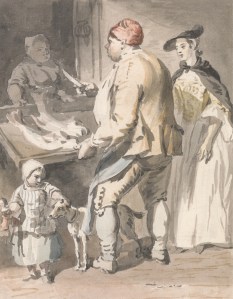
Sandby: A Fishmonger, YCBA
Sandby: A Fishmonger, ca. 1759 YCBA

Sandby had the skill to depict clothing with minimal gestures, as he does below in A Fishmonger, part of the London Cries series.

It’s that circa that gets you. I believe it for the ca. 1759, all the way. The figures fit into the visual continuum of Sandby’s mid-century work as I know it. (You’ll just have to trust me that I have a visual memory, and that, for once, the years of art school matter.)

And I kept wondering if he really had worked late into the 18th century, and then I found this:

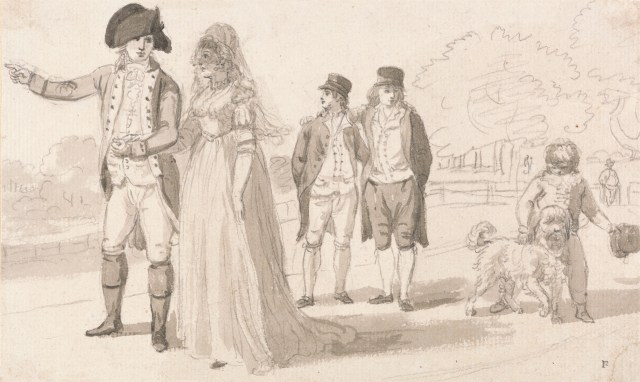
Sandby: Family in Hyde Park, YCBA

Again, no date, but there are distinctive markers to tell us this is post-1780, even inching to the early 1790s. The waistcoats on the adolescent boys are shorter and double-breasted. The shape of the boy’s hats has changed: these aren’t cocked hats, and they’re not soft round hats. But look even closer and you’ll see the ties at the knees of their breeches, very typical and fashionable for the 1790s. All this before we’ve even gotten to the woman! Look at what she’s wearing: that’s certainly a plausible ensemble for 1794, isn’t it? The waist has moved up, the skirts are lighter, likely mull or muslin, and the skirt of what I interpret as an open robe, much like Sara Hough‘s, is trained on the ground. If this is a Sandby drawing, which I don’t doubt, then I think we definitely see him working into the mid-1790s.

And just for one final kick, I checked the Met again, where they have a Paul Sandby drawing dated 1798-1799. I wonder…but the coat collar and waistcoat might have it.

Sandby, Group of 4 Children and a Dog, MMA

I’m still not sold on ca. 1805 for Sara Hough (why no ‘h’ on Sara when the drawing is inscribed by Sandby, “Sarah Hough…”?) but I’d endorse 1795. The tricky part, as always, is the circa: so much depends on how a museum interprets ‘circa.’ For some, it’s 5 years either side of the date; for others, it’s 10. When I see a circa date, I get skeptical, and start doing math.