Citizens of Boston

John Collet, May Morning, 1761-1770. Museum of London

I find myself involved in an event scheduled for August 10 in Boston, though I know this could go awry because I worked for a number of years with DC, the organizer of this extravaganza. He’s got a style all his own, and for a taste of the madness, you can see him here (~5:26) with unmistakable and inimitable mannerisms, at Louisbourg.

While the Adjutant is arranging and training the militia, the event still needs civilians, and as the interpretive consultant, my task is to create the context of the day and hammer into DC’s head that when organizing something like this, you can hardly over-communicate, though having been on the receiving end of his phone calls, actually, you can… but that’s where I come in with the editor’s sharpened pencil and cut, cut, cut.

Mr S has signed right up for this event, though he lacks suitable garb, and thus it will soon be time to break out the wool broadcloth. I really liked Sharon’s waistcoat-conversion suggestion, and happily Wm Booth had a lovely dark-green wool remnant of just enough yardage for a skinny man’s frock coat that very morning. Add the brass buttons in the stash, and I thought we were off and headed for 1770 with a regression to 1763.

Except… in doing more looking at 1760/1763 images, I began to wonder if it was better to beat the green linen into an earlier coat, consider it a lesson learned, and move on, since it is only a one-day event. (I saw some small remnants of that same green linen in the Adjutant’s stash, and perhaps I can get them for cuffs.)

My logic is this: it can be tricky to walk a coat backwards in time, especially in sleeve width, and Mr S is in serious need and want of a lovely coat for Battle Road. (Except yes, heh heh, he needs it by July 14 for an event at Washington’s HQ in Cambridge. There’s not even time for gnashing of teeth!) I don’t think it means more sewing, really, it only means penance with alterations and begging for fabric scraps. It also mean focusing, and letting the Monmouth-acquired cuts on my fingertips heal.

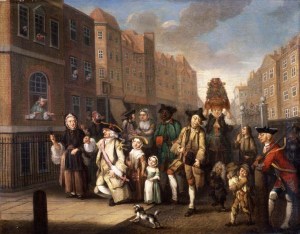
John Collet, Scene in a London Street, 1770. YCBA, B1981.25.110

Mr S will be just one of a number of men who will be militia in the morning and civilians in the afternoon. In thinking about the Boston street of 1763, I’m reading the Boston Gazette and Country Journal (which DC had not done beyond the main articles…) and looking at images from London. Maybe the scene won’t be as chaotic, since it is a happy celebration, but it needs to be busy, and populated with men, women, and children of various ages, races, and class levels. There’s a nice way to search for “street” at the Yale Center for British Art, and you get a sense of the crowds and busy-ness of the 18th century street.

To that end, I have asked my silk-gown friends, and I plan to be the cherry seller. (I should so like to have that done by Sturbridge to acquire some patina, but doubt I shall.) For the Young Mr, I see runaway apprentices as a possibility. In the Boston Gazette of August 8, 1763, There is a 16 year old mulatto fellow, “large of his age,” who had on “a brown camblet coat with red lining, a white linnen and a mixt colour’d flannel vest” as well as a blue great coat with yellow metal buttons and leather breeches. There won’t be leather breeches by August, but a camblet coat lined in red may be possible.

HSF # 11: Squares, Rectangles and Triangles

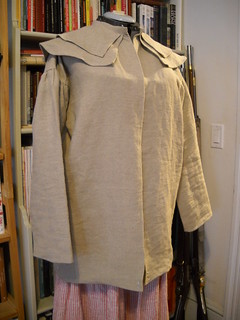
Hunting frock from the side. Just two sizes of one curve

I drifted away from the HSF. While, at some point, I had plans for HSF #11: Squares, Rectangles and Triangles, and they were even written down somewhere, something like table clearing and recycling happened…but, hey wait a minute, if you will allow me one curve done twice, I give you the Hunting Frock! (also, the checked bag).

Since there was a search for “best rifle frock for rev war reenacting,” I think this probably bears going into.

Presented, for your consideration, The Facts.

The Challenge:  HSF #11: Squares, Rectangles and Triangles

Without fringes or hem

Fabric: 100% “Osnaburg” linen, acquired from Henry M. Cooke IV of Historical Costume Services. I think he orders from the Ulster Linen Co. We are talking bolts here, people.

Pattern: Cut by Mr. Cooke, who used a yardstick, chalk, and an extant shirt (for the cape curve). I have watched him cut two now, and it’s pretty cool.

Year: 1778-1781 <choke> I forgot to ask.

Notions: Does thread count? That’s all this takes.

resolver

How historically accurate is it? Based on Mr. Cooke’s research into the hunting shirts worn by Massachusetts troops, and revised to reflect recent research by Neal Hurst, this frock pattern reflects the most current, accurate representation of the hunting frocks (sometimes called shirts) worn by Continental troops during the American Revolutionary War. The garment is entirely hand-sewn using, as much as possible, the correct (thankfully basic) stitches. Flat-felled seams, all that good stuff. Any place it is incorrect is purely my own genius.

Triangles and trapezoids!

Hours to complete: Remember those soul-crushing hours? Yes, these were among them. Actually, no, it’s not too bad. Perhaps twenty-four? You can power down on one of these, but even once you have the initial fringing done and the fringes attached, you will have more thread-pulling ahead of you.

First worn: Monday, May 27, 2013, for the Memorial Day Parade in Warren, Rhode Island.

Total cost: $45, for the linen and the cutting. Your mileage may vary, as the Young Mr and Mr S are in the regiment for which Mr. Cooke is the adjutant.

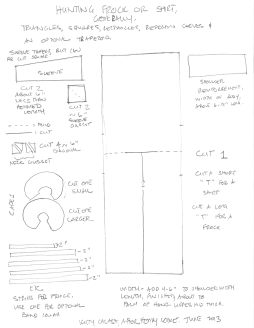
Hunting Shirt/Frock Schematic
Hunting Shirt/Frock Schematic, no scale whatsoever

To the person looking for the “best rifle frock for rev war reenacting,” I have to say, it depends. If you are with a Rhode Island regiment, for example, the linen you choose could be brighter, to reflect the fact that the state called for “whitened towcloth” for hunting frocks for Rhode Island troops. I have found some I think might be likely at Burnley and Trowbridge, but I have not checked it with the RI captain. You need to know if your regiment or group favors hunting shirts (pull over) or hunting frocks (open down the front), and then you need to figure out what kind of linen they were wearing in the period.

But, like a shirt of the period, these garments are very simple: triangles for the gussets (or squares), rectangles, and just the curved cape. The pattern (schematic) at right is adapted from what I have seen Mr. Cooke cut, which is quite similar to the Brigade of the American Revolution pattern I had for the Rhode Island frock I made (also entirely by hand). Since these were so close to shirts, they would have been very easy to construct, and since they’re large, measurements could be generalized. The BAR pattern does not use the under-arm gussets, and the sleeves are not tapered; there is more fringe on the standard Rhode Island frock than on the Massachusetts frock, but there seem to have been variations at the time.

You may also wish to consider whether or not there is a difference between hunting frocks and rifle frocks (I do not know, please don’t ask, I wasn’t told this would be on the test).

For more, here is Neal Hurst, on Fringe on the American Hunting Frock. You can read it before or after you pull threads out of those two inch strips until only 6 to 8 remain in the center. Happy fringing! 

The Drowsy Dame

The Drowsy Dame, 1769. LWDL, 769.00.00.11+

Like many people, I could sleep better. Lately, the middle-of-the-night waking has been caused by the Young Mr sneaking down the creaking stairs at 2:30, ostensibly to get a drink. Sounded more like a snack to me, but either way, I was awake at in the middle of the night and am yawning this morning.

The 18th century prints are full of domestic details not always found in formal portraits– and certainly this is  an image never to be found in a formal portrait. Prints gave artists a chance to play with light in a different way; lithographs, by their nature, allow this kind of chiaroscuro imagery and informality.

knittingNeedles 1768

On the table next to the “Drowsy Dame” is what really caught my eye: the stocking. This print, from 1769, goes very nicely withWm. and Joseph Russell’s ad in the Providence Gazette and Country Journal, 1768. That ad included knitting needles.

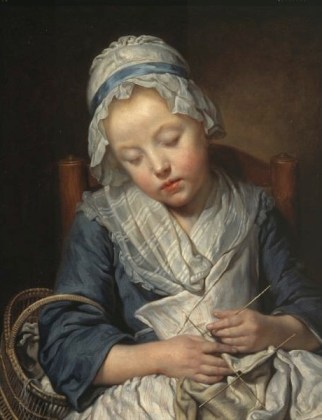
Young Knitter Asleep, Jean-Baptiste Greuze, ca. 1759. Huntington Museum, 78.20.8

At this time, needles are slender steel rods, not bamboo or wood or anodized aluminum (or plastic) we use today. Hand knitting is done in the round, as you can see in the hands of this sleepy young knitter. (Is it the repetitive nature of stockings that lulls these knitters to sleep?) For more in historical knitting, there’s Colleen Humphrey’s blog, Mara Riley’s website, as well as English sources. It’s not my thing–I’m able, but like these women, I cannot finish a stocking, though there are plenty of published patterns.

Aspirational Shopping

So, I always thought that window shopping was a product of the late 19th or early 20th century, the plate glass windows of the Bon Ton, and The Lady’s Paradise.

Providence Gazette and Country Journal, 4-18-1772

I was wrong.  Check out the last line in this ad from the Providence Gazette and Country Journal of April, 1772:

“Any Person not wanting to purchase, but having a Mind to see the greatest Pennyworths, shall be waited on with great Chearfulness, by their very humble Servant, PAUL ALLEN.”

In case we forget, the past is there to remind us that the consumer culture started much, much earlier than we think it did. Stop blaming Don Draper: I give you Paul Allen.