Authenticity: Sources I

There he goes!

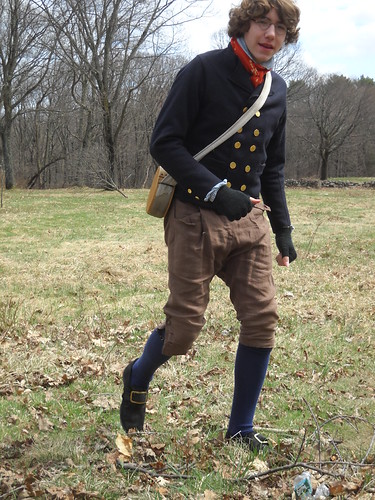
You know this guy: the reluctant drummer and avid ensign who wants to be in uniform but struggles with the fact that he might be seen by someone. (14 is complicated.) I’ve been mulling over several upcoming events and the comments that swirl around on the Interwebs after any large event, and, as I often do, find my clarity in writing. That means you’ll have to wait till the end of this post or a series to get “answers,” or what pass for them.

One of the things I struggle with is that the kid is not a mannequin. He has stated quite plainly that he feels like I fuss too much over his appearance, when he has nothing to do at events, which leads him to believe that I am fussing over nothing. There’s some truth in that, right: while God and authenticity may be in the details, all is for nought if there’s nothing to do or interpret.

This means I cannot simply dress him up as I see fit, I have to negotiate with him, and keep on eye on what he’ll be doing. And I don’t have the time to make all the lovely things I’d like to make (or not all at once, anyway) so it’s a matter of choosing.

June 21, 1774 Connecticut Courant
Connecticut Courant, June 21, 1774

Let’s start with what the kid has already: the blue jacket, checked shirt, neck cloth, breeches, stockings and shoes. I went to the newspapers (the lower sorts’ Vogue) looking for examples of runaways, and found some good ones. On June 21, 1774, an ad was published in the Connecticut Courant for a boy who had run away in a “check linen shirt, pair of striped linen trousers, one pair brown plain cloth breeches…” but the Young Mr wants no part of striped linen trousers, and his breeches are linen, not wool.

Essex Gazette, January 10, 1775

On January 3, 1775, the Essex Gazette ran an ad for a boy in a “short blue jacket, snuff colored breeches and long trousers.” Now that’s more like it!

Long trousers sound good to the kid, more “normal” than breeches,  but there’s a jacket in there that would satisfy my stripey love. For the short run, even if I don’t get the trousers made up in the next couple of weeks, he’s reasonably well documented, or at least within the realm of plausible appearances, even if he should be in wool and not linen, and even if one of the best reasons for making trousers is to replace the poorly-fitted breeches.

Kids shouldn’t just get a pass for inauthentic clothing, and children in what are really costumes do make me crazy–probably because I’m hand-sewing clothing for a wily teenager to grow out of, and looking for sources to make sure the choices I make have some form of documentation.

In a Pickle

Yes, for breakfast.

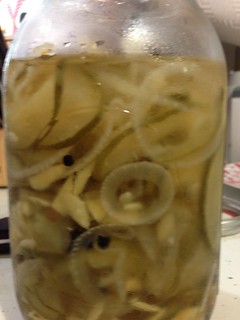
I like pickles. I don’t like being in a pickle, and I have to say that work this week has been as bitter-tasting as any week since February, so it’s a fine thing that the pickles I made last weekend are ready for eating.

The recipe is based on the Hannah Glasse recipe my co-commissariat made for Cambridge, and which I sampled in the NPS staff kitchen. I thought they were delicious, and so proceeded to make my own version, with some variations.

Here’s my version:

  • 3 large cucumbers
  • 1 medium onion
  • white vinegar
  • salt
  • whole peppercorns
  • fresh ginger
  • ground mace

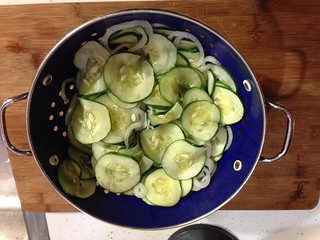
Slice the cucumbers and onion thinly and evenly (I used my old Martha Stewart Everyday mandolin from K-Mart). Layer alternately, sprinkling with salt, in a shallow dish or bowl, and cover, for 24 hours, in the fridge. Drain in a colander, pressing with paper towel to remove excess water.

Place the drained cucumber and onion slices in a bowl and cover with white vinegar for at least four hours, or while you go to work and are unable to leave early as you had planned. Pour the vinegar into a saucepan and boil with a little salt.

Peel and slice the ginger into sticks, and add to the cucumbers and onion. Sprinkle all with mace to taste, and add whole peppercorns as desired. Pour the boiled vinegar over all, decant into clean, boiled jars and seal.

I tasted these first over the weekend, and they were strong and spicy! The ginger made them a little hotter and sweeter than the ones I had in Cambridge. They seem a little mellower now (I had some with breakfast this morning) and I think they will be OK at OSV this weekend…if I take them. Glass jars seem crazy to pack for camping.

One Hot Banyan

Prince of Wales' banyan, ca. 1780. Royal Pavilion & Museums, Brighton. ID CT002728
Prince of Wales’ banyan, ca. 1780. Royal Pavilion & Museums, Brighton. ID CT002728

Alert! This item is currently on display at the RISD Museum of Art in Providence, through August 18, 2013. I have been to see it twice now.

As much as I am itching to get this on a table and investigate it, I am limited to craning my neck and squatting in front of the case. Awesomeness in cotton, this banyan has a five-button mariner’s cuff with a double arc like a broken pediment on a chest-on-chest. It would be a crazy thing for a Continental private to come strolling out of a tent in, not to mention impossible to make before the next camping excursion, but holy cats! that’s one fine banyan.

The RISD Museum is free on Sundays. You, too, can entertain the guards by craning your neck–photography is not allowed. Next visit: sketchbook.

There are a lot of other wonderful things to see, too–silk jersey breeches I expect to see on a colleague at some point, an indigo silk frock coat, the greatest great coat ever, and Fred Astaire’s tails, as well as a small section that I think does everything PUNK wanted but failed to do.

Drawing Beef and Flour

The Durham Ox: yet to come in 1778
Drawn meat: The Durham Ox.

Or beeve and flower, depending on how you’re spelling in 1778.
John Buss of the 10th Massachusetts complained mightily of the rations he drew, and the quality of the beef, pining in his letters home for cheese and cider. His affection for cheese has become part of the unit’s lore and an in-joke, so I did make certain to have plenty of cheese for Monmouth. Bread, cheese, ham, fruit in season, beef stew: yawn, after a while.

Trying to cook authentically in the field could result in dull, repetitive menus, recreating the soldiers’ experience, but unless everyone you’re feeding has signed up for that, you may have an unhappy crowd on your hands. Mostly they just want food, but people will grumble if you are cooking the same thing every week (and that opportunity exists). When I was a kid, my mother cooked chicken and broccoli every Sunday night, and to this day, I won’t eat chicken and broccoli unless it is in satay sauce.

Sorry, Private: not in this man's Army.
Sorry, Private: not in this man’s Army.

The 10th can count themselves lucky that they weren’t on the expedition to Quebec, when Newfoundland was on the 2nd Rhode Island’s menu, as well as squirrel-head-and-candle-wick soup. (Try explaining this Newfoundland business to your creative writing group. I tried historical fiction and got a reputation for being “dangerous,” and you can, too.)

At Monmouth, we served as another regiment’s….disposers…on Sunday morning, and were treated to the extra steaks they cut from a ham. Grilled and stacked on bread with hard cheddar cheese, this was delicious. Our conversation turned quickly to the question of grilling. After all, we only have kettles and sticks. I said I’d buy and carry a grate if they wanted ham so much, but the Adjutant proposed weaving a grid of green sticks and holding that over coals, and just brushing off the ashes when the meat fell into the coals. The minor detail left out is what we would use to retrieve the meat, though it must be a stick by any other name.

One cannot fry in or on tinware: the tinning will melt. We know soldiers carried as little as they could even in the regular infantry, so light infantry units were packing nothing but what they had to carry. No frying pan; no grate. Upon reaching this conclusion, we turned our sad-eyed stares on the other regiment with their table and stools and grill and ham, and were rewarded with another grilled ham piece each. Dogs have got a good thing going.

Begging and sharing aside, what about ham? The joke we make at home about ham being the natural prey of cats who butcher, brine, and cook the ham they beg for applies just as much to light infantry troops and their hangers-on. (They shouldn’t really have me along, but they are stuck and I’m pretty handy for getting the meals out, the canteens filled, and the wounds bandaged.) But a ham? Harder still to justify. Salt pork, yes; salt beef, yes. But the attractive and portable boneless hams at the supermarket are, sadly, more delicious than authentic.

One can take on the task of preparing meat properly oneself, in one’s copious spare time, but that won’t fix July and August’s meals. Staring sad-eyed at other regiments seems a parasitic and reputation-destroying plan. What to do?

Tune in next time for more adventures in historic meats!