Finding Bridget Connor

Two washerwomen, one of the sketches made in Edinburgh and the neighbourhood after the rebellion of 1745 Pen and black ink and grey wash, over graphite. Paul Sandby, British Museum Nn,6.10.+

Regimental Orders, July 23rd 1782
At a Regimental Court Martial whereof Capt Francis is president, Briget Conner a Woman Belonging to the 10th Massachusetts Regiment was tried for purchesing a publick Shurt from a Soldier in Sd. Regiment found Guilty and Sentanced to Return the Shurt to the person from whom she purshest it and loos what She gav for the Shurt.
The Colo approves the opinion of the Court and orders it to take place Immediately

Regimental orders July 25th 1782
Bridget Conner a woman Belonging to the 10th Massachusetts Regiment is Directed to Leave Camp Between this and to Morrow Morning at Roal Call for her Insolence to the officers of sd Regiment on pane of Being Treated with Severity

The entries above are from the orderly book kept by Captain Stephen Abbot who served under Colonel Benjamin Tupper of the 10th Massachusetts Regiment. (This is a Continental Regiment, so the entry for the book in the holding library’s catalog is, um, confusing.)

The entries were sent to me by Mr Cooke as a place to start working on Bridget Connor (name confusion, it is Connor). I checked the Massachusetts Soldiers and Sailors of the Revolutionary War, and what did I find? Francis Connor.

Francis Connor. Where did he come from?
Francis Connor, in the middle. Where did he come from?

Francis Connor was in Benjamin Tupper’s (10th) Regiment. He enlisted on December 25, 1781, and was reported deserted on July 25, 1782, the same day Bridget is directed to leave camp. Do you think Bridget might be Francis’s wife? I think she might be, and I am inordinately pleased about it.

It is a sad but true thing that it is easier to find a man in the 18th century records than it is to find a woman. (See Jill Lepore’s new book about Jane Franklin Mecom.) But with a husband to look for, maybe I can find more about Bridget. And if I can find more about Bridget (and even if I don’t) I can start asking the questions that create a more engaging impression or interpretation.

  • Where did Bridget live before they joined the 10th?
  • Where was she born?
  • How old was she?
  • What did Francis (if he was her husband) do for a living?
  • Did Bridget work? (Probably- but at what?)
  • Why did she join Francis in the Army?
  • Did she have previous run-ins with authority?

I have guesses about Bridget and Francis, and even if I can find no more than what I’ve found, I can create plausible stories about their lives to make the past more real. For history, though, I prefer telling truths to making up stories.

HSF # 26: Celebration Spencer

Cassandra in her new Spender.
Cassandra in her new Spencer.

This was supposed to be for #25: One Metre (yard) but things went awry. now it’s cause or #26, Celebration.

Make something that is celebration worthy, make something that celebrates the new skills you have learned this year, or just make something simple that celebrates the fact that you survived HSF ’13!

Heck, I survived the last two weeks of 2013, and that’s reason enough to celebrate. Water at work, relatives at home, high-stress holidays: if you can’t say anything nice, don’t say anything. So on to those pesky facts!

The Challenge: #26, Celebration! with a backward glance at #25, One Metre

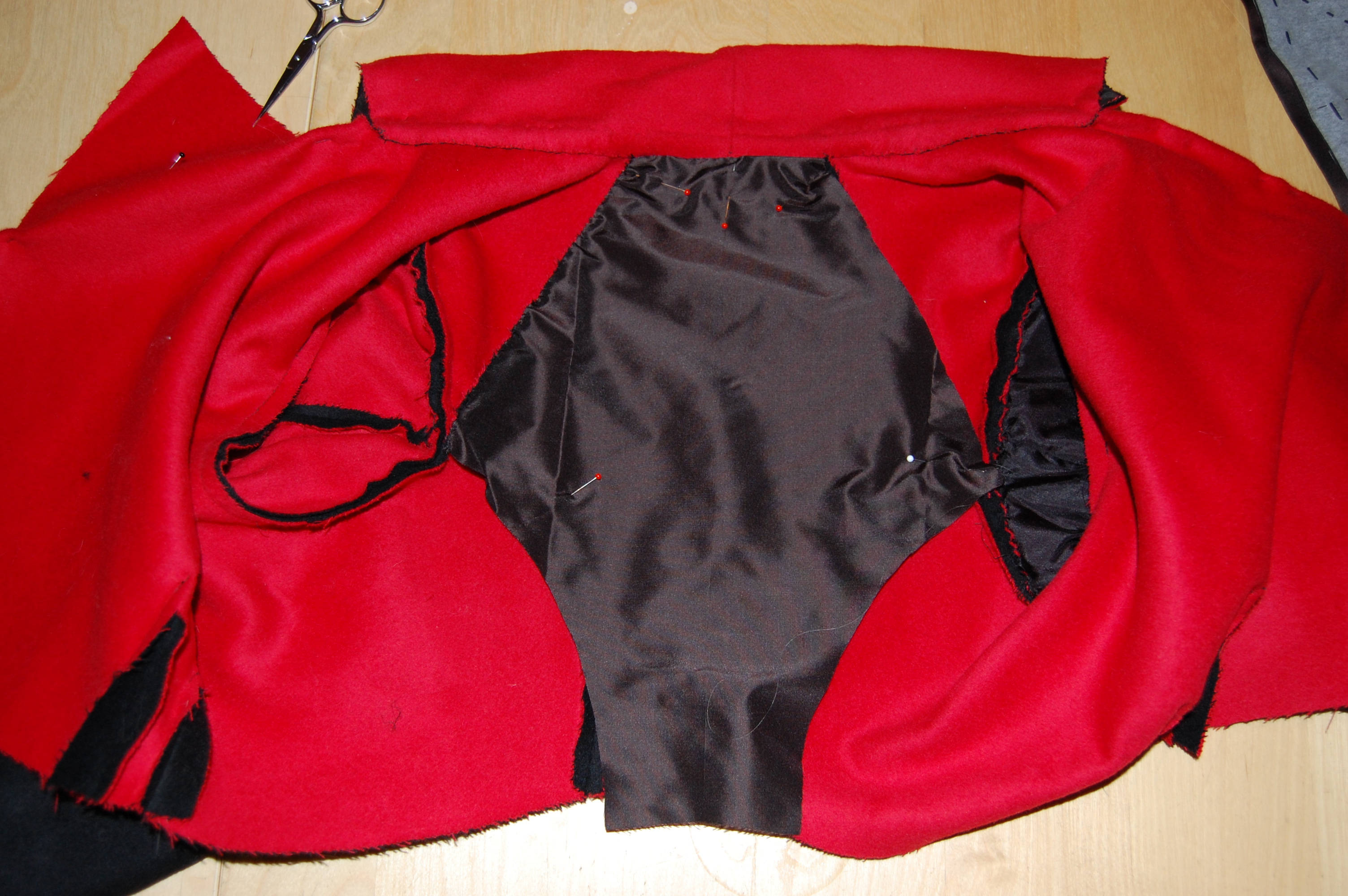
Fabric: 34 inches of double-faced Italian wool, bought at Apple Annie Fabrics as a 50% off remnant after she found it in a pile. The collar is lined with black silk taffeta and interfaced with buckram. The sleeves are lined with black silk Persian from Wm Booth Draper, but I used taffeta on the bodice to give it more body. Technically, that’s almost two yards because it’s two kinds of fabric. Initially I didn’t plan to line this, but the edge did not hold as well as expected so I ended up breaking the rules in order to make a better garment. Celebrate rule breaking! Also, better sewing skills!

The pattern pieces on 34 inches of fabric. One cuff is pieced.

Pattern: My own, mostly. I started with the Sense & Sensibility pattern, and then modified it to make the first Spencer, working my way towards the double-breasted broadcloth of the Swedish Spencer. I first modified the lapels, and then, in order to match the arm scye to the sleeve correctly, modified the bodice at the side, and at the shoulder point. I used the Janet Arnold Spencer/riding habit as a reference, and then measured up the Leloir pattern to check my work. The two-part sleeves are borrowed from Henry Cooke’s 1770s man’s frock coat pattern taken from that extant suit; the collar and cuffs came from the same place.

Once I reshaped the sleeves from the elbow to the wrist (as I do not have a gentleman’s forearms of steel), I concentrated on adapting the bodice to make the seam sit properly on the shoulder line. Watching Mr Cooke manipulate Mr S’s garments made this a lot easier to do.

Inside view in progress.

My theory was that if you thought of a Spencer as a miniature frock coat, starting with a man’s pattern might be the way to go. I played with that in a theoretical way, but did not pursue it fully, as I was committed to the double-breasted look.

Year: 1797, if you take the Amazon as the inspiration and marker, which I do. This style, and even the revers, persists for a while, at least in fashion plates. 1797-1800 seems about right. (See the expanded Pinterest board for examples)

Notions: Thread counts, right? Also button molds. But that was it.

How historically accurate is it? This is always the toughest part! I have verified the revers, the style, the fit, and the pattern pieces. The garment is entirely hand-sewn of the most period-appropriate materials I could find. I found reference to a very similar example in a Danish museum; if I had possessed enough fabric for a cape, I would have made one. The inaccuracies will be in details of techniques and the lining materials, which were chosen to ameliorate the very snug fit. Is it 90%, with points off for not being able to time-travel back to buy my fabrics from Providence merchants in 1797? Aside from the Andes Candies coat, I think this is the most accurate and nicest thing I’ve made yet.

The shaped back piece.

Hours to complete: 12 to 18 for the pattern and muslins. Each sleeve took 30 minutes to pin and stitch into the armscye, but the long seams were more time consuming. 12 hours of sewing, perhaps? It seems like more than 30 hours, but once the pattern was done, parts of this moved quickly. (Personally, I love setting sleeves and sewing curvy back pieces.)

First worn: Not yet. As soon as I can talk Mr S into taking photos, I’ll wear it, but right now I have no firm plans for wearing it, which makes me sad. Wouldn’t it be a fun thing to ice skate in? Except for the very authentic way it pulls your shoulders back, which could compromise your balance.

Total cost: $15 for the wool, $6.50 for thread, and $2.80 for button molds; $8 for the amount of silk Persian for the sleeves, the taffeta was in the stash, so $24.30.

Breaking into Museums (for research, silly)

Curator’s storeroom, World Rugby Museum

So, how do you get into museums?

Most of us come into through the front door, pay a fee or show a membership card, and enjoy whatever spectacle we’re after. Some of us like jelly fish, some of us like taxidermy, some of us like clothes.

A universal constant for going behind the scenes is a specific, and not a general, request. You can say, “Show me all your spoons,” but not even please is going to help when there are thousands of spoons.

I like researchers: they’re always interesting, they see the collections in ways I don’t, and they have insights that are valuable and useful. But someone who wants to see all the spoons, or all the chairs, or shoes, or fire buckets is really hard to help: There are too many of each of those things. Specific shoes, chairs, fire buckets or coats are manageable and realistic. “May I make an appointment to see spoon 1492.1.12, please?” is a question a curator, registrar, or collections manager can work with. One spoon, two spoons, five spoons, a few pairs of shoes: Studying these few things can take a great deal longer than you might expect.

STEAM Museum of the Great Western Railway storeroom

Think about it this way: in a Special Collections Library, you generally don’t begin with, “I’d like to see all your material on the Civil War.” For one thing, that will be a lot of stuff. Chances are good you won’t be interested in all (or even much) of it. What you’re really after is usually more specific. “All your home front diaries written by women over the age of 44,” or perhaps it’s “Battle accounts written by chaplains in the field.” Those requests archivists and librarians can and will gladly handle, and through a reference interview, can help you identify not just specific items on your topic, but help you think about your topic. But asking to see all the diaries (or anythings!) at once, is usually a non-starter. They’re all in separate collections, in separate boxes, on separate floors. Heck, I work in a place with hundreds of diaries, and I am pretty sure they’d call my therapist and the cops if I asked to see all the diaries at once. (Tempting thought that it is.)

Once in my life have I seen “all the somethings” pulled out from storage in a museum.  The Curator of  Photographs and Prints and a visiting (contracted) scholar were selecting daguerreotypes for an exhibition, and in my very junior role as the Curatorial Assistant, I got to pull out all the daguerreotypes by Thomas M. Easterly and help spread them out on an enormous mahogany table. I’ll never forget how beautiful that was, and how special, to see so same silvered plates and brass mats spread out on a dark surface. If this link is stable, you can get a sense of what it was like. Once, in a quarter century of working in museums. Sad, isn’t it? more people should get this chance, but it’s rare. However, this rule is in place for the preservation and security of the objects.

Yes, I want this wall of chairs. The Röhsska Museum, GÖTEBORG, Sweden

These kinds of restrictions are part of why museums have open storage, and it’s why I wish we could have open storage. But most museums don’t, so the key to getting into the storerooms (or the research rooms) is to ask the right way. I did a presentation on the process, and there’s more good advice over at the Still Room Blog.

Always, in museums or in libraries, if there’s a catalog, start there! You can narrow down your choices with database searches and questions in advance so that you can make the absolute most of the time you have. Your time is precious. Focusing in on what you really want to see will help the museum’s staff help you better. And if you really enjoy a collection, please consider supporting it financially, with a donation to a collections care fund, annual fund, or a membership. Your dollars count, they’re noticed, and they’re truly appreciated.

Les Oublies

Les Oublies. Le Bon Genre Plate 79: three ladies and a child look at a sundial in a garden, watched by a man. August 1815 Hand-coloured etching. British Museum 2003,U.14

I was first attracted to this image by the gentleman and his shapely legs, as you might expect, since tight buttoned gaiters or overalls do turn my head. This plate doesn’t make much sense to me: I can’t really grasp the satire, I can only guess. The explanation given for the series doesn’t help immensely. “The series is devoted to costume, mostly set in fashionable interiors, but the plates are treated in a semi-caricatural, humorous way that links them with French social satire.”

My best guess is that this plate from 1815 is showing off the latest filmy white fashions and tiny pink Spencers in contrast to the forgotten origins of the classical influence, personified by the gentleman in common dress at left. His hat and the gaiters suggest the French revolution, now forgotten (see “oublier” though the reference is also to the small cakes being eaten by the woman under the tree). The clock provides a reference to the passing of time, and forgetting, but I don’t think it is actually a sundial. The strap makes it look as if the man can carry it, and that’s a needle, not the fixed vane of a sundial.

Whatever it all means, I do find this more interesting for the man’s clothing than the women’s; after a while, the subtle differences between white columns is lost on me, but that’s a pretty interesting buff-colored waistcoat.