
Ballet Arthritique

Three men wearing orthopedic apparatus. Etching and engraving by Paul Sandby, 1783. Wellcome Library image L0019751

How was arthritis pain treated in the 18th century? One option was the mustard plaster, which operates on the principle that heat generated by the plaster increases blood flow, which will reduce inflammation. Frankincense supposedly inhibits the production of molecules that cause inflammation and break down cartilage tissue, which leads to joint pain, at least in knees. This level of scientific knowledge wasn’t available to the 18th century physick, but frankincense is an edible aromatic resin with a long history of use in treating ailments including arthritis. At least you (or your breath) would smell good.

The primary ailment treated of was gout, and the remedies above are mostly directed at inflammatory arthritis, the kind where joints grow red and swollen. Think of wealthy, overweight men drinking port with swollen feet propped up on footstools: that’s gout.
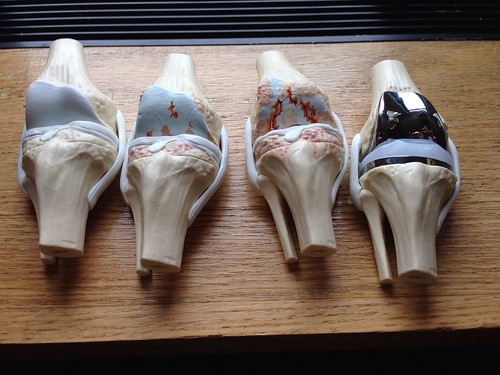
Models showing progressive arthritis in a knee, followed by joint replacement.

Then there’s osteoarthritis, or degenerative joint disease, once included in the catchall and obsolete term, rheumatism. This is a different matter, where changing your diet and icing the joint generally won’t bring much relief. When your cartilage is gone, your bones rub together. Osteophystes or bone spurs form is response to damage or inflammation, and cause both pain and noise.
In the pre-joint replacement era, treating this kind of arthritis was treating chronic pain. (In this era, that’s still the case: absent a TJR or resurfacing, all that’s treated is pain. Once the joint is replaced, there’s nothing left to hurt. It’s a neat little trick.)
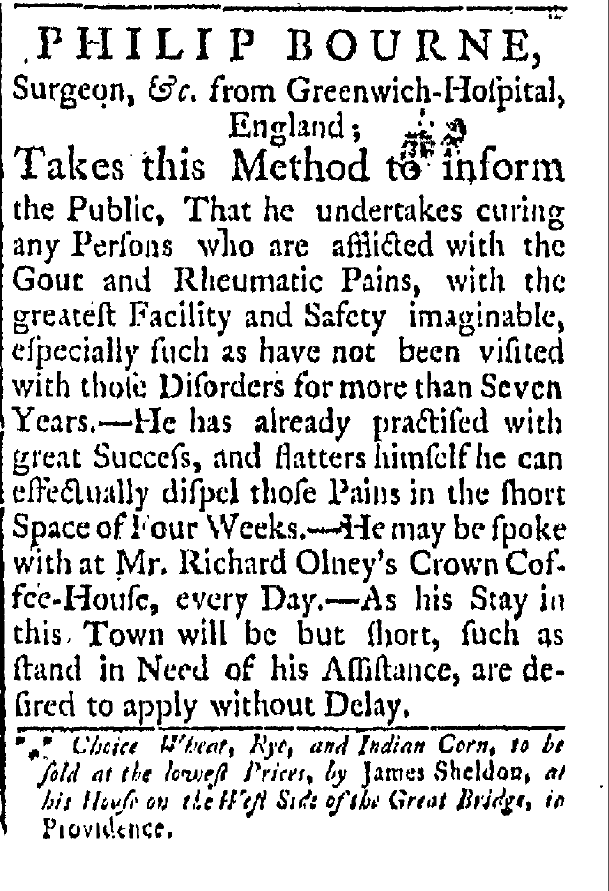
Providence Gazette and Country Journal, June 16, 1764. V II, Issue 87, page 3

In pre-Revolution Boston and Rhode Island, there were various cures advertised promising far more benefit than they were likely to deliver. Phillip Bourne, from Greenwich Hospital in England, promises to “undertake curing any Persons who are afflicted with the Gout and Rheumatic Pains, with the greatest Facility and Safety imaginable.” The caveat about “especially such as have not been visited with those Disorders for more than Seven Years” is particularly nice, since the longer pain persists, the harder it is to treat. He knew his limits, I suppose, if only of his patience, or the amount of time he could safely ‘practice’ in any location.
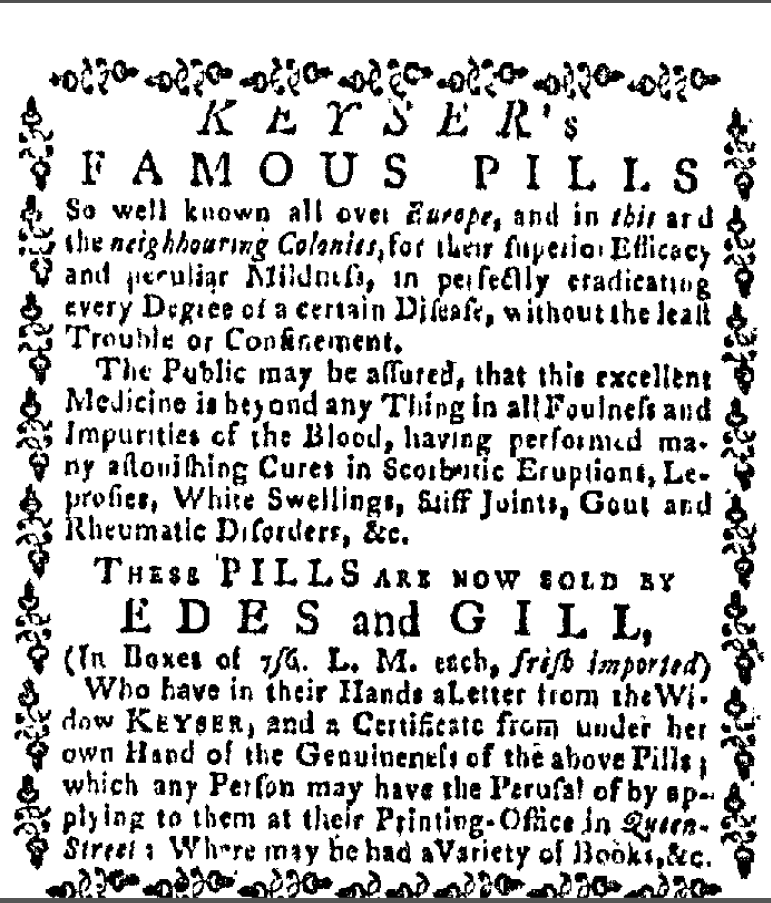
Boston Gazette, February 14, 1774.

Edes and Gill sold Keyser’s Famous Pills, “So well known all over Europe,” and promising much, like Cures for Scorbutic Eruptions, Leprosies, White Swellings, Stiff Joints, Gout and Rheumatic Disorders, etc.” I don’t know about you, but I think I’d prefer to have my scurvy treatments separate from my arthritis treatments.

Ultimately, the best option was probably a crutch or cane, though braces were devised and are still used, along with crutches and canes. All that prevents their use or efficacy is the vanity of the user.

Camp Followers or Women of the Army?

Soldiers and Camp Followers Resting from a March. Jean-Baptiste Pater, 1730. private collection. used from Wikimedia Commons.

I prefer woman belonging to the army, or “regimental woman,” which sounds like Mick Jagger or Roy Orbison could sing it, but one could have a pretty lively discussion of which term to use. Camp followers has a connotation–prostitute–that doesn’t reflect the full reality of army life for women in either the British or the Continental armies.

Were there prostitutes who took advantage of the proximity of a large customer base? Yes, undoubtedly. In the John Robinson Waterman Papers there is an unusual letter from Col. William Battey dated October 28, 1812 with a sketch of the army camp near Albany and a description of camp life. This description includes the treatment of a woman accused of prostitution and summarily banished from camp. I think she was beaten and half-drowned, so the army took the no-prostitutes-whatsoever dictum very seriously.

As far as cooking goes, a commenter elsewhere explained that women would have been cooking, at least for themselves. Typically, they did not cook for the soldiers’ mess, unless they were being paid to. This must have been a difficult situation for the Continental Army: when women were present, it made excellent sense to assign them all possible non-combatant tasks to ensure the maximum fighting force. But could discipline be maintained? Not always, given Bridget’s temper.

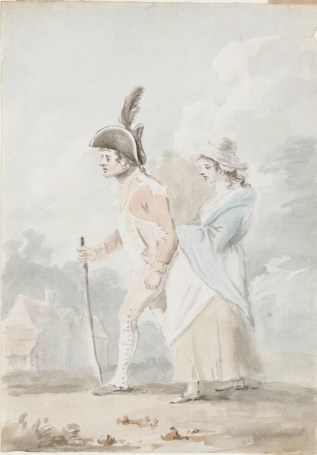
A soldier and his girl. Henry Bunbury, ca. 1794. Lewis Walpole Library, Drawings B87 no. 8

Rolling back a bit and trying to consider the army’s structure and camp layout, what are the mechanics of handling rations for women with the army? How are they fed? And did it vary, unit by unit? There is probably far more variation than we credit, that will only be illuminated by careful attention to the documentary record. That means finding as many victualing rolls and returns as possible, looking for women. It means reading all the orderly books that can be found, looking for women.

The best secondary source I know for the Continental Army’s women is with Holly Mayer’s book, Belonging to the Army. (And I’ll admit I haven’t read it in two years, so it’s time to re-read it.) If you’re British, I’m not in a position to help you as much, but there is Don Hagist’s work on Women of the British Army. For a more granular understanding of women in all armies, you have to turn to primary sources, and what’s available varies from unit to unit, state to state. There is a handy index of orderly books,  and while these vary in their utility, they are a good place to start. In fact, the whole RevWar 75 site is useful (though it is not loading at the time of this writing).

Soldiers’ diaries and accounts are also useful. Jeremiah Greenman of the 2nd Rhode Island Regiment recorded his experiences throughout the entire war, starting in 1775, when he joined Arnold’s expedition to Quebec. There were two women on that expedition, attached to two different companies. While there is not a plethora of detail about the women, it is clear that they were strong and able, and in one case, more able than her husband.

Camp Life

The Jolly Landlady in Hyde Park. Paul Sandby, 1780. British Museum 1904,0819.622
The Fair Stationer in Hyde Park, 1780. Outline engraving by Paul Sandby. British Museum 1880,1113.1915

Still wondering what to do in camp that’s not cooking or sewing? Technically, you shouldn’t be cooking if you’re a woman: that was a soldier’s job, though I recall seeing a reference to women cooking when all the men were pulled into the line during an engagement. A card file would help me, but for now, all I have is my scattered memory.

But if you’re tired of mending and making shirts (one of the most boring tasks, I find– all straight seams and very predictable), there’s more to do than laundry.

If the event represents a longer encampment, you could run a traveling coffee house or tavern. There’s the Widow Black in the Mid West, but I haven’t encountered this yet in New England. You could be a Jolly Landlady, or as the British Museum has it,  “a voluptuous lady stands in foreground to left, holding up a glass to a soldier on horseback.”

The Fair Stationer in Hyde Park 1780. Outline etching with watercolor, Paul Sandby. British Museum 1904,0819.576

The Fair Stationer shows us Lloyd’s Coffee House and what looks like a carriage body on blocks, converted to a news stand. You could sell newspapers and writing paper, pamphlets and poem and songs. It’s an impression that would take a lot of thinking and research for the American colonies, but could be very interesting. the transmission of news and information and the transport of mail and packages presented challenges. How were they overcome?

I’m also struck by the number of dogs in Sandby’s images. If it’s not the same dog, over and over, I would guess that in the 18th century as in the 20th, soldiers had pets that traveled with them, both common soldiers with common curs and officers with hunting dogs. The camps must have been disastrously messy, with fatigue details to clean them.  We can’t have dogs at reenactments, but we could have more outraged sergeants. It’s hard, though, because to do these things well, you have to know and trust the people you’re doing them with (and that includes yourself).

Light Housekeeping

Heavy Housekeeping: Piano Relocation

As new readers stumble along here, I thought it might be helpful to explain a few things, to explicate the process, if you will.

The Images

The images I post are, wherever possible, linked back to the holding institution or owner. When a full caption appears, chances are good there is a catalog record for the image. If the holding institution doesn’t have a database, or doesn’t have a good way to link to the image, there will be clues to the source in the text or caption. That way, if you want to share an image, you can click it and get the source to share elsewhere. Check Pinterest as well, usually there are even more images than I can fit here.

The Writing

While I conduct research for what I write and for the events I am part of, this is obviously not an academic blog. It’s a personal blog, and a conversation. I think by writing, so my posts tend to be process-oriented and more about questions than answers. The longer I live the less I know, and the more I am comfortable with uncertainty and the search for knowledge and understanding. You may not see the snow leopard. It’s OK. (I do recommend Matthiessen’s book if you haven’t read it.)

Jumping Snow Leopard by Emmanuel Keller

I try to give my sources (sometimes as footnotes, sometimes in the text; this is a blog, I don’t always follow the Chi Man of Style) so that you can verify what I find and reach your own conclusions. Most sources I use can be found on Google Books, or the Internet Archive so that everyone can enjoy the digital surrogates; I also try to link to holding library catalog records where digital sources do not exist. Please forgive me: I am not the greatest proofreader at 5:00 AM when many of these posts are written.

I pad stitch like crap, but it’s getting better.

The Sewing

Talk about your work in progress! I’m still figuring all of this out, and I expect I always will be. Grab your popcorn, I will be doing something stupid any minute now on a garment I need in very short order. Again, what I think is true is that 18th and early 19th century tailors and sempstresses had a vocabulary of stitches, materials, and techniques that they commonly used in a variety of ways. There will be typical constructions and idiosyncratic assemblages. Some garments will be a mix of both. Welcome to idiosyncratic central. This is about the process of figuring things out, gaining knowledge and increasing ability and understanding. I try to understand how I would have sewn in the 18th century, which  means not even as well as an 8-year-old would have constructed clothing in 1770.

The Topics

I have my obsessions, you have yours. Historic laundry processes, living history, poor women, cats, museums, art, books, construction, the spectacle of the art and antiques market…you’ll find I jump around. Think of it as a restaurant with a varied tasting menu built around a few key ingredients.

The Attitude

Snotty and snarky? Yes. But because I know some folks read this at work, you are spared my customary in-person profanity despite the mighty effort it takes some days to resist writing like Rebecca Schuman. Especially when I write about the art and antiques market.

The Philosophy or Mission

Be excellent to each other. Practice kindness. Share your knowledge.

Thank you for reading and commenting. I really do appreciate it. Now, where’s that snow leopard?