As you would expect from recent reports, the Young Mr has outgrown almost everything he owns, with the exception of his shirt. I put a lot of time into that blue wool jacket, so I’m not ready to sell it on Etsy yet, but I do have to replace it. Sewing new things means I get a chance to look again at sources for inspiration, and to do better this time around.
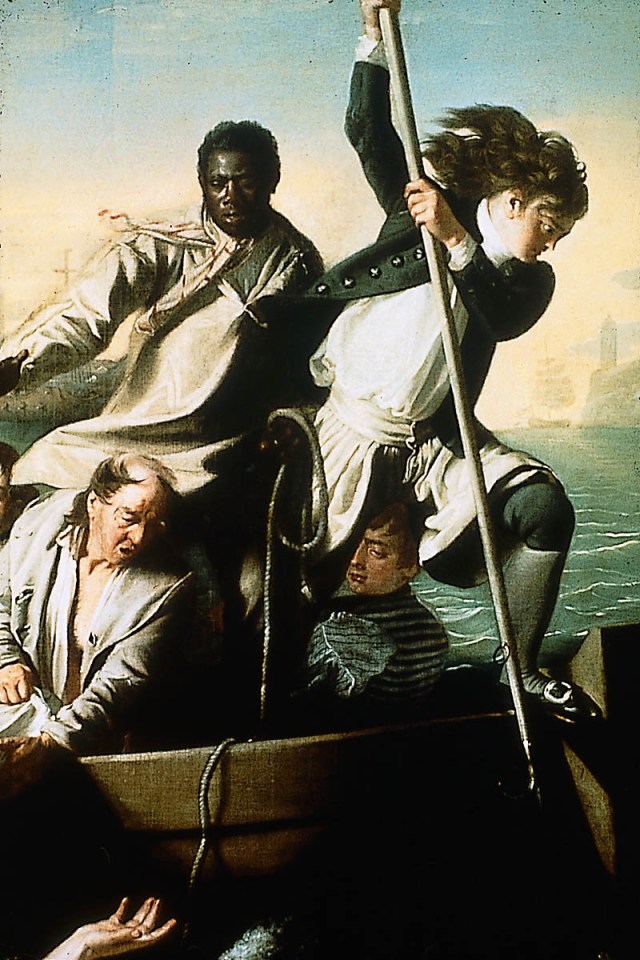
Since we’re in summer, I’m thinking blue linen, since I have access to very local inspiration in the form of Oliver Hazard Perry’s short jacket. But for earlier ideas, there’s Copley. I particularly like the horizontal stripe on the waistcoat, and what seems to be a striped shirt. Striped shirt! How exciting is that?
I’m thinking striped trousers, based on a Massachusetts letter, but we’ll see how far I get with that. The final deciding factor in wearing, of course, could be striped trousers are better than no trousers.
I think it will take a fresh generation with no memories of the 1970s to revolutionize studies of the American Revolution. What do the rest of you think, those of you who remember the 1970s as well as those of you who don’t?
They are half my age and already exceed me in sewing skill. They find new cultural nuggets I have never seen before.
I’ll see your camp kitchen and raise it a malnourished goat and acorns. (image from Drunk Tailor)
And that– younger people are finding new things–reminds me of Historiann’s post.
I could say we’re all standing on the shoulders of giants, but it is more about perspective, different ways of looking, and openness. The schisms are not just generational, but philosophical.
None of these breaks fall neatly, of course, but crack and splinter along desires and motivations. As long as you are willing to keep learning and changing (i.e. researching and making) then you’ll keep pushing at the edge of the interpretive envelope and that can only help push understanding of all kinds forward.
Madora [sic] water color by Maria Caroline Temple ca 1800. Inscribed Maria C. Temple. delt.’ and ‘Vide “Young Philosopher.” British Museum 1869,0612.599
I was looking for images of maids in 1800, and came across this in the British Museum. Having no idea what Maria Temple meant by Vide Young Philosopher, I went searching. Turns out the answer is surprisingly easy: It’s a novel published in 1798 by Charlotte Smith. So it seems that what Maria Caroline Temple did was to draw a scene from a novel she’d read. I was delighted by this, as something I used to do a long time ago was to draw scenes from books I had read and loved.
With a publication date of 1798, I think we can feel pretty confident in the British Museum’s ca. 1800 date; what I was looking for was a non-satirical illustration of a maid in 1800: what did she wear, how did she comport herself? not because I haven’t been a maid in 1800 before, but because I need to be a better maid in 1800.
The things to love in this image, aside from the clothes, are the checked slipcover and window drape, the brass lock on the heavy wooden door, and the view through those wavy panes of glass. I don’t love the wallpaper, but I appreciate the evidence of it– but not as much as I appreciate the hint of drape matching that raucous slipcover.
Now I just need to hunt down an affordable copy of this clearly dramatic and romantic work of early fiction, and to find out exactly what books were being read in 1800 Rhode Island.
Sylvia Lewis [Tyler], Diary (1801-1831), MSS 2899 in the Americana Collection of the NSDAR provides the basis for O’Brien’s article and my joy. It begins routinely enough with my favorite stuff– spinning!– and carries on to knitting: stockings, mittens, gloves, a hat or two, and even “comforters,” or scarves. Shag, or thrummed, knitting is mentioned, so at least those of us interpreting the world of 1801 and later can be war.
The real excitement comes on the third page: in the winter of 1803-1804, Sylvia Lewis cuts and sews a greatcoat. Then, in 1806, she makes a green Spencer, and in 1808, a black one.
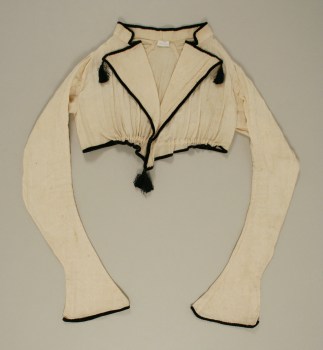
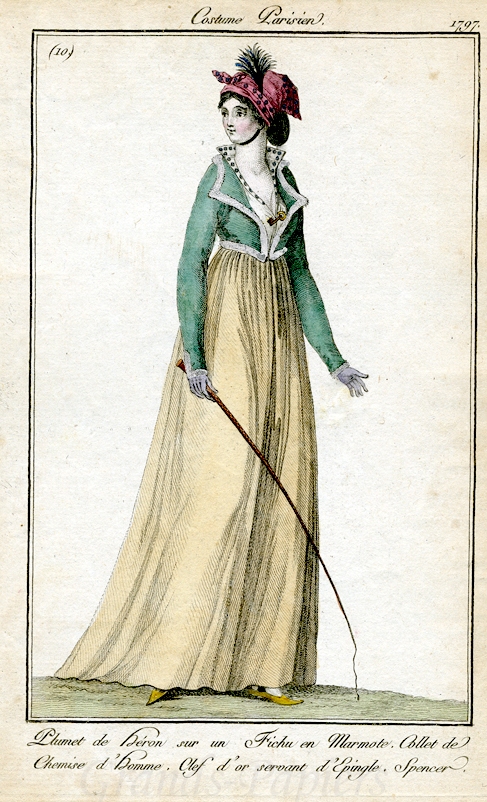
1806 is still later than I wore my Spencer. They’re shown in fashion plates of the 1790s, and here’s a pattern, too: so they’re clearly worn in Europe earlier than 1806. The similarity between the French silk spencer at the Met and fashion plates gives me confidence that they are being made and worn in the 1790s and early years of the 19th century; Spencers are also mentioned in tailoring manuals of this period.
1797, with a similar shape to the Met’s French silk spencer.
But there’s really good stuff in Sylvia Lewis’s diary for anyone who wants to know more about clothing production, use, and costs in early Federal New England. Even if your Library doesn’t have it, your Librarian can get a copy of the article for you through ILL or you can buy the entire proceedings here.



![Madora [sic] water color by Maria Caroline Temple ca 1800. Inscribed Maria C. Temple. delt.' and 'Vide "Young Philosopher." British Museum 1869,0612.599](https://kirstenhammerstrom.com/wp-content/uploads/2023/03/89c0c-an00291773_001_l.jpg?w=640&h=610)



 Kirsten Hammerstrom
You must be logged in to post a comment.