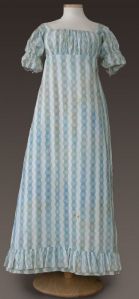
Day dress of roller-printed cotton, 1810-1815. Susan Greene Collection, GCVM 90.25
Lately, I have developed an obsession with this roller-print day dress from the Greene Collection At Genessee Country Village Museum. I first encountered it on the 19th US Infantry’s website, a haven for those of us consumed with the early Federal everyday.
The 19th US site provides more photos and a drawing of the dress, so that if one were to become impossibly obsessed with the dress, one could recreate it. And if one were up late nights, one might consider how to create a copper-engraved roller for printing cotton.
Johann Klein dress, 1810
A more productive line of thought might be to consider this fashion plate, found during an early-morning Pinterest session. I think it gives us a sense of how rapidly fashion crossed the Atlantic (just as quick as engravings could be printed and bound into magazines, and boats could make the trip), and how avidly women copied the latest fashion.
That avidity would have been tempered by access to fabrics, but the resemblance between the dress at Genessee and the fashion illustration is striking, indeed.
I’m close to being finished– all that remains are closures, but the sewing is done. It fits, though I haven’t yet tried it on over stays. It looks less wretched in the mirror than it does on a hanger, I will give it that.
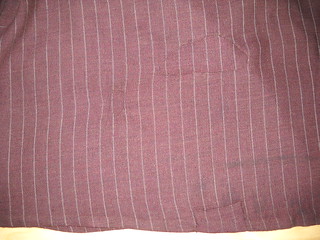
The wool is a yard and a quarter worsted remnant, and while it has a nice hand, it was sometimes annoying to press. It may have been the fault of the silk, though; I used a very light weight silk–even lighter than Booth’s “persians”– and that was probably a mistake.
Last-minute peplum and button additions.
The Swedish Spencer closes with clasps, and while hooks and eyes are pretty common for center-closing garments (men’s and women’s) “clasps” was new to me. The double-breasted riding habit coat in Janet Arnold (from the Salisbury Museum, no photos online) closes with covered buttons. That seems reasonable for this worsted trial garment. I’m beginning to wonder if the Swedish Spencer is really finished, or if the clasps might be a later addition. Time to write a letter, I think…
After a day at the Met on Friday, I went to work at my own museum on Monday. We moved paintings, rounded up miniatures for photography, and packed an ax for transport.
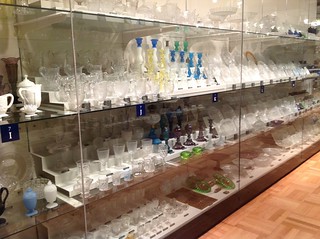
Glass at the Met. I hate this stuff.
On Tuesday, I took the MBTA up to Boston to deliver the ax (tomahawk, throwing ax, ax comma belt in Chenhall) to another museum, at the Old State House. I think this show will be very nice, and I had the pleasure of meeting someone whose wife I know through the interwebs: behold the power of the interwebs, and the small size of the reenacting community. Also, my state.)
Then, because I cannot get enough of this stuff, I took the Green line over to the MFA. By now you’re thinking, Kitty, really? How many museums do you need to visit in five days? Should we get you help? But the thing is, objects get me really stoked. Paintings, sculpture, heck, even glass– and I hate glass– make me pretty happy.
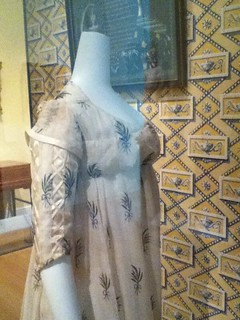
1998.96, overdress or tunic. MFA Boston
I’d just been to the MFA in July, so this trip was to visit some friends among the Copleys and Greenwoods and Blackburns. But I also know that the textiles have to rotate often, and there are dedicated mannequins in the Art of the Americas Wing. My reward for a return trip? This lovely over dress or tunic.
I love the fabric, and thought immediately of Quinn’s Tree Gown. Hmm. As you can imagine, I will be hot on the trail of something like this fabric as soon as I am done with the menswear on my list. (There is a lot of menswear, but that doesn’t mean I can’t do some real thinking and research in preparation for this tunic…which is all I can do for now.)
It does cross over in the front, and the floral motifs line up across the layers.
There are more photos of the overdress in the MFA set on flickr, and I have a lot more thinking to do about this tunic. It does have a cross-over front, which I like, but the lacing is really striking. This may take another trip to the MFA with a better camera.
Oversleeves, cross front, lacing, diamond-shape piece in the back like a keystone…there’s a lot of detail, and lot to love (and eventually curse while making) in this tunic.
I managed to mend my dress this weekend, motivated primarily by its odor and the desire to hang it up for an airing. The holes at the hem were such that the patch had to be applied over the fabric and not behind. It tends to wiggle, but the mends are done and the dress is hung up to “air,” which means it is “in the drafty front hall trying to make my coats smell like wood smoke, tallow, and animal secretions.”
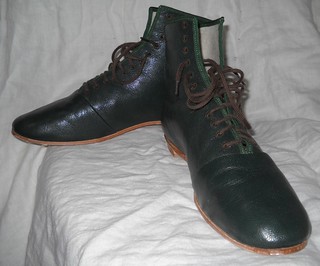
I told you my feet were big.
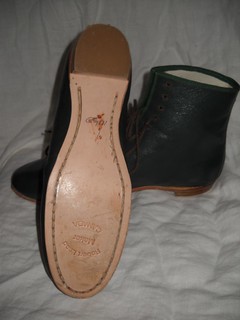
The Robert Land shoes arrived on Saturday, along with a heavy box of wool. That’s tucked away for now (trousers and overalls come first, oh my) but not the boots. Ignore the size marked on the sole–that’s a vanity size–but note the smears. I believe that for the shoemaker, as for so many of us, the historic item is not done until you have bled upon it.
I should note here that the shoes really make ones feet look like the feet of women in fashion plates. Those trippy little poses with dainty toes are achievable in these, and the minute I find someone to photograph that, I will. It’s a very different foot experience from 18th century buckle shoes.
It’s not done until you’ve bled on it.
In a mark of solidarity, I bled on the ribbon that’s going on my new bonnet. I spent Saturday making, and unmaking, a remaking, a late 1810s bonnet. I’m still not quite satisfied with the shape, but have the silks and ribbons ready for when I convince myself to go ahead and stitch it up. Sunday I made a late 18th century/early 19th century bonnet. After bleeding on the trim, I finally had the sense to stop.




 Kirsten Hammerstrom
You must be logged in to post a comment.