More than Just a Pretty Hat

While pretty hats were pretty important parts of the milliner’s trade, many more things were sold in a millinery shop.

Colonial Williamsburg’s Margaret Hunter shop is probably the best-known living history milliner’s shop, and they provide a nice definition and explanation of the trade. But that’s never enough: what’s the primary source information for New England milliners?

While there is documentation of a Rhode Island milliner in the 1830s, and even a thesis on her work, Sew 18th Century and I are working on an earlier shop. I started with Rhode Island newspaper advertisements, because I like the sound of “lately arrived from Providence,” and because I understand that context.
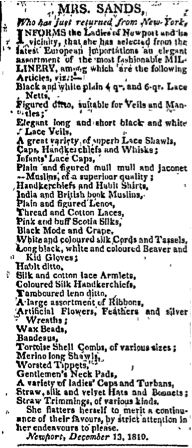
The Rhode-Island American, December 25, 1810. III:20, p. 1
The Rhode-Island American, December 25, 1810. III(20), p. 1

Here is Mrs. Sands, just returned from New York to Newport and vicinity, with a long list of things for sale, “selected from the latest European importations, an elegant assortment of the most fashionable MILLINERY.. viz,:–” (you have the love the punctuation, which is like the Chicago Manual of Style on New Republic crack)

What is she selling? In addition to what we think of as traditional millinery, the “variety of ladies’ Caps and Turbans, Straw, silk and velvet Hats and Bonnets; Straw Trimmings of various kinds,” listed at the bottom of the ad, Mrs. Sands carries:

  • Lace Shawls
  • Caps, Handkerchiefs and Whisks;
  • Infants’ Lace Caps
  • Plain and figured mull mull and jaconet
  • –Muslins, of a superior quality;
  • Handkerchiefs and Habit Shirts,
  • India and British book Muslins,
  • Plain and figured Lenos,
  • Long black, white and coloured Beaver and Kid Gloves;
  • Silk and cotton lace Armlets,
  • A large assortment of Ribbons,
  • Artificial Flowers, Featehrs and silver Wreaths
  • Tortoise Shell Combs of Various sizes;
  • Merino long Shawls
  • Worsted Tippets
  • Gentlemen’s Neck Pads

Whew! That’s a lot of stuff, and many different kinds of things, though all broadly in the ‘accessories’ or supplies range. I am delighted to see Habit Shirt on the list, as I buy my chemisettes, and I am intrigued by the range of handkerchiefs and by the Tortoise Shell combs, in part because I did not buy an assortment of them at a shop in western Rhode Island a month ago (kicks self).

Newport Mercury, December 11, 1811. L:2593, p.1
Newport Mercury, December 11, 1811. L(2593), p.1

In the December 21, 1811 Newport Mercury, Mrs Sands again advertised her goods lately arrived from New York. This is a less exhaustive, but no less interesting, list. “Ladies elegant green velvet mantles, with and without spencers” is particularly intriguing for a Spencer fan, and not particularly clear to me.
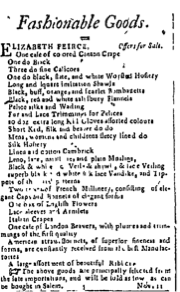
November 21, 1812. Essex Register

In Salem, which is where we will be in August, Elizabeth Pierce advertises her “Fashionable Goods” for sale. She, too, has a long list of things she will sell, from Canton crapes to imitation shawls, hosiery, lace sleeves and armlets, one box of English flowers, and American Straw bonnets.

I suspect that just as retailers do today, milliners of the late 18th and early 19h century probably had an assortment of things designed to bring buyers in to shop (new bonnet styles), and small items to tempt them into impulse purchases (English flowers). You can’t buy a new bonnet every week, but you can refresh an old one.

Frivolous Friday: Fashionable Reading

Anna Maria von Phul’s delicate watercolors of Saint Louis in 1818 (example at left) remind us that cities in the hinterland of America have never been as far behind the times as coastal dwellers might imagine. As a former resident of the Great Fly Over, I know how defensive people can be about their relative sophistication, and that could be why our Young Lady here appears slightly defensive in her posture.

The young lady is certainly fashionable in that white gown, and literate, too, though we cannot see what she is reading; perhaps Maria Edgeworth.

It took some doing to find a similarly posed and dated fashion plate with a book, for fashion has always been more fantasy than reality.

Criss Cross

Dolly Eyland, by Alexander Keith, 1808. (c) The New Art Gallery Walsall; Supplied by The Public Catalogue Foundation

I like Dolly. The colors, the textures, the style of her gown, shawl and cap all please me. She’s rocking some serious class for a woman headed towards a certain age. And she’s wearing a cross-front gown, which is what I settled on for my Quaker costume. 

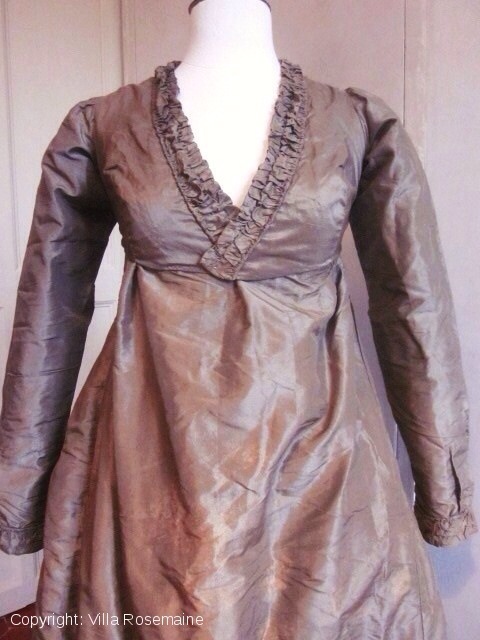
Taffeta dress, ca.1800-1810, Originally found on Villa Rosemaine site, where it does not appear now.

The trouble with making a gown based on an artistic sketch in a book is that you don’t have the most complete sense of what that garment looks like, or how it goes together.

Not to worry, I went ahead anyway, because this is as close to Everest as I will ever get.

But I wanted comparable garments to help guide me. Ages ago I found the gown at left on a French costume site. That’s helpful, in that it explains the trickiness of assembling and wearing this style of garment. Three pieces coming together in the front may be one piece too many. 

In making up my pattern, I used the pattern for the Spencer as a starting place because I knew that the set of the sleeves and arm scye were what I wanted. No reason to re-invent that process!

That left me with the luxury of concentrating on the neckline.

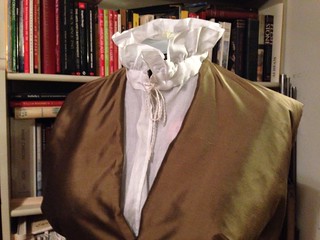
That took a few goes with the tracing paper and muslin:  I did lose count after a while. There may have been tears, there definitely was swearing. Mr S at one point made jokes about this process appearing on the Discovery Channel’s “How it’s Made” as “the Quaker dress.” He’s really very patient, and I do understand the selective deafness he’s had to develop as a defense against the dark arts of sewing historic clothing.

Thank you, Cassidy, for the chemisette!

Eventually, I had a decent lining and even some silk bodice fronts. I fiddled with the fronts, and settled on gathers instead of pleats, but couldn’t quite figure out where the casing went. Some days I can process drawings into objects, some days I can’t. I’d just about reached the point of cutting it all up into the gown I always make when I discovered that the excellent women of the 19th US had patterned the gown from the drawing, too. (If you don’t already use this site, I highly recommend it. Excellent work.) Those pattern pieces look like my pattern pieces, so I decided it was worth carrying on with what I have.

Haversack Stashable Lunch Bag

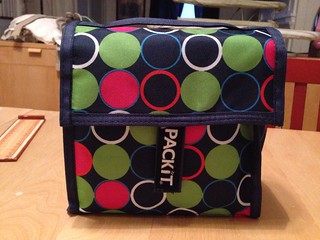
Found in the clearance aisle at Home Goods.

Mr S destroyed his lunch bag (zipper failure) and since I sew in a pre-zipper era, I declined to hunt up a new zipper and set it into the weird amalgamation that is the modern insulated lunch bag. I can’t even remember how old that lunch bag was, but it might have been six years old. So out we went for cat food (which happens a lot) and a lunch bag.

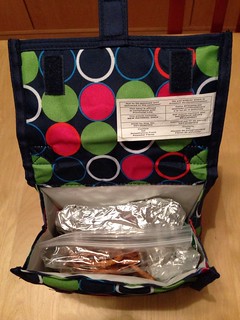
Just don’t get caught with tinfoil and plastic baggies if you’re eating in breeches.

This one seemed like it would be too small, but it does hold his entire lunch. And then I realized it would fit nicely into a haversack if one needed to pack a cold lunch on a hot day. You just have to be stealthy when opening the thing, at least until the velcro gets linty and quieter. This bag is lined with freezable something that serves as the ice pack, which does save space and should be more efficient and safer on a super-hot summer day (I’m looking at you, Cambridge in July.)

And, as ever, if you wrap your meal in tinfoil and baggies, hide it from the public. The best way to use it at an event would be to pull paper- or linen-wrapped period food from its hidden, chilled (shallow) depths. If you are not in the army, it goes in your market wallet, linen bag, or basket, not your haversack. Now, perhaps those cats can help me silence the velcro.