Style Council

National Gallery of Art furniture gallery, May 2017

One of the critiques leveled at historic house museums is that they’re often “frozen in time,” specifically a particular moment, rather than reflecting the changes that happened over time. This charge is sometimes leveled at period room installations as well, when all the furniture in a room is from a tight time span– a year, maybe five– when for most of us, the furnishings in our homes and the clothes in our closets reflect a number of years, rather than a tight twelve or eighteen months.

So, when we go out “into the field” (or the house or the milliner’s shop or the tavern), shouldn’t our belongings reflect the multiplicity of years of objects? If I’m a woman Of A Certain Age, won’t I have possessions, from jewelry to ceramics to clothing, from multiple decades? Well…. yes and no.

It’s true that as far as we can tell, John Brown moved his 1760 furniture into his 1788 mansion, but we also know he bought new furnishings, including a large (188+ piece) set of Chinese Export Porcelain (see above).

Up-to-date, stylish, expensive: table settings signaled wealth and sophistication as much as clothing and manners, so whatever JB had before 1788, he wasn’t setting his new table with it. What might he (or Mrs B) have done with it? Consigned it to use by grandchildren and servants? Given it to less fortunate relations? Possibly. And if they had creamware, it would not have been singularly out of place in 1788 or 1800 on any table– it was only 40 years old, and heaven knows my “best” china is from the 1930s– but would they have used earlier pottery, even in the kitchen?

All pottery is not the same: North Devon pottery, while imported to North America in the late 17th and early 18th century, is not what you would expect to find in a late-18th century farm kitchen. It’s here, sure, into the mid-18th century, but in 1799, it’s not the form you would expect to see. So what does that mean for living history folks? Does it matter what you use?

You know what I think: there ain’t nothing like the real thing and that means paying careful attention to details. If you’re portraying a camp follower in 1778, or tenant farmer in 1799, you are not likely to have, say, a Jackfield-type figured tea pot, just as you are not likely to have a salt-glazed squirrel-relief cream jug, no matter how much you adore it.

Time and style matter. The people of the past read each other the same way we read each other. Remember Clarice Starling, with her “good bag and her cheap shoes”? Get on a train anywhere, and you can read your fellow travelers: you can guess income and education levels, marital status, and sometimes interests and hobbies if you look closely. You make assumptions about people based on their appearance, whether you’re conscious of it or not– and so did the people of the past. To portray them accurately, and to help the public learn to read the past, the details matter.

History Hurts

We have been here before: terrible stays, stays in need of minor mods, and “it isn’t history till it hurts.” New this past weekend was the Busk Bust Blister (Bursting) which didn’t make History hurt, but sure did bring a sting to the wind-down afterwards.


These new stays are, so far, the best I’ve ever had and well worth the blood, sweat and swears it took to make them. Gowns do seem to fit better over these stays; they held up well at muggy Monmouth and in polar Princeton, but the last two rounds at Ti left me feeling like I’d taken a hoof to the ribs.

What gives, kidneys? At least this time I made it past Fort Ann and all the way into a private room in Glens Falls before I had to free the sisters and release the lower back.

IMG_7298

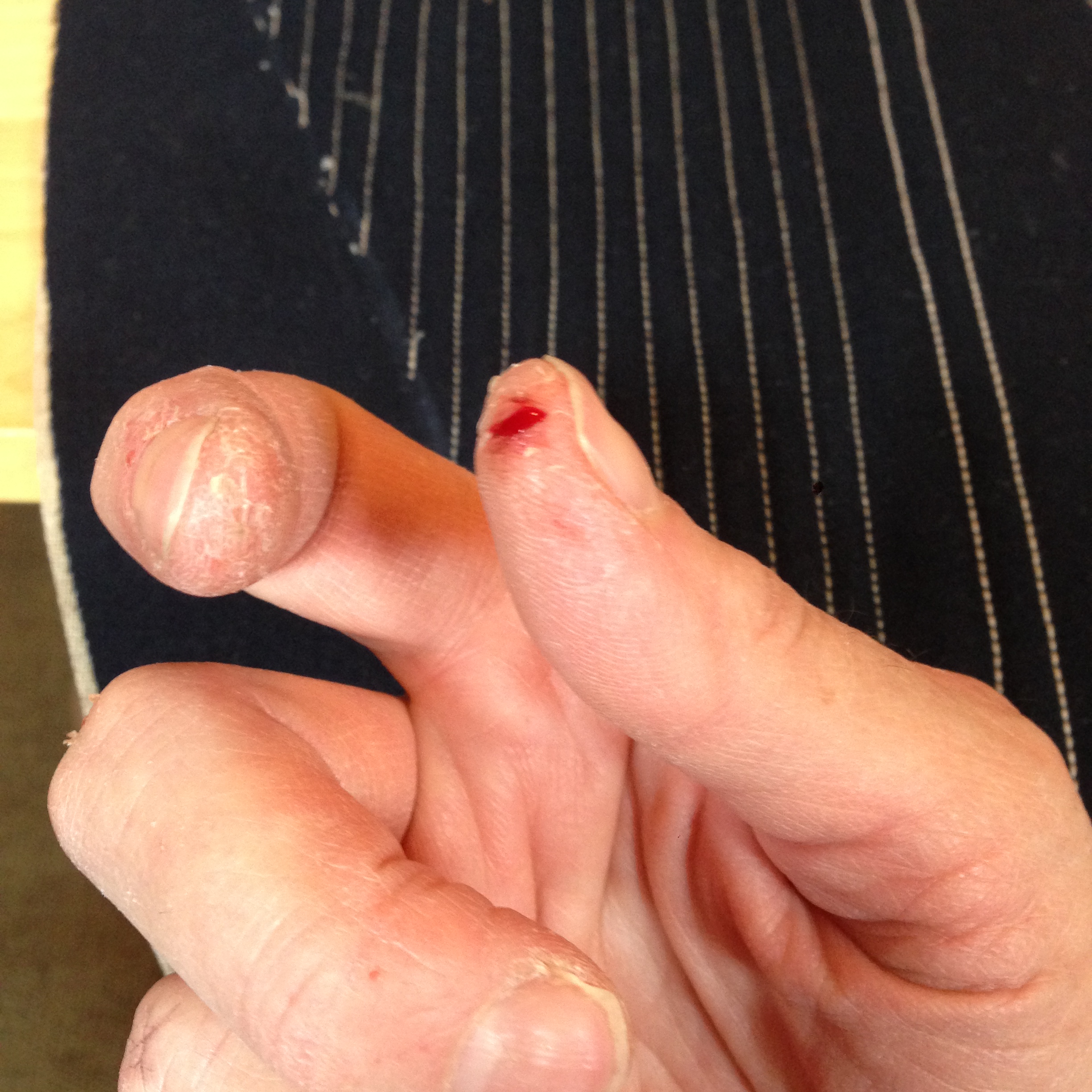
But this time, there was a bonus: the previously indicated Bust Blister. On the left side (I’m right handed), I developed a fairly robust .25” x .125” blister that crowned the top of a nearly 2” red mark, mirrored on the right by a less red and slightly less long mark. The culprit?

The Busk of Doom, of course.


dscn4568

Strictly speaking, I should not sport a busk when I desport as Captain Delaplace’s serving woman, or as a refugee cooking up the last of the bread, eggs, and milk. I’ve earned these marks and (potential) future scars by dressing above my station, and need to adjust accordingly.

Step one: Rounding down the busk edges (now in the capable hands of Drunk Tailor).
Step two: Foregoing the busk when working.
Step three: Wearing partially-boned stays when working.

Two is the easiest; three is the hardest. Which do you think I am, therefore, actually contemplating as a necessary next step?

But of Course: Step Three, Pathway to Finger Cracks and Stained Stays.

d'oh! surgical tape made this *much* better later.
d’oh! surgical tape made this *much* better later.

Fortunately I have people close to me who will ensure that I work through steps One and Two before embarking upon step Three, but I certainly want to know more about (and will look much more closely at images of) working women in the third quarter of the 18th century. My suspicion is that women who are performing labor that requires movement– up and down before a fire, back and forth across a floor, bending over a tub– may not be wearing stays made in exactly the way high style stays are made for ladies who bend over an embroidery hoop, glide back and forth across a ballroom floor, or move up and down the stairs of a well-built home they supervise.

Or my busk pocket is too big, my busk edges too square, and my actions too fast and continuous.

Paul Sandby. At Sandpit Gate circa 1752 Pencil, pen and ink and watercolor. RCIN 914329
Paul Sandby. At Sandpit Gate circa 1752
Pencil, pen and ink and watercolor. RCIN 914329

What are these women wearing? They certainly look fully boned. What can I change to make my stays work better for working? No matter what, where there are variables, there are experiments to run, and that’s what really makes history fun (even when it hurts).

My Life as a Chair, or, Warm in Winter

Can I get an “Aw, yiss” for being warm outdoors?

img_8826
After the aftermath. Photo by Drunk Tailor.

They may not be the most accurate <cough>machinestitchedoffabolt<cough> quilted petticoat and waistcoat, but they sure do make a difference.

These aren’t exactly base layers– a white wool flannel shift would not be amiss–but the quilted layers make a big difference to a day in the cold. When I added up the layers, I came to 8 without counting accessories like neck handkerchiefs and stockings:

  • Shift
  • Stays
  • Waistcoat
  • Lightweight Wool Petticoat
  • Heavy Wool Petticoat
  • Quilted Petticoat
  • Gown and Stomacher
  • Cloak

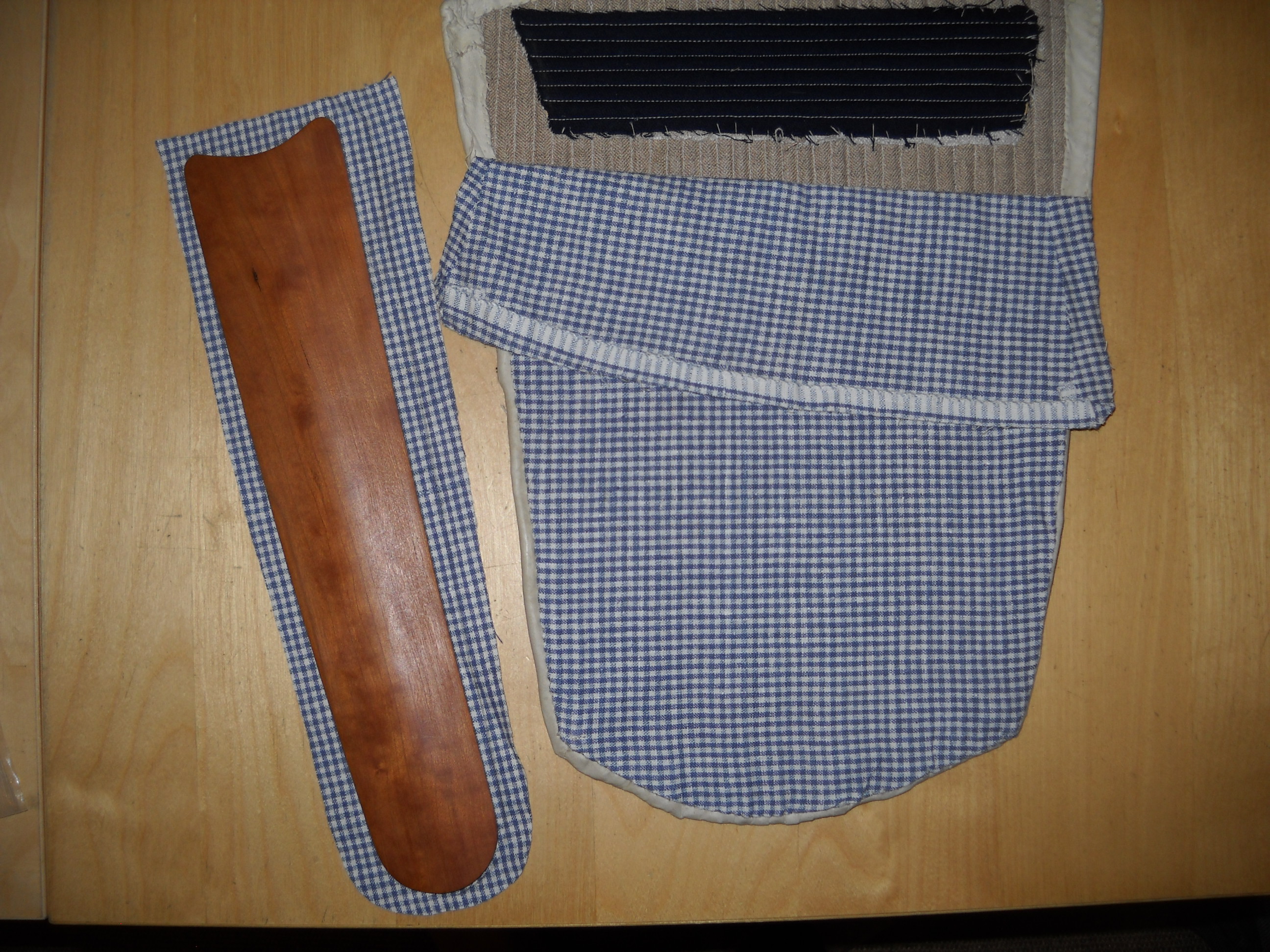
It isn’t always pretty, but in cold, wet weather, function trumps fashion (not that I’m not pretty pleased with this upholstery). The waistcoat ties on, so you have some adjustment should your weight or shape fluctuate. The petticoat, in this case, works like every other petticoat, with the sole exception of a short pocket slit on one side due to operator impatience (this was finished just a few days before it needed to be packed for Princeton).

img_8823
Thanks to Drunk Tailor for more patience.

The quilted fabric (originally intended, I am sure, for a bedspread) is lined with a plain weave wool for extra insulation and body; the waist band is bound with wool tape, as is the hem. Down in the basement, there’s a camblet- wool batting- linen lining sandwich on a frame, ready for quilting, if I only I would drag it up stairs and start, and I know it would be both more insulating and more accurate.

Does it all fit? Well…pretty much! An open robe with stomacher makes it easier to fit all these layer underneath, and, happily, I don’t have the best sense of my own size, so my clothes tend to be a little bigger than they must be. Fortunately, historical clothing generally involves adjustable closures that make fluctuations and layering easy to accommodate.

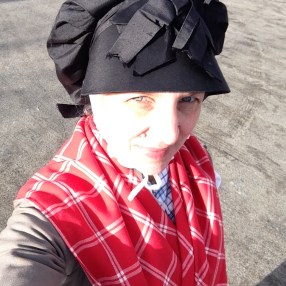
After Anna B’s and Anna K’s comments on the overview of the event, I was reminded that these are the confessions of a known bonnet-wearer, and I will humiliate self for history, so in case you are wondering: no, I didn’t wear drawers of any kind, or leggings, or long underwear. A pair of silk stockings under a pair of wool stockings kept my lower extremities warm, but my nethers were sometimes chilly, in a highly specific, localized, but small way. I think this may be where the wool shift comes in– or one that fits a bit better than my current garment, which is a tad too large.

On the porch at Morven, a range of head coverings. Photo by Matt White
On the porch at Morven, a range of head coverings. Photo courtesy Matt White

When it comes to ears, you can see that we adopted a range of solutions. Ear-covering caps under bonnets, under straw hats, and under kerchiefs, were worn by some. At far left, my cap perched on top of my head, so I tied my bonnet on with a kerchief and pulled my hood over all of that. Mistress V (at far right) wore a cap, a kerchief and a hat (which was summarily removed in the afternoon, by Mistress S at her left). Mistress F, holding the cream colored blanket with a wide black stripe, wore a wool hood over a cap and under her straw hat. Wear enough layers– and the right layers, meaning mostly wool and silk– and you will be warm, perhaps even sweaty if you’re active. Still, I might trade in my “Hobo Woman of Princeton” look for a quilted silk hood if the right one came along.

Fashion, Fantasy, and Intention

Fort-based: as military as I get.

I am not a costumer, not really. But I’m not really a re-enactor in the classical sense: I no longer roll with a military unit and my military experiences are typically fort-based domestic activities. My favorite events have me representing women’s work in the past, the quotidian experiences of ordinary people. Documentation is my thing: what happened on a particular day, in a particular place. Who was there? What were typical clothes? The foods in season? The gossip of the day?

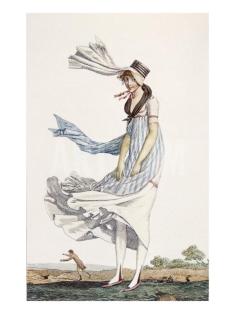
A Lady's Summer Promenade Dress, 1800.
A Lady’s Summer Promenade Dress, 1800.

And yet. Everything I do is really a fantasy, even when it’s work. We are not [yet, always] using the actual words people spoke or wrote. We typically inhabit characters who are grounded in fact but for whom we do not have full documentation. We are representations. We are playing, more than we are being.

I could easily be persuaded to take a walk along a sea wall  or coast to collect seaweed samples for pressing. This would inch me into Austen territory, especially if my friends will join me. I’ve even gone to the lengths of acquiring an appropriate hat, and to make another gown is but nothing in the pursuit of happiness.

Mary Gunning, Countess of Coventry. Jean-Étienne Liotard,.
Woman in a Turkish interior Pastel on vellum, Jean-Étienne Liotard, 1749. Museum of Art and History, Geneva.

If I could truly be a fabulist, I might be tempted to adopt a style a la Turque, for a portrait by Copley or for my paramour. This portrait by Liotard– who was known for his Ottoman works—  is a great temptation, with her patterned overdress and belt with golden clasps, though she is thirty-three years earlier than The Abduction from the Seraglio, Mozart’s comedic and trendy 1782 opera.

If I made myself a Turque (and Reader, it is tempting though useless), I will confess it would be for the multiple pleasures of wearing it, knowing why it had been worn in the past, and for the pleasure of having it taken off me. Because we forget what the European fascination with exoticism and Orientalism meant: they meant sex. The Abduction itself is, in essence, a tale of sex trafficking.

And that is something we do forget about the past, that the clothing we adopt as we portray the past had meaning– sometimes a meaning we miss, when we layer costume upon clothing. Wives and mistresses alike were portrayed a la Turque, and some theorize that this style of portraiture was chosen to portray the sitter in timeless, classic dress. For Copley’s sitters, it was a way to be at the height of London fashion; for Lady Mary Montagu, Turkish dress allowed her to travel freely in the Ottoman Empire. But portraits of women in Turkish dress situated in Turkish interiors were also allusions to polygamy and to sexuality, and there is no way of escaping the fact that paintings of women were largely made for men.

So what, then, of fantasy dressing in the past? What sense can we make of historical representations of “Oriental” fashion? How do we understand what our clothing and our appearance means? Every choice we make is layered with meaning, in the present and in the past.  For women, routinely objectified by society, the meaning of our clothing is particularly important, even when, or perhaps especially, when it is not what we want to focus on.