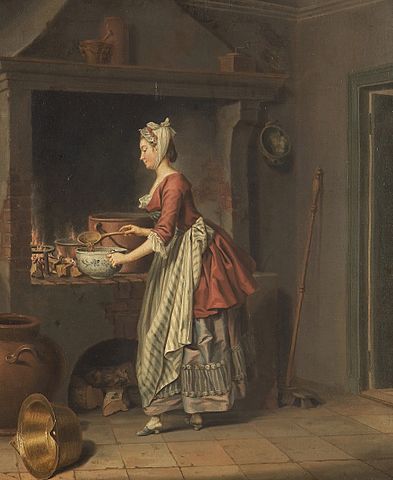
Consider the Chicken

https://i0.wp.com/farm9.staticflickr.com/8311/7995409969_f925f8a7eb_n.jpg
Nobody puts Dumber in a pot

With apologies to the late David Foster Wallace

The majority of us do not consider the chicken. We may consider whether the package of chicken we purchase is free range, organic, cage-free, grain fed, cruelty free. But we are unlikely to think about the implications for the physical being, the essence of chicken-ness, that the chicken’s conditions create for it.

And I am here to tell you that the cage-free, organic, free-range chickens and chicken parts that you purchase at Whole Foods or your other large vendors bear little to no relationship to the actual free-range, catch-as-catch can, ne’er-do-well chicken of the historic barn yard. For one thing, living history chicken is ripped.

https://i0.wp.com/farm9.staticflickr.com/8205/8243387583_072e352ff9_n.jpgIt’s well-developed physically, with strong, sturdy bones and robust ligaments. Its musculature is tight: this is not a bird in need of a personal trainer. Its meat, when cooked, is not white. It is dark meat, not so dark meat, and sort-of white meat. Its taste was described to me as gamey, but I disagree. It was chicken, but earthy, sweet and fresh and rich.

But all that came after the meeting of human, knife, and chicken.

Disassembling the chicken fell to me; I declined rubbing butter into flour having prevented a fall down cellar stairs by putting my hand in fresh goose guano, so I after I washed my hands, I addressed the chicken in its bowl, and took up a knife.
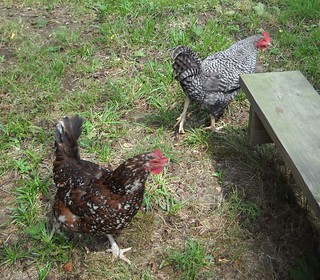
Dumber & Friend

By this time, post-carrots, -parsnips, -squash, -string, -tallow and -suet, the knife lacked the purest essence of knife, that is, sharpness. But it functioned well enough for the task, with some persuasion. The skin was much thicker and more resilient than a store-bought chicken, and greasier, though not in an unpleasant way at first. The muscles were well-developed, and pink. Rosy pink, deep pink, dark like wine. There were no large slabs of the shiny, flaccid, pale meat you find on the chickens in the store. Those aren’t chickens any more: those are products.

The process of quartering the chicken took strength and pressure on the knife, and the strength of my hands. I did have to rip joints apart, and break the carcass’s back. All of this had a sound, and a mild smell of chicken, mixed with the melting tallow. But it was the sound that, with the greasy, slick knife, and the grease that soon covered my hands and wrists, that kept bringing me back to what I was doing, and that, when the bird was broken apart and in the pot and my hands washed, again (they itched), send me outside and up the hill for air and sky.

We boiled the chicken in a kettle we’d already boiled crook neck squash in; later, we added sage, thyme, parsnips and carrots. It was delicious. The broth was incredible, and the whole meal very simple. That’s the whole of the recipe: boil a chicken, add herbs and root or fall vegetables, boil until done, serve. Use any uneaten broth and bones/meat for  stew, pie or other dishes. That’s it.

The product chickens from the market are bred to fall apart. They haven’t got what a running, pecking, eating everything chicken’s got in muscle, ligament, and tendon.

On Sunday, after we came home, I looked at the food in our cupboards. There were boxes, cardboard, plastic, layers of packaging. The cheese was square. These things came from the good market, but were they food, or were they products? I felt like a passenger on the ship in Wall*E, and I was appalled.
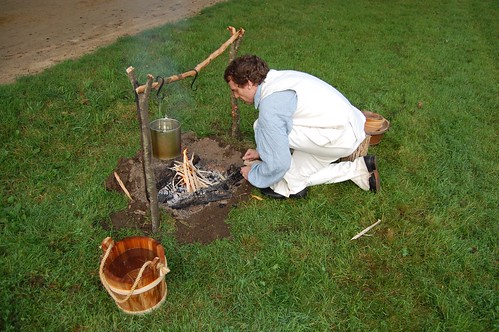
Camp Cooking

Our first overnight, camping-in reenactment went fairly well. Why the artillerists had to bring a concertina to a gunfight, I’ll never know, but a 2:36 AM rendition of “Good Night Ladies” was truly unnecessary.

The most important thing I can emphasize about reenacting in high summer is to stay hydrated. We brought the big white water pitcher we used at the House Cleaning in April, sliced a lime into it, and filled it repeatedly at the town pump. The Young Mr doesn’t like lime in his water, so he filled the coffee pot for himself, but the rest of our Regiment and members of the 10th Mass helped themselves liberally. It was well worth bringing.

The meals we ate were simple: apples, bread, ham and cheese for breakfast and lunch (I forgot to bring the eggs…) and beef stew for dinner. The stew is the most interesting part of the business. Mr S bought the meat, and without even realizing it, he picked up the appropriate amount of rations. Men were supposed to be issued a pound of beef and a pound of flour or bread a day; women, half that, and children a quarter. The amount we packed was a pound and three quarters. Seemed like too much when I packed it into the cooler, but as it turned out, we ate it all.

Enhanced Ration Stew (feeds 3 to 4)

  • 1.75 pounds beef stew meat
  • 3 carrots, sliced
  • 1 very large onion, roughly chopped
  • 4-5 small, firm, potatoes, cubed
  • Half a small kettle of water
  • 2 packets or cubes of portable soup (beef boullion)

Note: start the fire and get it hot before you bring the meat out…

Cut the meat into smaller chunks, add to the kettle, and place over the fire. Brown the meat on all sides; note that this will take as long as it takes.

When the meat is browned, add the onions and cook until they start to get soft. Add the rest of the ingredients, stir, and cover.

Bring to a rolling boil for at least twenty minutes; stir occasionally. Be sure to add wood to the fire to keep it hot. I think we cooked our stew for about 2.5 hours, but it’s hard to say exactly, as we were not wearing timepieces. We started the fire after the battle, which would have been at about 3:30 or 4:00, and ate around 6:30.

I used my pocketknife to slice the vegetables first, and arranged them in our wooden bowls. Then I sliced the beef into smaller chunks, using a piece of firewood as a cutting surface—since it gets burned, you don’t have to wash anything but the knife in hot water. Thanks to the 40th Foot at the SOI for demonstrating that technique.

Tea Party Madness

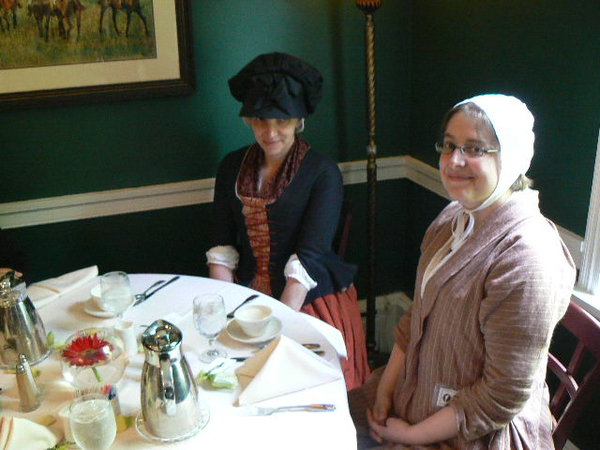
There they are, those lower sorts! We had tea, with delicious scones and excellent company in the form of booksellers from Brooklyn. We don’t get out to tea very often, and it was a pleasant introduction to more old-fashioned notions of parties.

This is a useful thing, because the known bonnet wearer must prepare cake and punch for an as-yet-unknown quantity of guests to include the Second Helping Regiment. Perhaps the historic recipes are not so far off in quantity after all..

The clip is from The Compleat Housewife: or, Accomplish’d Gentlewoman’s Companion. A similar recipe appears in The Art of Cookery Made Plain and Simple, by Hannah Glasse. You can find it on the Colonial Williamsburg website, along with a translation for the 21st century cook. I think I’ll try it, and I’ll have to start soon to get it right by the end of June.

Now for a punch recipe for an unknown quantity…

Pork Pies in Dighton

The weekend before Memorial Day, we spent two days in Dighton along the Segregansett River. It was a Continental Line event, and as such it was interesting to see that different organizations host reenactments with subtle differences.

The biggest difference for us was we got to day trip it from home since Dighton is so close, and that meant two different lunches. Day one, a variation on pasties. Day two, bread and cheese and fruit.

For the pasty variation, I cheated with store-brought crust. I figured the week my guy fell in a 12-foot-pit, I could cut a corner or two that did not involve safety, since I was getting home so much later.

Here’s how the filling worked, riffing on a Daily Mail recipe:

  • Some olive oil (a tablespoon, perhaps)
  • Half a medium sized onion, diced fine
  • A teaspoon of sage
  • Half to two-thirds of a pound of pork cutlet or boneless chop, whacked thin
  • One firm apple, sliced thin
  • One carrot, sliced thin, or a parsnip, or both, or neither
  • One medium potato, diced small
  • Tablespoon of flour
  • A tablespoon of lemon juice
  • Salt & pepper to taste
  • Small amount of water, as needed
  • 1 egg, lightly beaten

Heat the oil in a skillet; add the onion and sage, cook until soft.
Add the pork, cook until lightly browned.
Add potato, apple, and lemon juice; this is the time to add carrot/parsnip.
Sprinkle lighly with flour or cornstarch.
Cook until pork is browned and vegetables softening but not soft; add water as needed to create some juices.
Season with salt and pepper to taste.

It is best to let the filling cool before spooning it onto the crust.

Cut the circles of crust into halves. Divide the filling into four equal parts, and distribute among the half-circles. Fold the crust over, pinch closed. Brush with beaten egg to glaze, cut small slits for steam holes. Bake at 350 degrees until filling bubbles and crust is brown, about 30 minutes, depending on oven.