Passing Strange

Inspiration: gown, 1740s (silk) remade 1775-1780. Colonial Williamsburg 2000-133

In representing Magdalen Devine at the Museum of the American Revolution’s Revolutionary Philadelphia event, I decided to make a brown silk gown. This is an easy and solid choice for nearly any (every) woman in any location in the Anglo-American colonies in the latter half of the eighteenth century. If you want another option, go blue. But the reason I chose brown is not just because it’s common, or because I have achieved a certain age, but because both Magdalen Devine and Anne Pearson, although members of the Church of England, were associated with prominent Quakers. 

Magdalen Devine, known to Elizabeth Drinker as “Dilly,” accompanied Drinker on trips to Bath at Bristol, Pennsylvania, where the two visited the waters. In what is now Bucks County, these baths were chalybeate or ferruginous, meaning they contained iron salts. These mineral baths,  initially described as “nasty,” were eventually sought for their medicinal uses. (There is a handy book on American spring resorts called They Took to the Waters: the Forgotten Mineral Spring Resorts of New Jersey and nearby Pennsylvania and Delaware.

Devine and Drinker visited Bath several times in July and August of 1771. Drinker seemed hesitant to take to the waters at first, and while it is not clear whether “Dilly” helped her overcome her nervousness, the two made multiple trips over the course of several weeks. Eventually, Drinker recorded sharing a bed with Devine, so the two must have achieved a level of comfort, if not friendly intimacy, with each other. (You can read the diary entries here.

A Lady, ca. 1747-1752 watercolor by Paul Sandby. Royal Collection Trust, RCN 914415

There is nothing in Drinker’s diary to suggest Devine’s appearance or clothing, which, although disappointing, is normal for a diary of the period. But this level of comfort suggests that Devine projected a pleasing, non-jarring appearance and blended in with Drinker and her family and friends fairly well. This could easily be achieved in a brown, grey, or other dull-colored gown. Any of these colors would have been appropriate for Devine, who by 1771 was likely in or approaching her 50s, having been married in Dublin in 1748. (Lest you think Dublin means Catholic, Devine was married at Saint Catherine’s Church, https://www.saintcatherines.ie/our-story, an Anglican church originally built in 1185 and rebuilt in 1769. The Catholic St. Catherine’s in Dublin was completed in 1858.)

Similarly, milliner and trader Anne Pearson is recorded visiting Dr. John Fothergill in London in February 1771. Fothergill wrote to James Pemberton of Philadelphia:         

“Dear Friend,

I have just got the enclosed in time to send by our valuable acquaintance Nancy Pearson, who has been so obliging as to see us as often as her business would permit. We were pleased with it as she acts the part of a mutual Friend; brings us an account of our esteemed Friends with you, and carries back all the intelligence she can get that may be acceptable to you.” Pemberton Papers, Etting Collection, II, 65, Historical Society of Pennsylvania.

I know this is Anne Pearson, because she wrote to William Logan of Pennsylvania describing her meeting with Dr. Fothergill. Anne was known as “Nancy” to her mother and family. “Nancy” is described in a footnote by editors as “A Quakeress, well esteemed in her ministry,” but I believe they have mistaken the meaning of “mutual Friend.” 
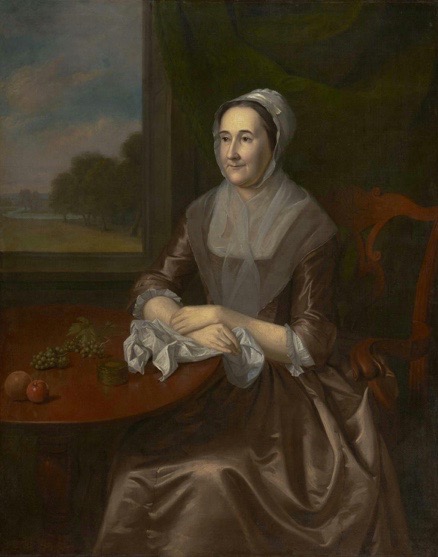
Hannah Lambert Cadwalader (Mrs. Thomas Cadwalader). Oil on canvas by Charles Willson Peale. Philadelphia Museum of Art, 1983-90-2

Did Fothergill assume Anne was a Quaker because she came from Philadelphia? Or did she dress in a manner that suggested she was a Quaker? It would have been easy enough to achieve a level of “plain” dressing with a brown gown and simple accessories like a white handkerchief and apron, and a lappet cap or a relatively unadorned cap. Did Anne and Magdalen (Nancy and Dilly) dress in ways that made their Quaker customers feel at ease? It would be possible to dress both plain and well, with neatly made fine accessories that would appeal to the eyes and instincts of Quakers and Anglicans alike. Perhaps. While there is no way to know for certain, and two passages do not make data, they do suggest something about these businesswomen and their ability to move among and between distinct groups.

Friends in Newport

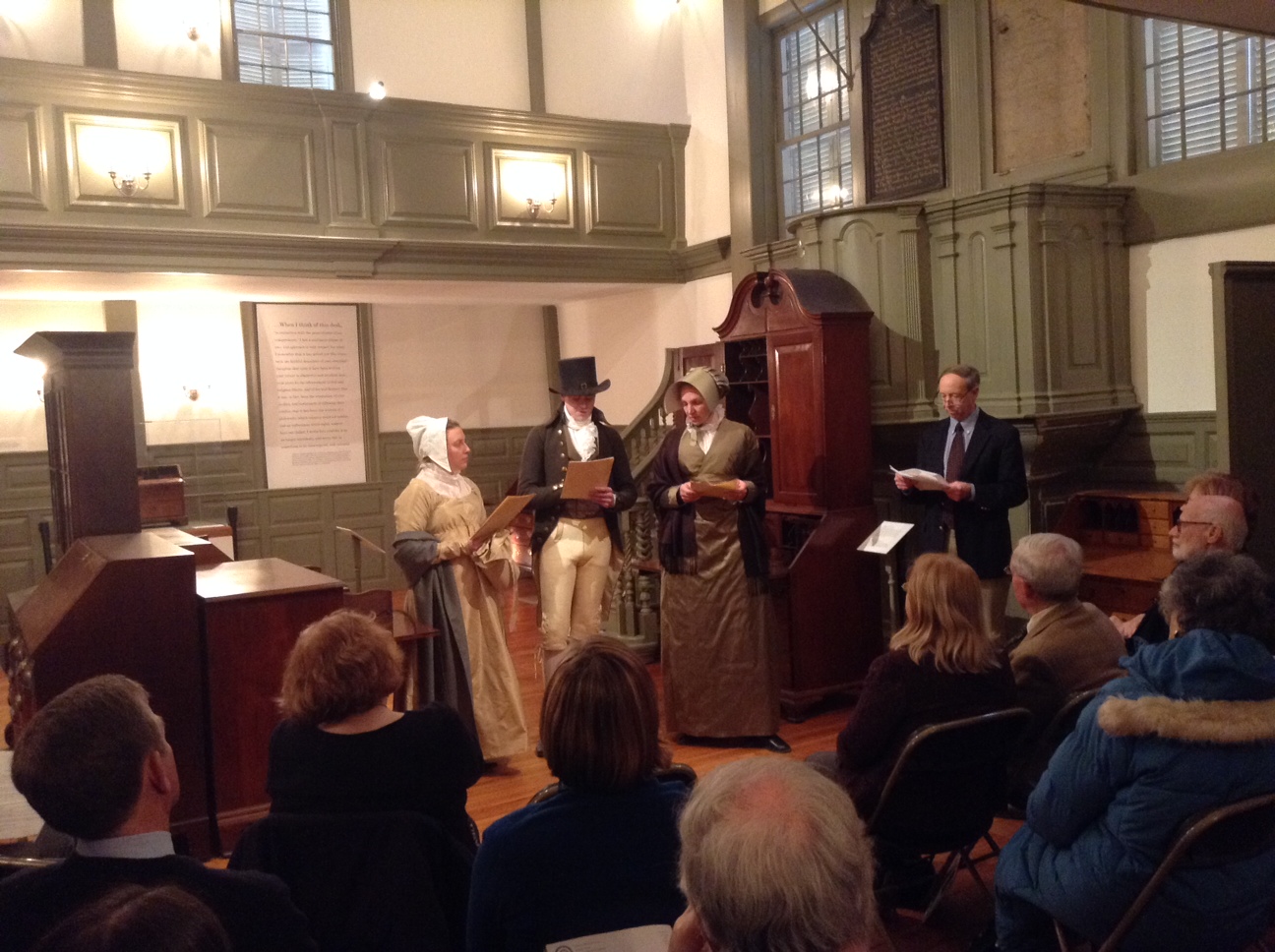
Costumed interpreters as 19th century Quakers
Interpreters at Newport Historical Society, February 2014. Photo courtesy Newport Historical Society staff

I’m so glad I have friends in Newport. If I didn’t, I wouldn’t get over to the Island nearly as often as I do now.

Next Thursday, I’ll be joining friends in Newport next week for a program based on letters in the Newport Historical Society’s collection.  This program will be much like the one I was part of earlier this year, but open to the public.

The letters are really interesting and entertaining, providing a window into Newport history that I know you cannot hear anywhere else.

The Society of Friends

Courtesy Newport Historical Society

Last Friday, I joined my friends in Newport for a program at the Newport Historical Society.

We stood in the Seventh Day Baptist Meeting House behind the NHS’s headquarters building and read excerpts of letters from the Williams Collection.

This is a simple, elegant concept for a program, and works incredibly well if the correspondence have the gift for expression that these people did. Even quotidian details–the price someone wants to get for their dining set, the likelihood of moving one’s mother, who must be carried ‘as carefully as a box of China’–take on humor when read aloud.

Courtesy Newport Historical Society

The best letter might well have been the last one, read by Sew 18th  Century. The latest of the selection, the writer described a visit to Newport around 1844, arriving at the dock to the bustle of wagons, walking streets and finding a barber who knew the old fish hawker, the enormous jaw bone of a whale on a street corner, and even lifting the latch to walk inside the Seventh Day Baptist Meeting House where we were standing.

It was a lovely way to end the program, resonant with details the audience could connect with.

My dress turned out all right, and I managed to get it on and keep it on, which seemed a small miracle requiring only two pins.

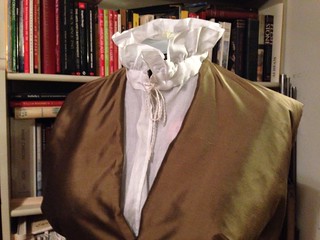
When I tried it on at home, the front panel didn’t wrinkle, so I think I pulled it too tightly around me on Friday. I kept my bonnet on because I didn’t have time to make a new cap, so made do with the housekeeper’s cap from last fall. The chemisette was made by Cassidy, and saved me from the migratory ‘charms’ of a kerchief. The ‘shawl’ was a gift  Christmas from my mother, who rightly saw it as a scarf, but those who wish to keep warm do not quibble when they cannot find exactly what they want. Before I wear the dress again, I have to attend to interior seams of the skirt and scoot the cuffs down to lengthen the sleeves. Four yards of 48-inch wide silk was just enough, but needs a little tweaking when you’re a tall as I am.

Criss Cross

Dolly Eyland, by Alexander Keith, 1808. (c) The New Art Gallery Walsall; Supplied by The Public Catalogue Foundation

I like Dolly. The colors, the textures, the style of her gown, shawl and cap all please me. She’s rocking some serious class for a woman headed towards a certain age. And she’s wearing a cross-front gown, which is what I settled on for my Quaker costume. 

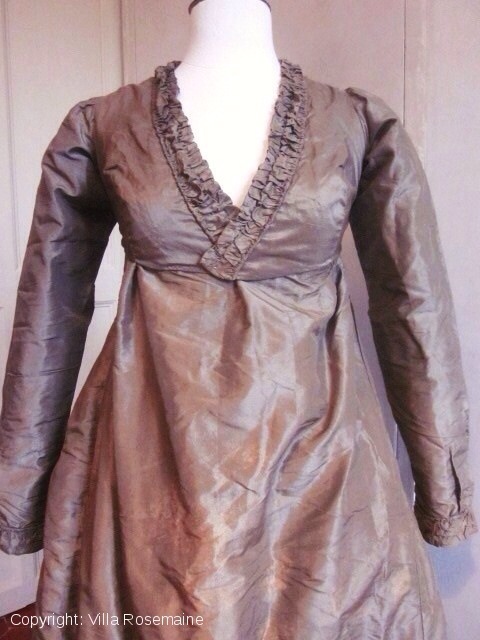
Taffeta dress, ca.1800-1810, Originally found on Villa Rosemaine site, where it does not appear now.

The trouble with making a gown based on an artistic sketch in a book is that you don’t have the most complete sense of what that garment looks like, or how it goes together.

Not to worry, I went ahead anyway, because this is as close to Everest as I will ever get.

But I wanted comparable garments to help guide me. Ages ago I found the gown at left on a French costume site. That’s helpful, in that it explains the trickiness of assembling and wearing this style of garment. Three pieces coming together in the front may be one piece too many. 

In making up my pattern, I used the pattern for the Spencer as a starting place because I knew that the set of the sleeves and arm scye were what I wanted. No reason to re-invent that process!

That left me with the luxury of concentrating on the neckline.

That took a few goes with the tracing paper and muslin:  I did lose count after a while. There may have been tears, there definitely was swearing. Mr S at one point made jokes about this process appearing on the Discovery Channel’s “How it’s Made” as “the Quaker dress.” He’s really very patient, and I do understand the selective deafness he’s had to develop as a defense against the dark arts of sewing historic clothing.

Thank you, Cassidy, for the chemisette!

Eventually, I had a decent lining and even some silk bodice fronts. I fiddled with the fronts, and settled on gathers instead of pleats, but couldn’t quite figure out where the casing went. Some days I can process drawings into objects, some days I can’t. I’d just about reached the point of cutting it all up into the gown I always make when I discovered that the excellent women of the 19th US had patterned the gown from the drawing, too. (If you don’t already use this site, I highly recommend it. Excellent work.) Those pattern pieces look like my pattern pieces, so I decided it was worth carrying on with what I have.