So, I always thought that window shopping was a product of the late 19th or early 20th century, the plate glass windows of the Bon Ton, and The Lady’s Paradise.
Providence Gazette and Country Journal, 4-18-1772
I was wrong. Check out the last line in this ad from the Providence Gazette and Country Journal of April, 1772:
“Any Person not wanting to purchase, but having a Mind to see the greatest Pennyworths, shall be waited on with great Chearfulness, by their very humble Servant, PAUL ALLEN.”
In case we forget, the past is there to remind us that the consumer culture started much, much earlier than we think it did. Stop blaming Don Draper: I give you Paul Allen.
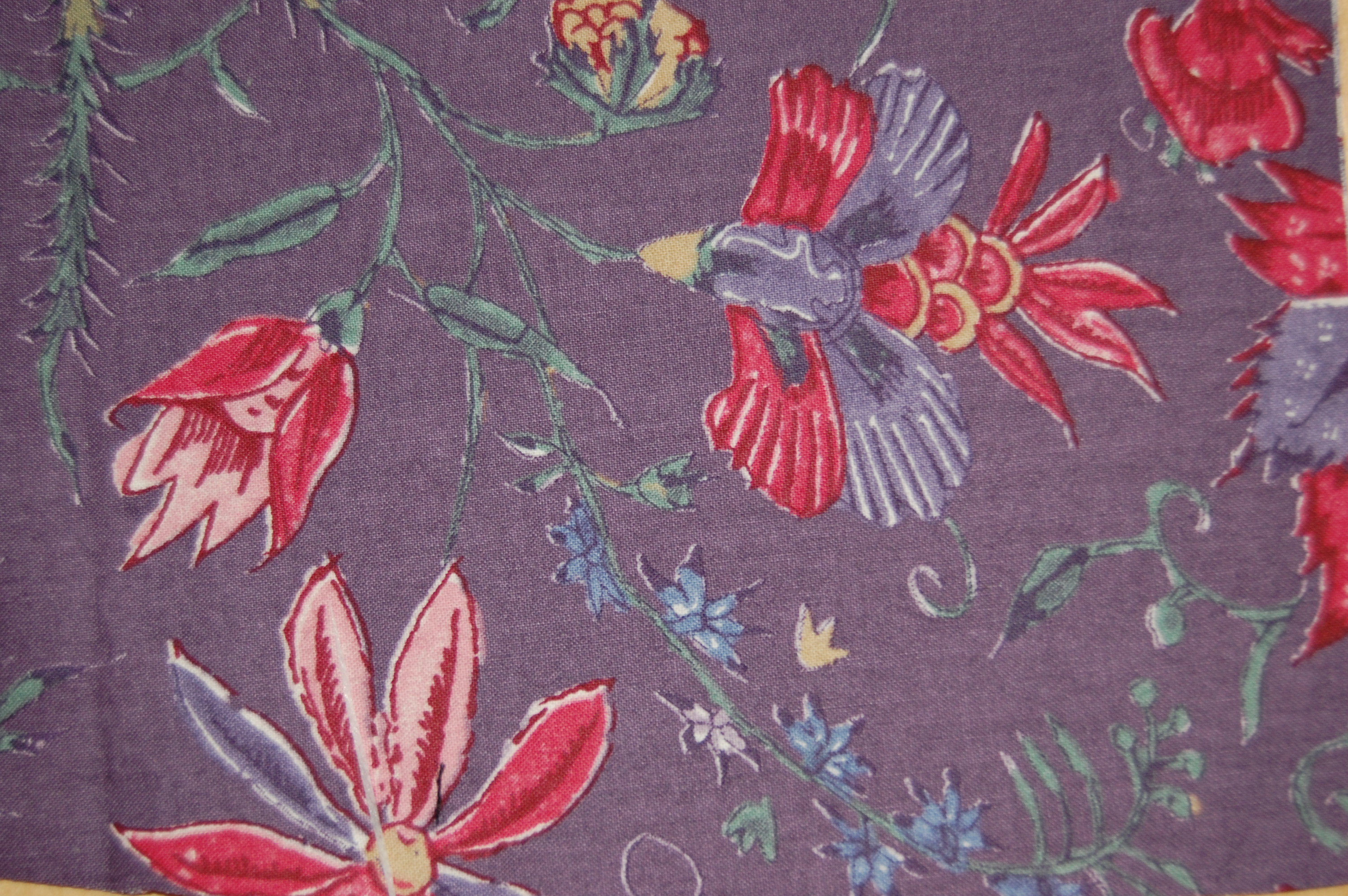
Because I am prey to a pretty print as much as the next princess costume blogger tenant farmer’s wife, I thought I should go looking for evidence before I launch into any cotton sacques, and to justify the use of the print remnant I’m stitching up into a jacket. (Apologies in advance to my friend who bought enough for a gown, because you know we’ll wear them to the same event…)
Providence Gazette and Country Journal, March 16, 1765
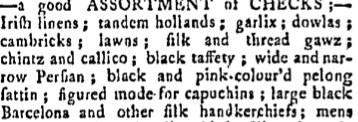
American Historical Newspapers to the rescue, once again. Here’s an ad for Alexander Black and Archibald Stewart, from the Providence Gazette and Country Journal of March 16, 1765. Chintz and calico: it’s here in Providence in 1765. I knew there were merchants selling calicoes and chintzes in Providence in 1768 (including Samuel Young, who printed his broadside in red).
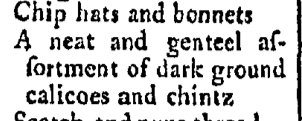
Three years later, Joseph and Wm. Russell at the sign of the Golden Eagle are selling (lately imported from London and Bristol) “A neat and genteel assortment of dark ground calicoes and chintz.” This ad runs to four columns in the Providence Gazette and Country Journal, 1768, April 9. It’s a tantalizing list, and no, I did not miss those chip hats and bonnets!
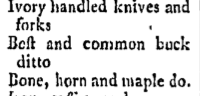
Digression: I was attracted to this bit about forks as I recall being told by a historic house tour guide once that “forks were not in common use until the Civil War.” It’s an early house, maybe he meant the English Civil War, but I think forks were here to stay and be bought for a variety of prices long before the American Civil War. How else to explain those archaeological finds that show forks of some kind at Rev War forts and camp sites? /Digression. New digression: OMG, knitting needles! /New digression.
Back to chintz: Here, in 1771, is William Eliot, selling chintzes in Providence, and advertising in the Providence Gazette and Country Journal of June 1, 1771. He also has “flowered and sprigged lawn in aprons,” and Kenting and check handkerchiefs. (Kenting was a fine linen fabric)
In the limited search I ran (1754-1783 newspapers), plenty of references to chintz appear in Providence alone (there were 166 hits, but the ads repeat). This completely unscientific approach in which I stopped looking in 1771*, has turned up 5 merchants, if you count the RIHS Library’s broadside for Samuel Young. Chintzes and calicoes were everywhere. Dark grounds were “genteel,” checks and spots and stripes are popular and common.
Paul Sandby, London Cries: Black Heart cherries… ca. 1759. YCBA, B1975.3.206
I begin to see 18th century Providence, if not all of the Colonies, as a variegated, kaleidoscopic place of pattern and color. I think there was more than we realize, even if only in small amounts.
Look again at the cherry seller: her petticoat is yellow and blue, if not yellow, blue, and white striped, her apron is blue, her stockings brown or faded reddish, her cap is affixed with a pink or red ribbon, and she wears a checked kerchief. She’s poor and sort of faded, but she’s colorful–more colorful, perhaps, than we have credited.
*I do have to head out to work, but I can search again.
Last night, I went to a meeting downtown for my boss, and chose to walk instead of drive. I took some blurry photos along the way as evening became night and the city became more and more like Busy Town. The skill level of local drivers is not too different from Richard Scarry’s drivers…and the hills and the way the houses stack up, and the way we recognize or know each other here reminds me of Scarry’s books.
Walking back to the museum, I stopped at one of my favorite bookstores, where the selection runs from the perverse to the erudite. I picked up many books and limited myself to three, including Very Vintage. (Did I mention Symposium’s remainder table pricing? Ah, yes: that’s why three books were possible.)
The text could have been edited a little more carefully and I am a fan of the endnote (not present here). But there are excellent photos I have not seen before and diagrams patterning garments. Now you see why I bought this: where else will I find diagrams of aTeddy Boy Jacket and a 1960s Bellville Sassoon-inspired evening dress?




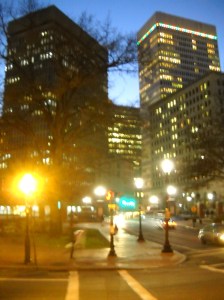 Last night, I went to a meeting downtown for my boss, and chose to walk instead of drive. I took some blurry photos along the way as evening became night and the city became more and more like

 Kirsten Hammerstrom
You must be logged in to post a comment.