By Jupiter!

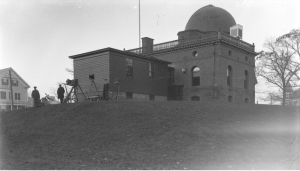
Ladd Observatory, 1898, back of the transit room.
Ladd Observatory, 1898, back of the transit room. Brown University image

On Tuesday, after a long hiatus, the local observatory was, at last, able to open to the public. Between the Snow on Monday theme of this winter, and the tendency to clouds and rain in what New England calls Spring, Ladd had been closed, and sending plaintive and apologetic emails, for weeks.

We walked up shortly after the 8:00 PM opening to find long lines, and a crowd as large or larger than the Halloween open house nights, when the staff and students turned the Observatory into a haunted house, neighborhood naughties swiped too much candy, and the roof deck was open for star gazing. Being Tiny Town, the Young Mr’s middle school art teacher was in line ahead of us with her young son and wife. To his credit, he did acknowledge her.
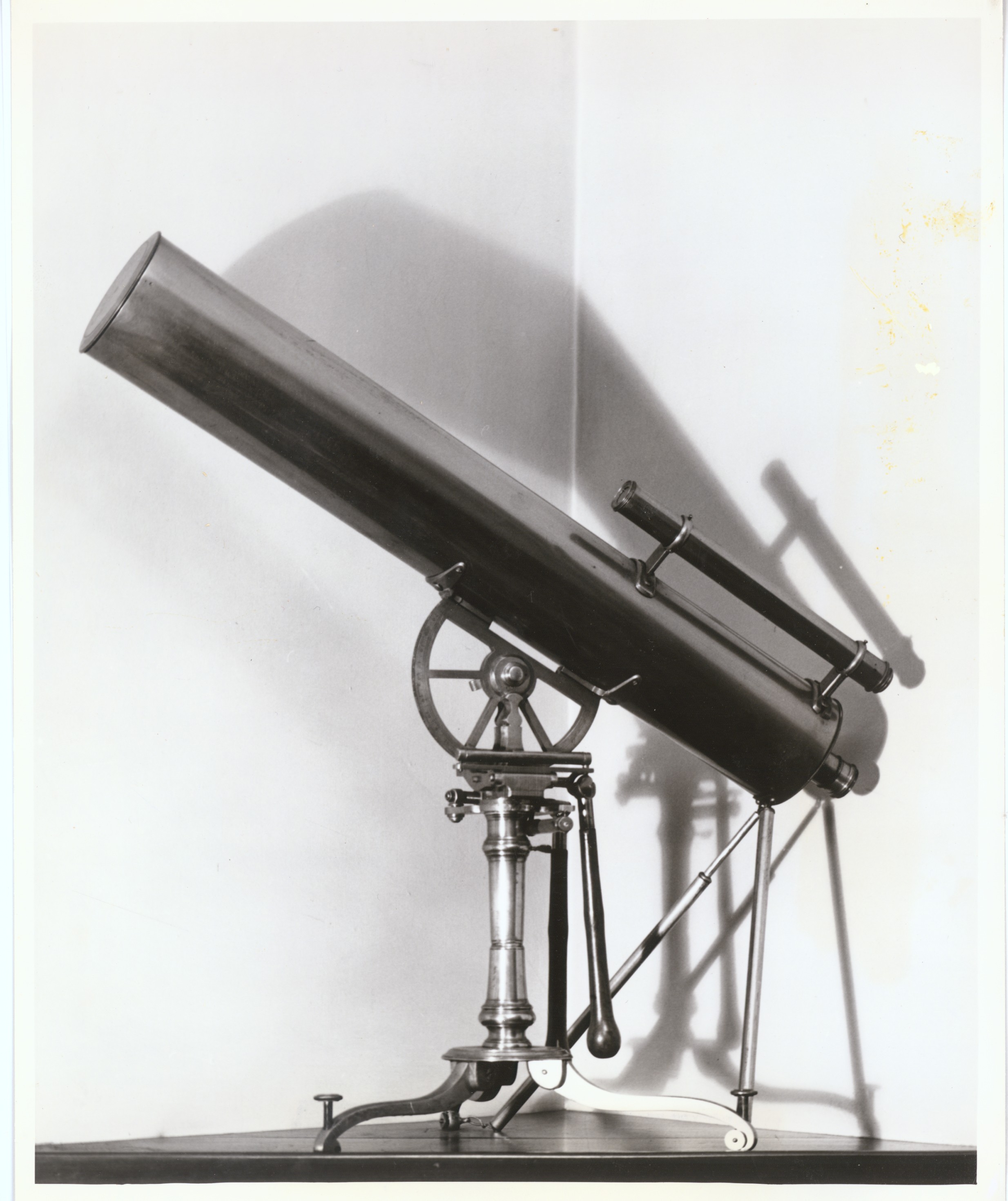
The telescope used by Benjamin West to observe the Transit of Venus, 1769
The telescope used by Benjamin West to observe the Transit of Venus, 1769. Brown University image.

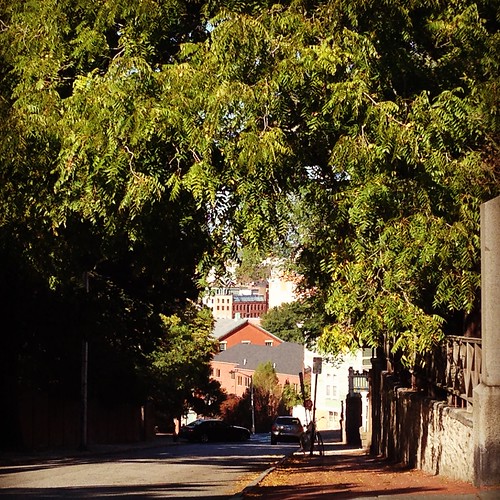
There’s a long history of astronomical observation here, with a street named Transit for the 1769 Transit of Venus, observed by Benjamin West and other local notables.

We were happy to join the queue to look through the much larger telescope to see Jupiter, easily visible now.

It is really is a “wow!” moment, cooler even than the packages that make it here from India and astonish me. All that distance, light. How truly awesome the view through a telescope must have been in the 18th century, when we, collectively, knew less about the world and universe. How awesome it is now, to be able to see a world so far away, and to wonder what it is like.
What Cheer Day Review

There will be more, and better, images

Let’s begin with the easy part: pretty pictures of a pretty house. (It’s too easy, right?  More on that later this week.)

There are only a few for now– while our photographer took over 800 images, before he can process and sort them, we have to put the house back together first!

October 25 was a Saturday in 1800, the last Saturday before the first public schools opened in Providence on October 27. Mr Sweet, the tailor’s apprentice, had too much current-day public school homework to join us.

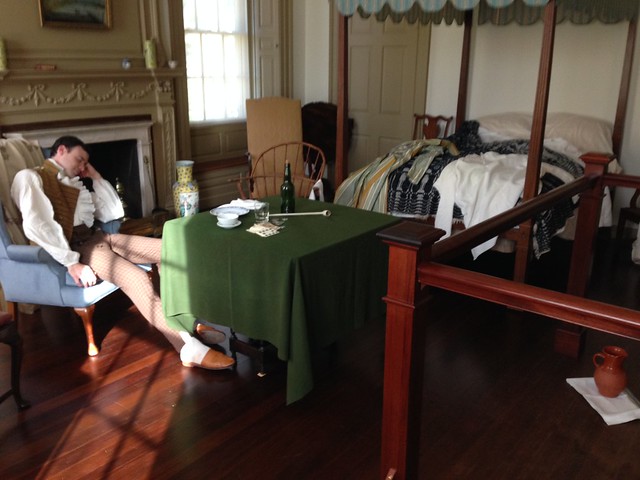
Mr Mason begins his day

It was as well, perhaps, that Mr Sweet did not see the client in his natural environment. His tailor, Mr Taber, arrived with many samples and plates for Mr Mason’s perusal, and the room was in quite a state by the day’s end. I do not know why Mr Mason could not take the short walk to Cheapside, but his custom is so good that the tailor made an exception and came to call.

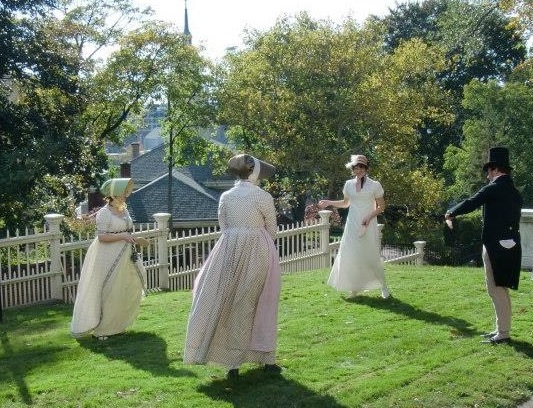
Lawn games

Late in the afternoon, we played battledore and shuttlecock; I was surprised and pleased to see the images and how much like Diana Sperling’s drawings they looked. It was a pleasure to see that we were doing something right, though a cold scoop bonnet was no help in seeing the shuttlecock.

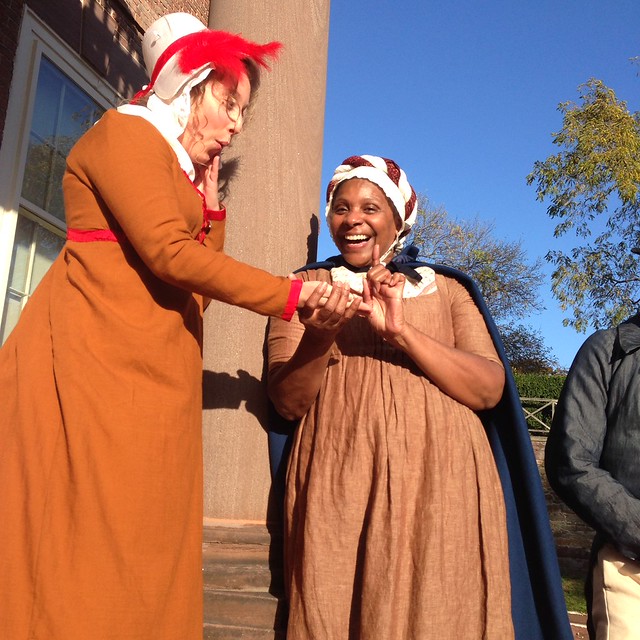
Nancy Smith hears her fortune from Goody Morris

The fortune teller came, much to the consternation of Mrs Brown and her sister. I believe it was the housekeeper who thought she could get away with inviting her friend to the house; in any case, it was foretold that Kitty should have comfort in her life, which was a great relief to someone who had been wearing straight-lasted and very flat shoes for some twelve hours.

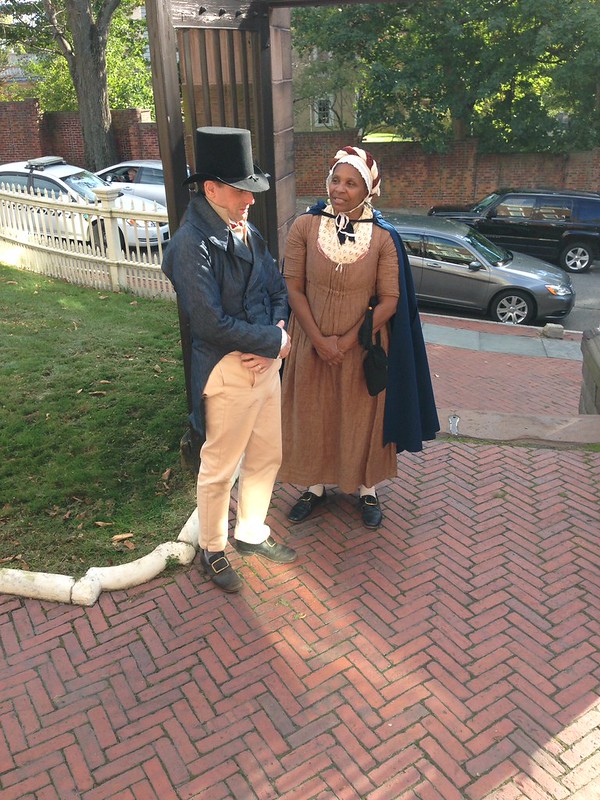
Mr Young and Goody Morris

Of late there has been a man hanging about the house; he enjoyed Goody Morris’s conversation as well, though late in the afternoon he caused quite a disturbance with a delivery of wine. We think he had been imbibing from our order, and his behaviour caused our new maid, Eliza, much distress. Mrs Brown was not well pleased at the commotion in her house.

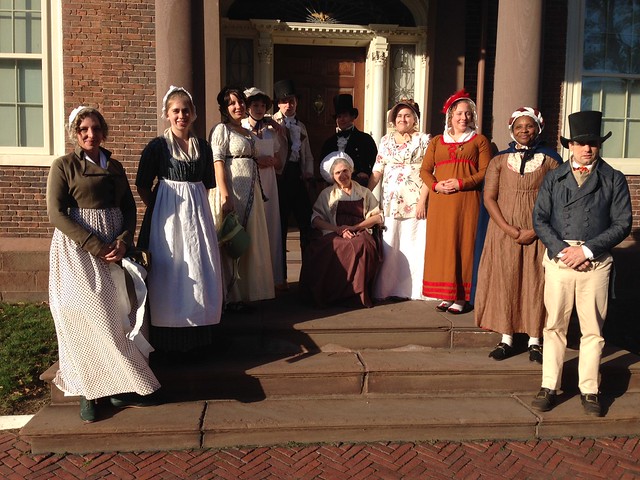
What Cheer Day 2014

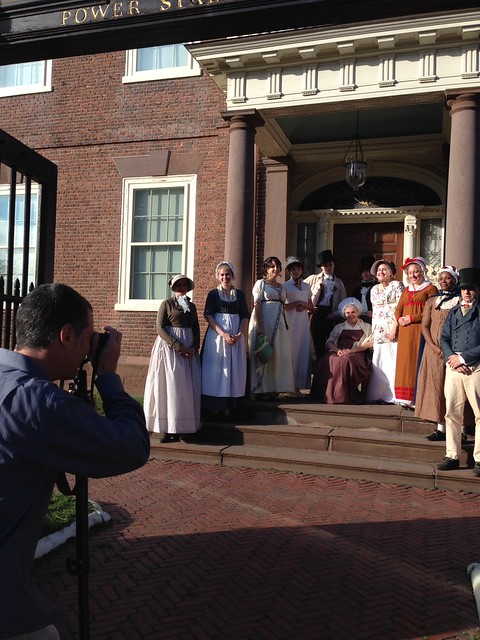
Still, by the end of the day, we were well satisfied with our work, and posed for the passing limner.

Cold Scoops

What Cheer Day preparations must begin in earnest now, no matter how distracting I might find orderly books or silk shoes (not in my size, alas: no last can be found). I already have clothes enough for a housekeeper, though I still crave a broadcloth Spencer and am working on a petticoat. I’ll hardly go outside that day, so why am I thinking bonnets– especially when I have a known bonnet problem?

One of my favorite resources for Federal era Providence is Julia Bowen’s diary. Born December 1, 1779, Julia’s diary records her life in Providence in 1799, when she was 19. She records the daily activities of the second set of Providence women– daughters not of the most elite merchants, like John Brown and John Innes Clark, but the Bowens, Powers, Howells, and Whipples. Distinguished, but not super-elite. Many of the entries are as prosaic and superficial as you’d expect from a young woman in late adolescence, and thank goodness they are, or we’d never be able to imagine life in such fine detail.

Julia got me thinking about bonnets with her entry of April 12:

found the Major & Citizen Sarah & C. Angell altering their cold scoops into Rosina hats, so busily were they employed that the Major could not go a visiting, which deprived me at once of the greatest pleasure I anticipated in my visit.

(She used code names for her friends; some we can decode, and some we cannot.)

I haven’t been able to decipher what “Rosina hats” were, but cold scoops I could handle: coal scoops.
That colloquialism fits not just fashion plates but extant coal scoops and buckets.

You just have to imagine them turned over.

The Gallery of Fashion, 1797, Bathing Place, Morning Dresses.

I went for cold scoop, with a pasteboard brim and olive green taffeta brim and caul. The mannequin is a 3-D sketch, if you will, of what the housekeeper plans to wear this autumn. At least until she can figure out what a Rosina hat is.

Good Help is Hard to Find

Esther helps Mrs Smith with her bonnet

Esther Hudson here has a terrible fascination for knittin, and an abundant fascination with sheep.I fear sometimes for her sanity, as she spends much of the evening sketchin cats on her slate and showing em to me. Cats, sheep, and knittin are much of her conversation and I wonder if she will ever be settled in a home of her own. I durst not send her away, as her father is at sea, and knowing what might befall her, given her simple ways, I think it best to keep her close. She is fond, as you can see, of dressin, but refuses utterly to quarter a fowle. She will beat a fine pound cake, but the coarser tasks of the kitchen she finds distasteful, preferrin to dress the ladies’ hair. Of her future, I do sometimes despair.

Mrs Smith and Miss Smith

My cousin, Miss Eliza Smith, has donned her new dress to come up to town from her beloved Newport to see about a position. The family with whom she has found employment these many years has suffert in that city’s decline since the late war, and she seeks a new future in Providence. She writes a fine letter, and with excellent references, Miss Smith would be well suited to manage a household for Mrs Brown’s youngest daughter, the recently married Mrs Mason. Miss Smith seems also to steady Esther, whose conversation grows more sensible when she is not with me. Perhaps after speaking with Mrs Mason, Esther, Eliza and I can slip away to enjoy some of the newly pickt apples she has brought up from Rhode Island.

Mrs Smith, ready for some ale
Mrs Smith at day’s end

At the end of a long day filled with visitors– every stage has stopt at our house, some mistaking it, I think, for that questionable establishment operated by ‘Mrs’ Mary Bowen on South Main Street–I was ready to remove my soild apron (thankfully Esther has a spare) and venture down the hill to seek refreshment with my frinds. I may chanst to hear some news of the Ann & Hope, bound for Canton, and on which my son is a sailor. Or perhaps, before the light fails, I may read a bit of Mr Defoe’s most moral tale, Moll Flanders, and think in gratitude that my late husband’s family has seen fit to give me employ. I cant read at home, for if Mrs Brown catchs me readin that book agin, I will surely be trouble.

(Top photo thanks to the Providence Journal; bottom two thanks to Sharon Ann Burnston, our Mrs Brown)