The Devil is in the Details

durer_hare
The Hare. Watercolor on paper by Albrecht Durer, 1502. The Albertina, Vienna.

The Witch. I had to go see it after Mr JS sent me a link to this article, and of course I was captivated. (I also needed a break after what was very nearly the Worst Week Ever, starting Wednesday at 4:30AM.)

“The recreation of farm life in 1630s Massachusetts is so complete it pulls you into the pocket universe that exists inside the characters’ minds. As you experience their fear, you experience your own. The barrier between you and the people on film disappears, and their terror consumes you. And that is how you make a scary movie!”

That pocket universe: that’s what some of us are after when we go about this living history business, creating a world so seamless (or so meticulously hand-seamed) that you, the interpreter, appear to inhabit the past and the present simultaneously.¹

So how does it work? How did it work in The Witch?

Here’s Eggers on authenticity:

“…authenticity for the sake of authenticity doesn’t really matter. To understand why the witch archetype was important and interesting and powerful—and how was I going to make that scary and alive again—we had to go back in time to the early modern period when the witch was a reality. And the only way I was going to do that, I decided, was by having it be insanely accurate.”

Got that? Authenticity for the sake of authenticity doesn’t really matter.

But the only way to make the witch powerful was to be “insanely accurate.”

The only way to make living history powerful is to be <ahem> insanely accurate.² If we’re not, the points where we are not accurate will stand out, the spell will be broken, and the visitor will be lost. The real thing is the right thing for your time and place. Context: It really does matter. 

That means that just because you perfectly replicated a silk gown from a French fashion plate it may be wildly incorrect for the streets of Providence, Boston, or Philadelphia– much less a military camp– even if it’s the same year as the event you’re attending. It means that just because you got every buttonhole perfect on your 1765 frock coat, it won’t be right for an 1803 funeral if you’re only 30.

Don't take an anecdote to a data fight.
Don’t take an anecdote to a data fight.

When you’re wearing and carrying the right clothes and objects for your portrayal, you can focus less of the what and more on the why. As interpreters, re-enactors, enactors, whatever you want to call yourself, we lead the visitor to better questions and a better understanding of not just events but the meaning of the past if we are thoroughly convinced and convincing. And that only happens by questioning ourselves.

The Witch is a horror movie, and while it was tense, the world it portrayed felt pretty close and natural to me and to Mr JS. Maybe that’s because we spend so much time trying to understand that vanished world—it’s Roger Williams, baby—maybe because we engage in living history and material culture. I don’t know if it’s scarier for folks who don’t have that level of context, don’t assume a world where hierarchy, acceptance, succumbing to a higher power, is normal. Where everything is a matter of faith, and belief. It’s a tiny world, that past. We were so immersed in that world that walking out into the mall was a shock: colors, noises, smells. And the world was so immersive because the details were so correct.

Ultimately, what we do with living history is interpretation, and interpretation is provocation.³ But what should be provoked is not a question about what you have, but why you have it, and what you’ll do with it. And that only happens if you have the right thing.

………………….

1 Your mileage may vary. It’s my dream goal. “Man’s reach should extend his grasp” and all that.

2 That is, as accurate as possible, recognizing the limitations of modern materials and access to primary source documents. More on that later.

3 Freeman Tilden. Interpreting Our Heritage, Chapel Hill: 2007. p. 35
Lysistrata on the Lake (and elsewhere)

Let me be clear: Fort Ti was amazing. It was everything I’d hoped for. Far away, made of stone, populated with people I like, with an event cleared of all the crap that makes me crazy.

File_000 copy

The issues that enrage me are both societal and hobby-specific.

While boys were boys and women were women this past weekend, I found myself tired out by biologically deterministic behaviour. For the love of Christ, you can listen to a woman, not talk over her or interrupt her even if:

a) she is not your boss or mother
and/or
b) you do not want or expect to sleep with her.

Gentlemen: we are human beings as smart as- if not smarter– than you. If we are smarter, society has taught us to manage that for you, so you won’t feel <ahem> small. I know that what men fear most is humiliation (the bravest ones will admit it) and what women fear most is violence (it’s true).

But a woman’s interest in history, or even military history, should be as joyous to you as your male friend’s interest.

So why the shouty?
Why the taking over of the conversation?
Why the relegation of women to a separate bench?
Why am I pointing this out?

Well… because even some of the best progressive reenactors have trouble getting past uber-traditional gender roles.

I get it, really, I do. I am accustomed to being a woman in a (hyper manly) man’s world.

I studied sculpture in college in the Dark Ages and I know from male-dominated fields. I ran a foundry in grad school, and a bunch of mostly-male work study students. I’m an owner’s rep for construction projects, and work with a lot of different contractors and construction workers.

But that doesn’t mean I have to like it or tolerate it, as any of my history, art, or construction associates will tell you. My younger counterparts have even less tolerance than I do, so I advise you to listen up, think about gender roles, gun shows, assault/predation and interpretation or consider Lysistrata the future you have earned.

It’s really simple.

You like living history?
We like living history.

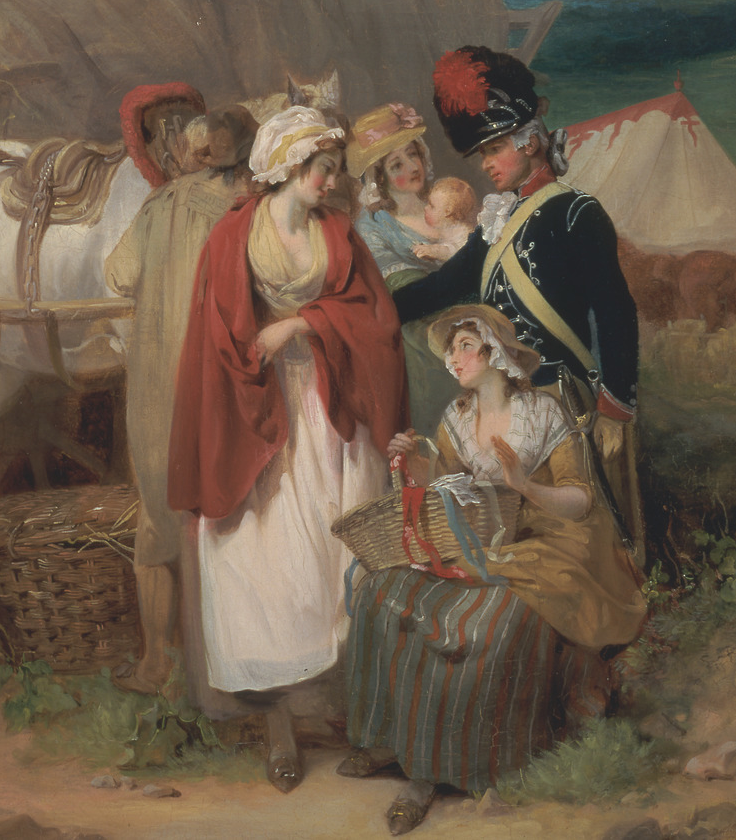
Francis Wheatley, 1747-1801, British, Soldier with Country Women Selling Ribbons, near a Military Camp, 1788, Oil on canvas, Yale Center for British Art, Paul Mellon Collection

Let’s play together better to more accurately represent the past without replicating crappy gender relations. If you start listening and stop interrupting, we’ll stop laughing at you.

Fort Moonrise Kingdom

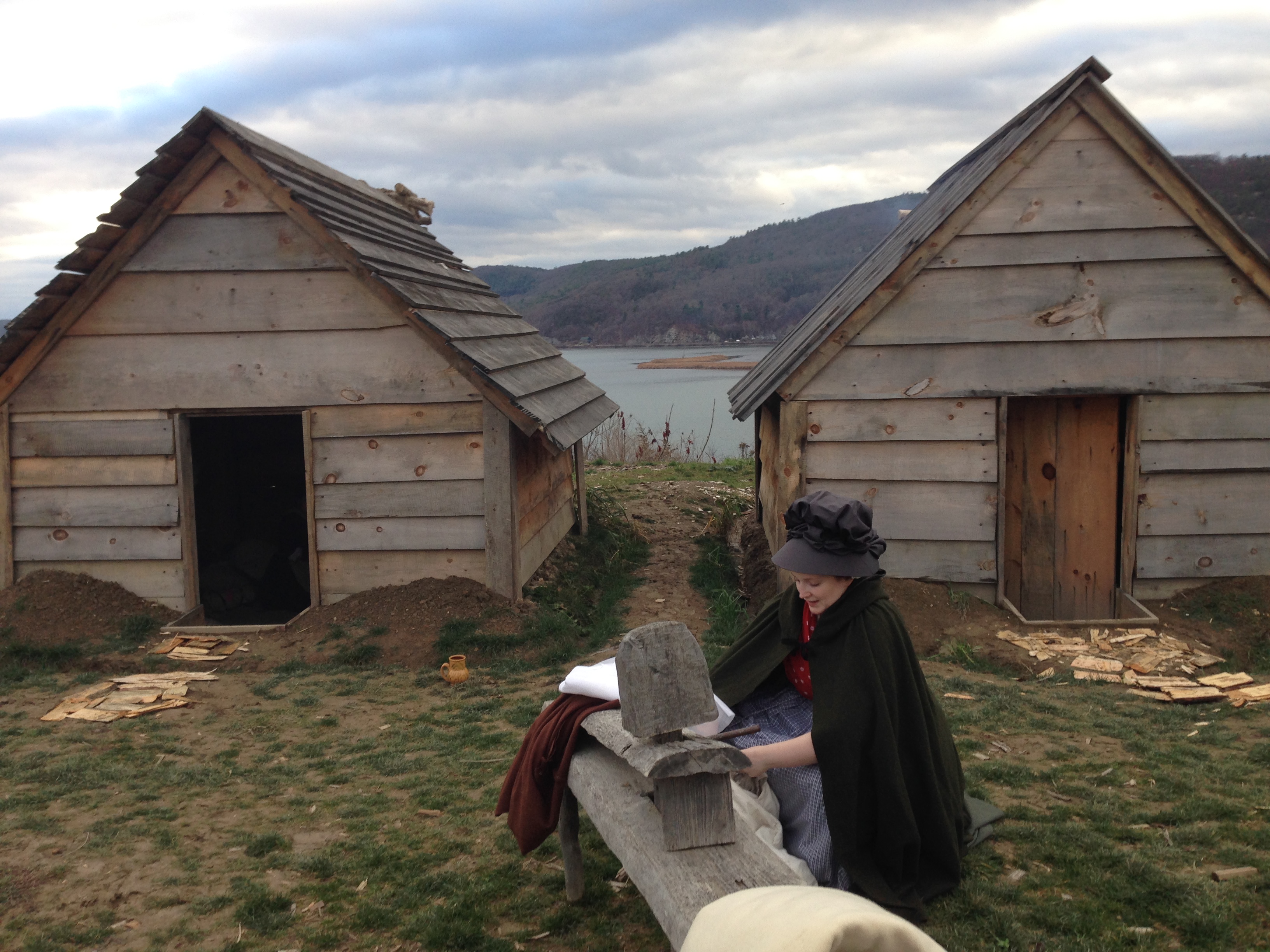
Fort Ti was described to me as “Disney World for Re-enactors,” but my vote is for Living History’s Moonrise Kingdom.

Idyllic, ain't it?
Idyllic, ain’t it?

I almost didn’t go when my Saturday night roomshare cancelled on Monday and then I developed an ear ache on Wednesday, but on Thursday, Low Spark , Mlle Modiste and I arranged a carpool, so on Friday morning, a Carload of Rhode Islanders (a thing to behold and to be wary of) set off for points north.

Our initial plan was to to sleep in the soldiers’ huts, but they proved extremely crowded and smokey, so when Mlle Modiste and I were offered a bunk in the barracks, we took it… unfortunately, only one of the blankets I’d brought for us did not make it back up to the fort or into the car heading home.

Mlle Modiste at the huts

Before supper, we stuffed bed ticks, started a fire, startled a bat (I was not the source of the shriek that brought officers, women, and soldiers running), and stuffed straw in the hole we thought it flew into (thank goodness I’m tall, I guess).

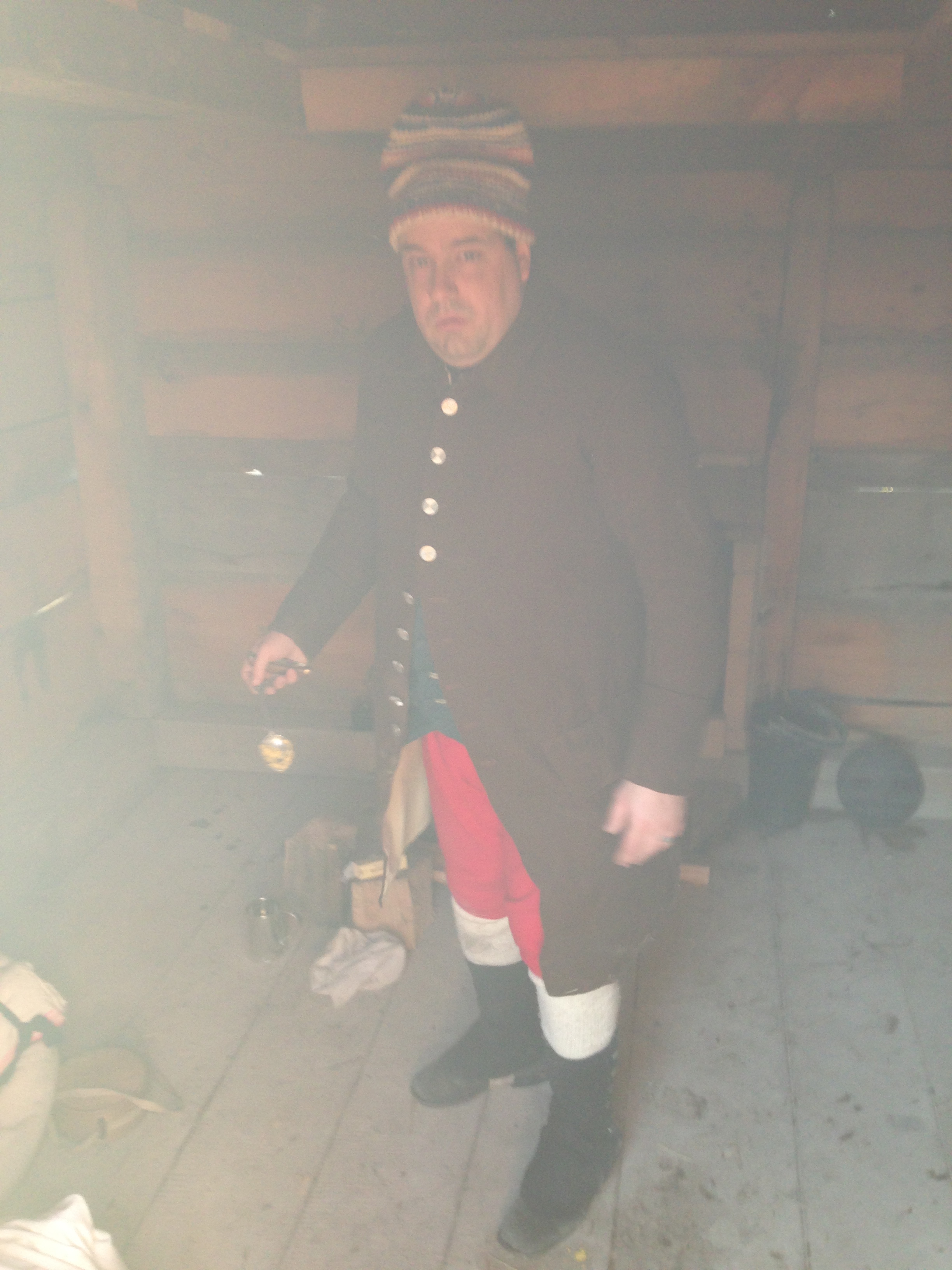
Smoke didn't just get in your eyes...
Smoke didn’t just get in your eyes…

The tavern moved up to the would-be armory at the barracks, though I’m certain multiple political deals and presidential candidacies could have been plotted and bought down at the smoke-filled huts. Instead, it was reenactor politics as usual: parallel experiences for men and women (not ladies, thank you, and if I hear you use “distaff” about me, expect to find one has become part of your anatomy). Just because I’m used to it doesn’t mean I don’t notice it, understand it, and still dislike it.

We’d expected to attend to “sick” soldiers in the hospital, but Saturday was such a lovely day that we spent most of it outdoors, starting and tending a fire to boil laundry and make dinner for the women’s mess. This pleased me mightily, even as I may have distracted troops despite my advanced age as I crouched at the fire being a human bellows. You try getting low in stays and see how you do: immodesty, thy name is fashion.

While I kept the fire going, much credit should go to Rory, a bad-ass woman in men’s clothing who split wood a-plenty for us.  Rory made me want badly to make myself a suit and wield an axe. I find myself wanting to do the same work as the men (I have always been this way), and I was intrigued by the debate that was reported to me: should a woman do men’s work in women’s clothes, or in men’s clothes? In the end, they chose men’s clothes, and Rory wore them well. Reader: I was jealous. I was also covetous of an axe, having realized all the cutting and hewing tools are no longer domiciled with me.

Aunt Kitty's coming' for you. boys.
Aunt Kitty’s comin’ for you, boys.

Saturday really revolved around three things for me: food, free agency, and feminism:

  • I ate some interesting things, including a smoked chocolate cake (left overnight in a hut, I can describe its flavor best as sucking diesel exhaust through a chocolate cupcake).
  • Now that I’m a free agent attending events sans unit, I have much more fun.
  • I am determined and dedicated to effecting well-researched roles for women in living history events of all kinds.