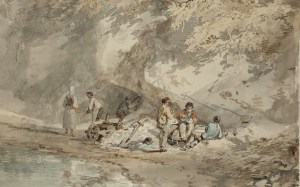
Eating in the Field

Workmen Lunching in a Gravel Pit circa 1797 Joseph Mallord William Turner 1775-1851
Workmen Lunching in a Gravel Pit, circa 1797. Joseph Mallord William Turner 1775-1851

A compatriot asked how we handle food and cooking in the field. What do we do about “yucky stuff?” by which she meant meat.

She was doing just about the same stuff we were doing, and with Battle Road around the corner, I thought I’d write about food in the field, and ways we handle it. Other people will have other ideas, but the main things I think about are:

  • Maintaining authenticity and food safety (Nobody wants flux.)
  • Historical eating is seasonal, local eating
  • Gear: less is not only more, but easier

Food safety is one of those things where you really don’t want to compromise too much, though from eating at the farm, I think there is more leeway than we admit. I will confess that when I was poor and in school, I stored dairy products on the windowsill of my studio when there was no fridge, so eating at the farm is like eating… when I was a whole lot younger.

Here are my principles. I’m not an expert, your mileage may vary, but this is where I begin.

Universal Truths

Start with who you are.
Objects you bring, and food you eat, should be true to your impression.
Authenticity goes beyond the date of accouterments: a porcelain tea set may be quite correct for a 1778 Newport or 1763 Boston parlor, but it makes very little sense if you are with a Continental private. One chipped plate is different for a woman to carry, or a piece of pewter. How long either would last you is another story, but at least you’d have a story. If you are the Colonel’s wife, it’s a different matter, even more so if it’s a British Colonel.

Food safety trumps purest authenticity.
Cloth covered, hidden ice packs will hurt no one and may save you misery later.

Stay Hydrated.
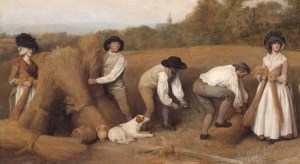
Reapers 1785 George Stubbs 1724-1806
Reapers, 1785. George Stubbs 1724-1806

Soldiers drank water.

In a hot summer camp, we keep a large pitcher full of water (see the Stubbs painting at left). Covered with a white linen or cotton cloth, it will keep coolish and free of dust & insects (or dog fur & fleas, if you’re in the Stubbs painting). We sliced limes into our enormous pitcher, and refilled it all day from the pump at OSV.

Limes are in period; justifying a source can be tricky, but at a certain level, safety trumps authenticity. 98 degrees and 90% humidity means drinking a lot of water.

Chances are you’re a caffeine addict like me, so what do you do? Boil water in a kettle, and bring tea in a screw of clean white paper is one answer. What’s your justification? I’m a personal fan of ‘stole it from my master,’ but in small quantities, perhaps you got it from home, or did a farm woman  a favor. Or stole it from her. John Smith (I kid you not), Sergeant in Colonel Lippitt’s Rhode Island State Regiment, in Continental Service, writes in his diary* of apprehending geese and chickens who failed to respond with the correct password when challenged.

*Published as “Sergeant John Smith’s Diary of 1776”, edited by Louise Rau, in Mississippi Valley Historical Review, No. 20, 1933, pages 247 – 270. NB: Kitty Calash recommends reading, not stealing.

Tomorrow: Food-related recommendations by event type.
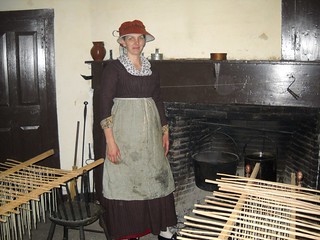
It Isn’t History Till it Hurts

End of the day, Sunday

That’s approximately what the costumed interpreters say their leader says.

Let me affirm for you that history does, in fact, hurt, when you are doing it right. That is to say, you will be bodily tired. You will be hungry. You will be cold. Your judgment will be impaired. Your world will shrink.

I have so many thoughts/ideas/inspirations/observations after another weekend at the farm that I do not quite know where to begin.

Yesterday, I made 290 candlewicks and draped them, with some help, over 50 sticks. My colleague and I managed to dip each stick of 6 wicks 2 or 3 times, though I had to trim the wicks after the first or second dip so they would match the depth of the kettle. Today, we got there late (thanks to my broken stay laces which had to be replaced…once replacements were found…annoying) so the fire was not hot, the wood not gathered, the tallow not melted—oh, it was not what this control freak wanted. I wanted to both make dinner and dip candles.

Well, we did manage both, in a way. Dinner was more of a snack of boiled chicken and root vegetables, followed by a snack of squash custard tart, and the candle dipping was managed only sporadically once the tallow was melted. First it was too cold, then too hot: it was a day of details. At some point I realized I was so tired that I could no longer think about a simple thing, and that what got in my way was simple lack of fluency. If I did this every day, I wouldn’t need to think about it. But I don’t. So while I can do these unfamiliar tasks, they are just a bit harder when I am cold, hungry, tired, or hurting.

Hot tip: sheepskin insoles. In wool stockings yesterday, my feet were freezing cold in the kitchen when I was not near the fire. With sheepskin insoles, my feet were warm today. Your mileage may vary, but well worth a try.

The Great Curtain-a-Long Kerfluffle

Not to be confused with the Great Benefit Street Curtain Kerfluffle of 2007, in which I averred in a lectured that the wealthy of Providence did, in fact, have not just shutters but also curtains, and was publicly challenged by irate docents. Sometimes I feel the need to remind them that John Brown did not in fact squat naked in a corner of a fireless room gnawing on a joint until Benjamin Franklin appeared with the gift of fire called down from the sky by a kite….why, yes, I do have some docent issues.

Way back in a warm sunny month I bought the Waverly curtains at Lowe’s in the cream color way, though both the black and the red were also tempting. Now the question is, what to make? Not that there aren’t plenty of other projects requiring my attention…but sometimes, you want to do something just because it’s fun.

“Fun” is a concept I have some trouble with. I am much better with work and responsibility and guilt. “Spontaneous” isn’t too bad (how do you think I end up in some of the situations I find myself in?) but simple “fun” can be tricky. So here I am with the spontaneously purchased curtains, and the need for a plan.

The plan has vacillated between “just for fun” dress and a fully documented dress. A “just for fun” dress would not have to be documented to 1770-1780 New England or 1790-1805 Rhode Island. How liberating! French dressing, here I come! Except…where and when would I get to wear my new creation? So I need not just a plan but a cunning plan.

Where to turn? I chose the Met, and here’s what I found.

Dress number 1, 1725-1750, British, embroidered linen. Has the right features (open, robings, cuffs) and the fabric could be plausibly mimicked with the print. Could be worn with a matching petticoat (need another curtain if I do that) or a red flannel petticoat. Would be super amazing with a crewel stomacher if I made myself do that. Could probably be worn to Rev War events if I felt a bit brazen. (She wore curtains at Battle Road?! My dear, the idea!)

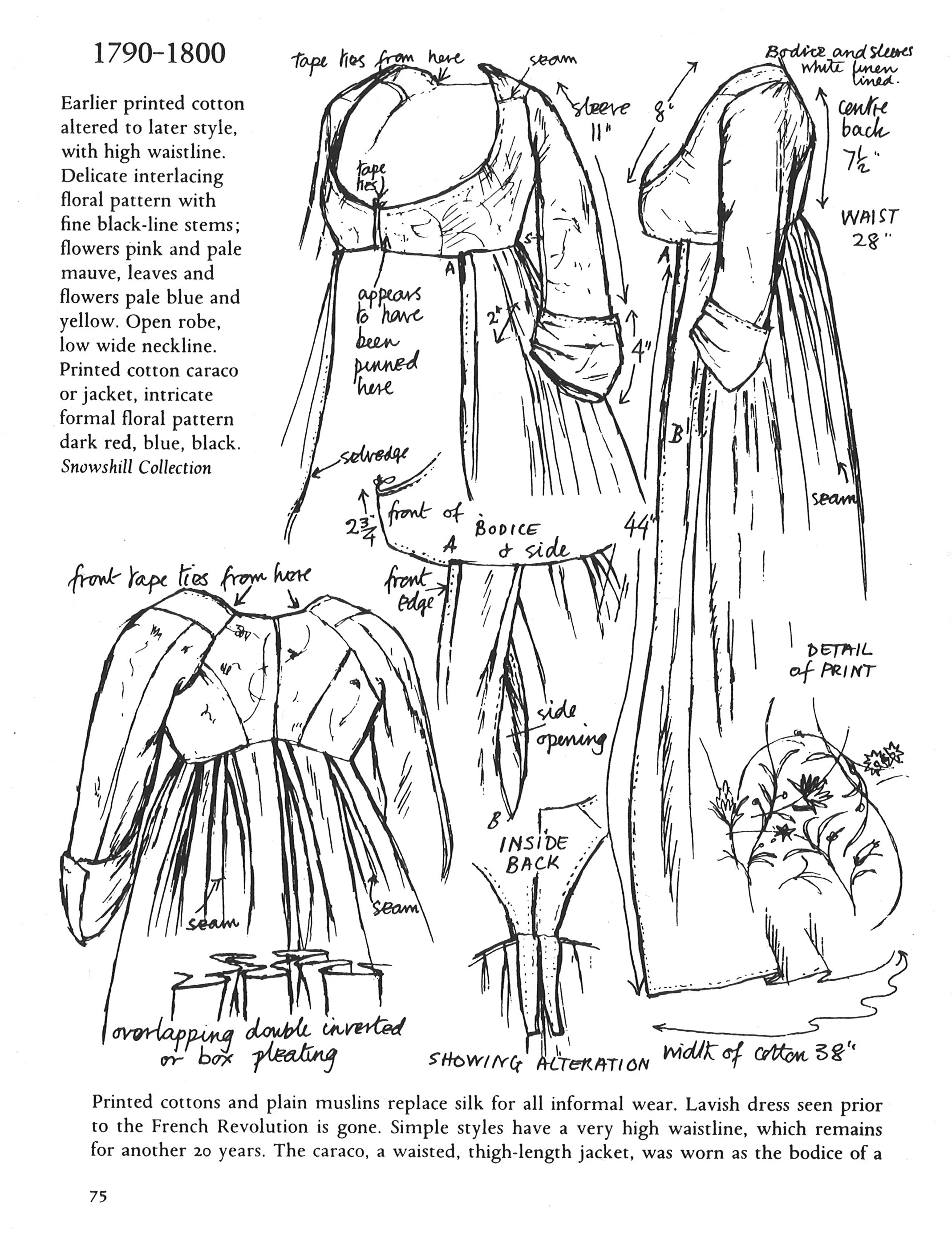
Dress number 2, 18th century, French. Printed cotton. Actually a two-piece item, jacket or bodice and petticoat, this is probably 1790-1800. Dates are good for work and other places in Rhode Island. Problem? It’s French, and there’s no evidence that anything like this was worn in the U.S., much less in New England.

Dress number 3, mid-18th century, American, linen and cotton. The bodice closes edge-to-edge, the back is pleated, and the skirts open. Probably 1775-1785, trending later than 1775 judging by the closed front and the longer sleeves and the style of the cuff. Not OK for Rev War events. Just OK for events at work, but not ideal.

Dress number 4, ca. 1780, from the Scottish National Museums. I have been looking in the National Trust Collections online for an image of the gown that appears in Nancy Bradfield’s book (see below), but to no avail. (I do keep falling asleep at night, and while that doesn’t help, it may be that the dress has not been photographed.) The fun part of this dress is that I have some light-weight Ikea curtains to make a petticoat and  kerchief out of. Also, my hair can get into the crazy hedgehog style practically on its own. But I can document this to Rhode Island 1780-1790?

See the dilemma? Maybe the thing to do is to make the fabric into a banyan for Mr S (that would be a little weird to see on a private soldier in von Steuben camp) and think again about the later styles.

Or maybe the thing to do is to lighten up a tiny bit and make a dress that’s just for fun.

Images and Ideas

If the museum date is mutable, what to do? How to take non-illustrated Vogue for the Lower Sorts and turn it into an actual plan for a garment? By using period images.

Anne Carrowle runs away in 1774 in “an India red and black and white calicoe long gown,” but what does that mean?

Start with the negatives: It means she is not wearing a short gown or a bed gown or a jacket. She’s probably wearing what we most commonly think of women wearing, an ankle- or near-ankle length dress, open in the front (remember that the petticoat is described!) that pins to a stomacher or is fastened with bands or a band over a handkerchief.  (Excellent info on the topic At the Sign of the Golden Scissors blog.)

 When I start thinking about a gown for 1774, I start looking for earlier images. Not too much earlier, but a range. In this case, Anne left England in 1769, so 1769-1774 seems like a reasonable time frame. I made a Pinterest board for 1765-1774 ideas, which is easier than posting them all here.

To the left is a robe that’s clearly open: it’s hanging open. Laundry-work, women washing at Sandpit Gate, Paul Sandby, 1765; watercolor. Royal Collection.

1765 gets us closer to the time period, and it is before Anne left England, and it’s likely from the class she was born into. But it is early.

The two prints above are both from 1774; on the left, note the maid’s gown, which hangs open and has robings. On the left, the old woman asleep wears a gown laced over a stomacher.

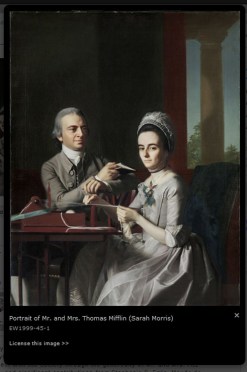
But best of all perhaps is this image, of Thomas Mifflin and his wife, Sarah Morris Mifflin, painted by Copley in 1773. Thomas Mifflin (1744-1800) and his wife, Sarah Morris Mifflin (1747?-1790), were the only Philadelphians painted by John Singleton Copley. Mifflin was an ardent patriot and by the time this portrait was made, had established himself as a successful merchant; later he rose to the rank of major general in the Continental Army, and was elected the first governor of Pennsylvania after the United States achieved independence.

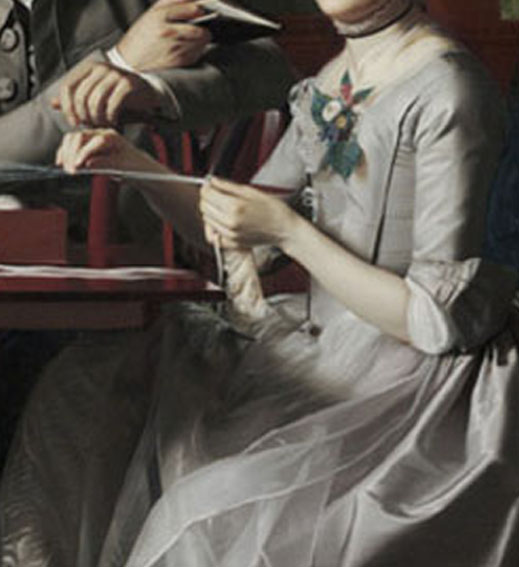
Why does this work for me? Because these are Philadelphians, and my woman ran away from the Philadelphia area. The detail really shows that Mrs. Mifflin is wearing an open robe with robings and stomacher over a quilted petticoat with a filmy white apron. This is multiple tiers above Anne Carrowle, but the style is what I’m aping, not the materials (obviously silk).

Another Copley portrait, of Mr. and Mrs. Isaac Winslow, depicts a woman in a gown with robings and a stomacher. Jemima Winslow is 41 in the painting, putting the style into my ballpark, and better still, the gown is of a patterned fabric.

Below is a detail of the fabric and stomacher. Though it will be a vastly simplified version, I think I have a model for my dress.