
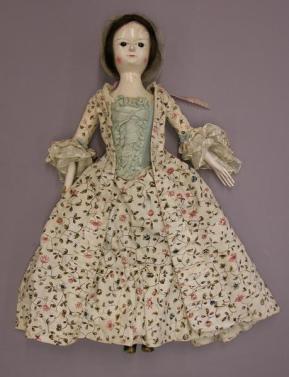
Sweet, right? Who wouldn’t want to look (or at least dress–those pupils suggest something untoward, chemically) like this doll? And she’s 1763. Of course, my friend DC didn’t get the grant he applied for, so he has to try again.
Still, it seems the event will go ahead and I am stumbling on under the impression that I will have a chance to make myself something lovely for August. Of course, that comes only after I make the regimental menswear, so why am I typing and not backstitching? Because after a while, it’s just plain dull. Plus, doll! Printed cotton! Lightweight and lovely! And look: a hairstyle I can manage: birds’ nest.

What I like about this doll are her details. (The better written description is on the V&A website, but the better photos are at VADS.) She’s wearing a sacque (known also as a sack-back robe or a robe a la Francaise) and matching petticoat, a green silk quilted petticoat, a white linen petticoat, and a pocket that matches her gown.
The blue silk of her stomacher is used as trim on her sleeves, which are ornamented with flounces. Hallie Larkin goes into this well on her blog post about Changes in Cuffs. And that’s what stops me: the fine linen and the lace.
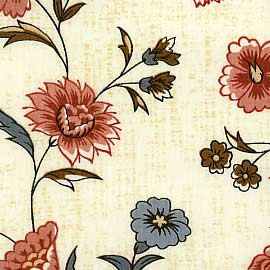
The gown itself, even a sacque, seems like something I can manage. (And yes, this is but one more piece of cotton sacque evidence.) A very similar fabric is available and if this sells out, there are variations on the theme. The blue silk stomacher can be managed: I have taffeta sources, and from making bonnets have learned the basics of the serpentine designs. I could make that. But those flounces–what about those?

Here’s the V&A description: “lace and cotton elbow ruffles.” Hmm. Cotton, perhaps that I can find in a fine, sheer weave. But the lace?
The more I think about this lovely gown, about the materials, and who would wear it, the more I think I’m better off sticking with lightweight wool and Sandby’s cherry seller...
I love a good challenge, but the lads need regimentals and their own 1763 apparel. Sandby’s woman wears a gown I’ve made before, so construction screw-ups will be fewer time will be shorter. And at least we can all wear whatever I make for various other celebrations and riots. New England had them in abundance in the 1760s and 1770s.
 Kirsten Hammerstrom
You must be logged in to post a comment.