International Women’s Day: I may have missed it online but I have spent this day– this entire week, in fact– working with a woman I greatly admire and like. I’ve written about her before, my 96-year-old friend who was in the OSS and married a man who had fought for Chiang Kai-shek in World War II and against the Communists after the war.
It has been a week of learning about my friend, her mother, her aunts and great aunts and grandmothers; of learning about her daughters (and son), and her friends and the work she did.
Tuesday night, we had dinner with one of her friends who lives in a little red house not far from where I lived before I left Rhode Island. The Little Red House, as we always call it, was cozy and warm, built in 1793 when the East Side of Providene was rural, and the north end of it occupied by the Dexters, Morrises, Sessions and Coles on their farms.
The parlor was small, and the five of us filled it (along with a silver standard poodle who shook hands with us all). We ate in what had been the kitchen of the house, with a fire in the fireplace that had been used for cooking (and was still set up for cooking, though that was not where our meal was cooked). We ate from antique transferware, drank wine poured from antique decanters, and sat on antique chairs at an antique table in a room lit by candles. I would be lying if I tried to deny the warm magic of the setting, the scene, and the storytelling.
But the point is not that I had a wonderful time: the point is that I learned that night, and this week, about the ways that women look out for each other (when they’re not competing with each other), and the ways that women shepherd the history of families and places as they maintain collections of furniture, textiles, paintings, and prints.
As I held my friend’s hand and lit her way with my phone flashlight down a stone path to a waiting Subaru, I might as well have been holding a lantern and guiding her down a path to a waiting carriage, where wooden and tin footwarmers would replace a heater and blower motor. Some things are timeless and placeless: friendship, love, and caring. The need (the aspiration) to always care for the people around you, to be gentle and giving when you can, and to take and ask for help when you must: Those “feminine” values are what makes the world go ‘round, and keeps it steady.
Changing seasons, change we can believe in, be the change you want to see in the world.
This dumpster fire of a year is nearly over, and the commonplace is to note how much has changed: that’s our human instinct. But much does not change, most often within ourselves.
It’s our perception or understanding that changes, and, if we are lucky, causes us to act. That’s the mechanism behind the progressive movement in enacting/reenacting/living history. It’s the mechanism behind organizational change, and personal change. Sometimes it’s the sole inspiration to get me to clean my house. Holy cats, that’s a lot of kitty fur! As the sun finally shines in on the rug.
Sometimes we push as hard as we can to make change happen, but lack access to all the levers: then we have to wait. I am waiting now: I have pushed every lever and turned every knob within my reach, and the waiting is agony.
High school seniors applying to college know this feeling: when will I know? People starting new habits wonder, when will I see a difference? As a species, we have trouble with time. But tiny changes and tweaks aggregate, accrue over time like compound interest. We’ll get there.
Think about what you used to know, and what you know now, how you’ve learned more about what (or who) you love, how the way you approach a problem from collar stands to coat names. All those little changes make a difference– all the difference, the only difference.
Dread Scott performing “On the Impossibility of Freedom in a County Founded on Slavery and Genocide” under the Manhattan Bridge (photo by Hrag Vartanian for Hyperallergic)
So I know a guy. Where I live, everybody knows a guy, but this guy I went to high school with, and stayed in touch with off and on over the years– we’re both art school refugees, looking at “America” in very different ways.
The work he’s done over the years has been controversial. But it’s his latest stuff that I’m thinking about– yeah, I know, I missed it: he’s always scheduled for when I’m at Fort Moonrise Kingdom, or, you know, tearing my life apart and rebuilding it.
Dread Scott. Images of Oppression. After a whirling dervish of a weekend that culminated in some fancy early-morning driving in Boston, I’ve almost forgotten why I was thinking of Dread Scott and living history, but here’s the short version:
Why do we choose to reenact or enact the moments or events we do? We are, by default in our selections, limiting our characters because of the script we choose. In the main, we continue to choose to re-tell and enact the dominant stories that align with common myths about the founding and history of the United States. Until we choose to enact other stories about our collective past, we will continue to enact the same arguments that Our Girl History and I have made in the past. That’s too meta even for me.
As a friend asked a few weeks ago, “Why do we commemorate massacres and not Mondays?” Let’s commemorate some Mondays, shine a light on some moments, and reimagine what enacting history can mean.
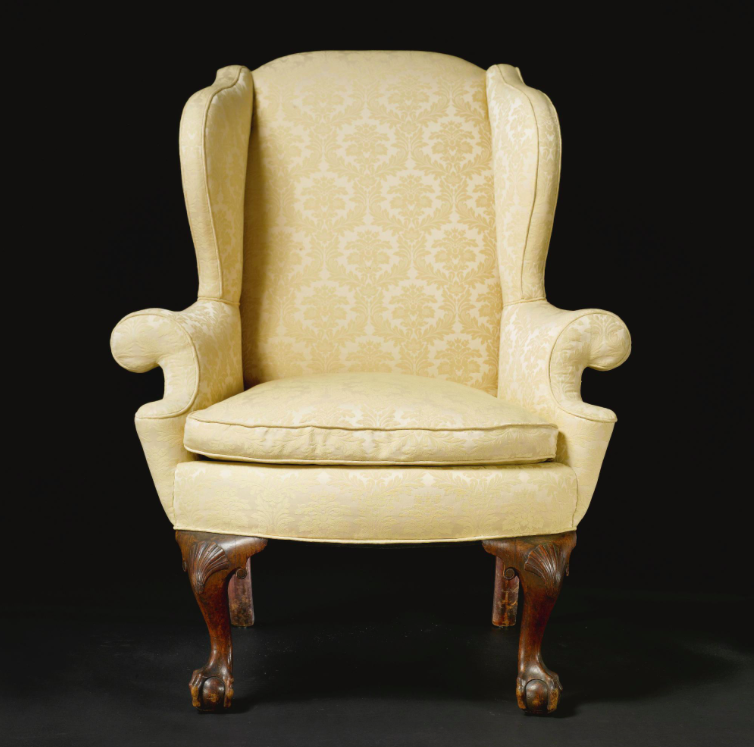
Sotheby’s Sale 8446, Lot 20. Easy Chair, Philadelphia ca 1770
We’re taking a brief break from this week’s nightlife programming to bring you this special report. Regular snark resumes with the next post.
It’s not a secret that I work in a museum. I operate in a world of objects that cannot be touched, sat upon, slept in, worn– you get the idea. Well, sometimes things that I believe belong in a museum don’t end up in one. Sometimes beautiful objects with great stories and deep resonance with the museum I think they belong in don’t make it there. Sometimes museum professionals take phone calls from irate family members who are incensed that you’re even talking to someone in the family about how to organize their materials. Sometimes objects do make it, but then, before the paperwork is executed, the gift is rescinded. People get weird about stuff.
Sometimes they get weird about stuff because of what it’s worth. Eleven years ago, a family chose not to fight over objects, but instead sold their family furniture. They grossed nearly $13 million. Thirteen Million Dollars: Enough for a baker’s dozen of Dr. Evils. With chairs that sell for $204,000 (Sale 8278, lot 586), it’s no wonder people get weird about stuff because of money.
Lot 586. It’s a pity the catalog is no longer available online, but even Sotheby’s has to conserve server space. It was a beautiful chair: a 1763 upholstered easy chair– upholstered by Plunket Fleeson of Philadelphia.* I pored over that catalog page in the Important Americana sale catalog. It would have come in just before Christmas, or just after, slick clay-coated pages printed with fine ink. When the auction catalogs arrive at work, we stand in the kitchen-mail room and bury our noses deep in the gutter: smells like money.**
Staircase Group (Portrait of Raphaelle Peale and Titian Ramsay Peale I) Charles Willson Peale. Philadelphia Museum of Art, E1945-1-1
I wanted that chair, Lot 586, that walnut easy chair made in Philadelphia. Wrong town, you say? Mais non, Philadelphia was the place to buy fancy goods– especially upholstered goods– in the 18th century. Providence merchants were trading with Philadelphia, the town that set the style for the colonies.*** It was sophisticated, urbane, refined. So, when Sarah Brown was pregnant with their first child, John Brown sent to Philadelphia for an easy chair. It would be the best.
He’d already ordered a tea table and roundabout chairs from Newport at the time of his marriage in 1760. These objects were about more than function: they were signifiers of taste and sensibility as much as wealth. So, as the time came closer for Sarah’s confinement, John Brown became increasingly agitated with Plunket Fleeson, who was delaying the delivery of the chair. John Brown was concerned for Sarah’s comfort postpartum, and said so in a letter. I can’t quote or link to it, because it’s in private hands, quoted in the catalog entry for lot 586.****
So what about that chair? Well… I got permission from the Authorities (a Board-level committee, with the support of the Executive Director) and we bid on the chair by phone. You know already we were not the winning bid. We were willing to bid a lot– really, a lot of money for us– for this chair.
Why?
Not because it’s worth so much. Not because of Plunket Fleeson, or the quality of the carvings, or the craftsmanship, really.
Because Sarah Brown sat in that chair cradling her son, James Brown, in 1763. She sat in that chair with the children who came after him, the babies who lived, and the babies who died.
Because that chair told a story about a family, about a relationship between a husband and wife, a man and a woman, at its most basic level.
That chair told a story about love.
Even I am a sucker for love.
Love is why people get weird about stuff, about the chairs, the family photos, the workbaskets, heck– the drill presses. We imbue objects with meaning, with memories, that substitute for the people we love when they’re gone. Sometimes it’s a t-shirt that smells of a lover. Sometimes it’s sewing basket used by three generations of women. And sometimes it’s a chair.
In the case of the easy chair, imagining the cradling comfort of the chair and the memories it recalls is simple. In the case of, say, shield back side chairs, the leap is a little harder. But perhaps– just perhaps– arranged around a festively set table, those chairs conjure memories of holiday meals, birthday dinners, graduation parties. Maybe those chairs take you back to the people and times when you felt loved.
Or maybe they’re worth $100,000, and you consign them to auction.
But if you value the story as much as the object, here’s the funny thing: you can keep that memory forever, and share the story with everyone, if you give that object to a museum.*****
When people really love an object and are fighting with their families over who gets to keep the things, I don’t play Solomon. I tell them a story about memory, and preservation, and about endurance. Sometimes I can convince them. Sometimes I can’t.
When I can’t, I tell them I understand, and that my priority– and my institution’s priority– is not things, but people. They can keep their object: we’ll be here when they’re ready. It’s all true, and I do mean it.
But inside, I feel like Indiana Jones, soaking wet on the deck of a pitching ship.
That belongs in a museum.
*If money were no object, I’d buy it for that name alone.
**The quality decreased in 2008, when the financial crisis hit everybody hard, but the paper weight and ink have been creeping back up in quality of late.
***I know, it sounds crazy now, but it was true. At the time of the American Revolution, it was the second largest English speaking city in the world, after London.
****You are correct, sir: I’d like the letter book it’s in, too.
*****Subject to acceptance. Some rules and regulations apply. Leaning is touching. Don’t lick it.






 Kirsten Hammerstrom
You must be logged in to post a comment.