Living the History Life

man in historical clothing smoking a pipe
Pre-event PR photoshoot. Photo by J. D. Kay

The recent BBC video making the rounds on social media got me thinking about how we live our lives, and what commitments we make to being our true selves, how we follow our bliss, if you will. It takes a lot of courage, willpower, and hard work to achieve one’s deepest inner dreams and although I have taken some steps towards mine, I have not let go all the way (as one does not when one is putting a child through college). 

I think about this desire to be true to one’s own internal vision, and I think about my friend Justin, who found a place and fell in love with what he saw, past and future. It’s hard work to run a farm and a business, but Justin does it beautifully, with grace and integrity. What he achieves makes me ache with want, not for the house, or the frozen cat’s water dish, or the work, but for the courage. 

Working with Justin pushed me into places where I found, if not fear, at least discomfort. As we said, It isn’t history till it hurts. The first What Cheer Day we ran, I remember standing behind the door on the second floor landing of the servants’ quarters, knowing it was show time. I looked at Justin and said, “What the hell have we done?” terrified to go out and “be” John Brown’s housekeeper. But, out we went, and it was amazing. That work inspired me to push myself harder, to try the things that scared me and made me uncomfortable. That’s where the meat is, and the truth: where things hurt.

woman and man in historical clothing looking at a book
The housekeeper was caught reading naughty novels. Photo by J. D. Kay.

As with all things I tackle, I could push myself harder, not to sew better or more authentically (that’s the easy part, really) but to live the way I want to, authentically. To decide what matters and what doesn’t, and stick to it. That’s the real lesson of these men, and why they’re inspiring. I just happen to prefer the one with mud. 

Codes of Conduct & Rules of Civility

These have been a tough couple of years. We are, once again it seems, in a period of polarization and increasing political violence. In times like these, when disagreements flare brighter and behavioural norms are changing, even the things we do for fun can be affected. From online fights that turn nastier than ever to onsite behaviour that runs the gamut from passive-aggressive to hostile, the real world creeps into our fantasy worlds. I have experienced and seen behaviour that I find unacceptable. It was subtle, but not acceptable. When I posted about it online, a lively discussion ensued.

From that, an idea was born: Sharon Burnston suggested a Code of Conduct, which I heartily endorsed. Drawing on her experience organizing and managing events and groups, Sharon wrote a draft code of conduct. Now, with edits and suggestions from others, it is available on her website.

“We are all here at this site/event for the same purpose, to portray events that happened here in the past for the benefit of the public, and for our own enjoyment. We agree to follow the site’s rules for fire safety, gunpowder and weapon safety, curfew, alcohol consumption, and whatever other restrictions they require of reenactors. Just as we have agreed to adhere to standards for our clothing and our kit, it is appropriate that we agree to adhere to standards for our behavior. The standards for our behavior are modern, not period. We are interpreting history, not re-creating historical attitudes to class, gender, or race. We are 21st century people, and 21st century expectations apply.

In its simplest terms, treat everyone else as you would want them to treat you. Don’t be a jerk. But to break it down into specifics, and in order for this community to feel welcoming to the largest possible population, we expect everyone to endorse the following standards of behavior. Anyone who cannot adhere to these simple rules will not be invited to future events.”

Don’t be a jerk.

Seems so simple, right? Apparently not for everyone, because not everyone embraced a fundamental grade-school lesson:

“I will take responsibility for both my actions and my feelings. I have the right to have my feelings respected, I have the right to be heard and understood, I have the right not to feel pressured or browbeaten. I extend the same rights to all other reenactors and to the public.”

For me, this presents an interesting conundrum. You see, I kinda started this when I announced online:

Now, this is in fact a wimpy way to deal with a person who I think treated me pretty shabbily at an event, and who made clearly misogynistic comments at that event, and has posted white nationalist stuff on social media. A quicker-witted person than I would follow Sharon’s precept six:

“I will call out these inappropriate behaviors in others. If I see something, I will say something – either to the offender directly or to an authority figure – a captain, event planner/organizer, or someone I trust. I will stand in solidarity with my fellow reenactors and pledge to stand up to bullies, abusers, and other unpleasant behavior to ensure the safety and comfort of those around me.”

This last is easier for some than for others. It gets easier when one can believe that one will be listened to, heard, and taken seriously. And that is not on the person reporting: that’s on the person hearing. When someone’s feelings are dismissed, or another’s actions excused (he’s a good guy; he’s just insecure), the status quo is maintained, the ranks secured, and the world unchanged. It will take all of us to make places safe and pleasant to be it. A code of conduct we can all agree to is a good place to start.

Living Deliberately

WCD: The Original

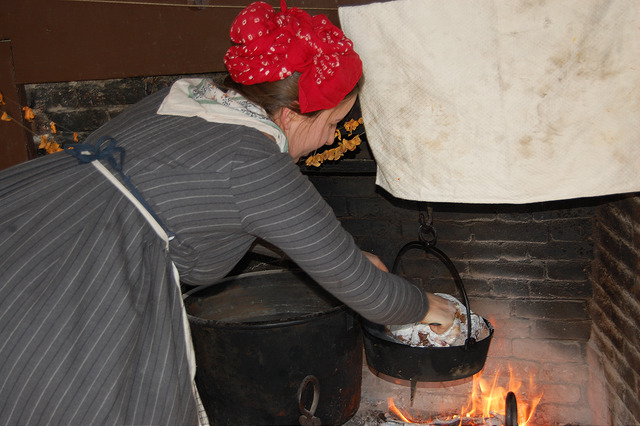
A friend of mine recently wrote about replicating the domestic life of the past (specifically the 18th century) and how much meaning that had for her.

Being so deeply embedded in the rhythms of life there, it became my home in a very real sense that has never left me.

I read that quickly, and what I read was that the place she had spent so much time was home to her because the place never left her– she carried its rhythms and seasons within her. Perhaps that isn’t quite what she meant, but that’s the risk of writing: the reader reads what they need to.

It made me think of home, and of living deliberately, and of a very bad year I had a long time ago, before I even imagined doing living history, when I thought I would spend my life making new things, like cities and buildings. (This makes me think of an album I listened to at the time, More Songs About Buildings and Food, which seemed all the more important because I’d gone to RISD, too.

Food, in a Building, in Rhode Island

The year I turned 25 was particularly bad not because a man broke my heart, though that didn’t help, and not because I had a miscarriage, though that was the catalyst that led to the man breaking my heart, but because the miscarriage shattered my sense of purpose and self. Somehow, everything that I had ever wanted to be — a sculptor, an architect, a writer– was gone, and I didn’t know what to do or how to be. (Read The Year of Magical Thinking if you want a well-written take on this kind of loss.) I didn’t know what to do next, but the man who eventually broke my heart gave me a book to help me figure it out: Chop Wood, Carry Water

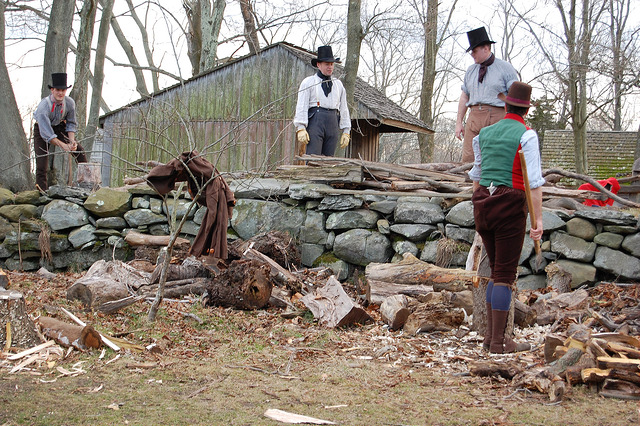
Chopping wood.

Two years ago, I wrote a piece called Zen and the Art of Living History, in which I extolled the virtue of the everyday: Embrace the everyday, bring everyone back into history. Since then, I’ve thought more about how history and historic house museums can be a catalyst for change, how domestic sites can create “homes for history,” where we can have the difficult conversations that must be had to make the change I think we need as a nation, and as humans. These changes are happening, slowly, in museums and at historic sites, but even at the personal level, there’s meaning and change to be had through the business of “doing history.”

I suspect that among the reasons people really enjoy immersive, civilian (non-musket) events is because the work brings them into the rhythms of the natural world in a way that industrial life precludes or even prohibits. Consciously or not, interpreting the domestic life of the past forces us into mindfulness, into being as much as or more than doing. That’s the point of “chop wood, carry water:” to live deliberately. To cook without a clock, with only the color of the coals and the smell of the food to guide you; to notice the changing light because, as it fades, you must act to create light; to find the flaws and shifts in a floor as you scrub it, because there’s no machine between you, just your hands and a brush or a mop: all these tasks force you to be in the moment, noticing your environment, noticing yourself. You. A corporeal presence in a material world. How does that feel, moment to moment? Physically, emotionally: the challenge of living in the past is to live an unmediated life.

To go back to basics the way we do with civilian or domestic-site based living history brings us back to our base: we face our physical needs and the challenge of meeting them. We face emotional tests that help us imagine how people in the past endured– I often wonder how everyday people coped with “melancholia,” grief, and disappointment– and help us endure. It brings us home to ourselves, to our individual histories and our shared histories, and that’s what really matters. The connection to the everyday that we experience in a place in time puts us in a continuum with the people of the past, and gives us a place to be, a thing to do, a meaning. And that is what every one of us needs.

Didion, Despair, and Not Looking Back

Not everyone develops a relationship with a place that feels romantic, a relationship so intense, even when tortured, that when you leave, at last, as leave you must, you are torn apart by knowing the place abused you– and knowing you must go. Still: you love the place and cannot quite bear to not be there. It’s a complicated thing, and as with most tempestuous relationships, this tug of a place on one’s heart must be analyzed, objectified, studied, and understood. I thought I was making progress that way until I was given a chance to look back– don’t ever look back– and even though I did not look the basilisk full in the face, I was nauseated: waves of sadness and anger broke over me at reading a head line and image caption.

I stepped back to consider just what it was about the place and the situation that affected me so. Reading almost always helps. This time, I pursued literary criticism as a means to understanding. Van Wyck Brooks absent from the shelf at my local public library, I took hold of Joan Didion, and found myself rewarded.

The Seacoast of Despair” described my place perfectly.

‘Happiness’ is, after all, a consumption ethic, and Newport if the monument of a society in which production was seen as the moral point, the reward if not exactly the end, of the economic process. The place is devoid of the pleasure principle.

Devoid of the pleasure principle? In Freudian psychology, the pleasure principle is the instinctive seeking of pleasure and avoiding of pain in order to satisfy biological and psychological needs. Specifically, the pleasure principle is the driving force guiding the id. Didion states, “To have had the money to build “The Breakers” or “Marble House” or “Ochre Court” and to choose to build at Newport is in itself a denial of possibilities; the island is physically ugly, mean without the saving grace of extreme severity, a landscape less to be enjoyed than dominated.”

Indeed. Mean with the extreme severity, a landscape to be dominated. Those phrases define the principles that shaped my relationships with a few denizens of Newport, who, in truth worked and did not live there, but who seemed fully to embody, embrace, and imbue their personages with non-pleasure principled forces drove them to dominate others, and to consume, for their own use, much of what they encountered. Didion described my experiences and observations of Newport in language better than I could ever hope to conjure.

Three years ago this week, I came to a realization, first on a drive to Newport, and then on a train to Boston. I saved the tweets from that train trip.

I went to Boston that Saturday–it snowed; the train was an early one–to make a presentation at History Camp on work that related to Rhode Island and to Newport history. Earlier in the week, I’d had a vision in Newport that unsettled and delighted me, and informed those tweets.

“There was a for sale sign on one property (Sotheby’s Realty, of course), and for an instant, I imagined walking into the house and owning it, starting a life completely different from the one I live, with different people and places.”

Between that vision on Bellevue and Saturday’s train trip, I had enough exchanges with the object of my desire to form a fuller notion of what that vision meant. That understanding led to the tweets, which I posted as #fiction to protect the vision, and the desire, from the reality of my seemingly-unalterable situation.

The miracle here is that I had a vision, and have very nearly carried it out, despite not fully understanding how much of my standing life I would have to burn down to achieve that kind of freedom. It had not occurred to me that moving and changing  to achieve what I wanted–to no longer have a secret, to grasp those lapels nearly every night when I arrive home from work, and taste that accent on every kiss– it had not occurred to me how much I would have to destroy, or leave behind, and that in doing so, I would leave bones of my former soul to be picked over by opportunists ready to exploit an opening.

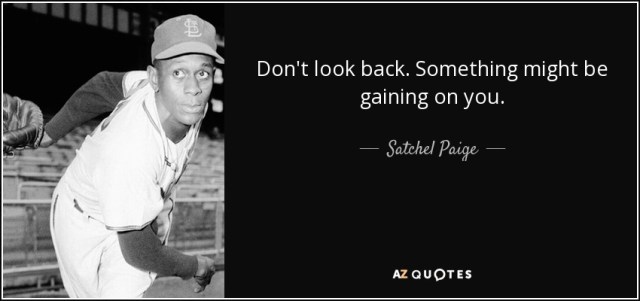
The consumption ethic: they have grabbed what they could not get while I was still there, and they run their paws over the work without fully understanding it. And that is where I can take my sole pleasure: the schadenfreude of watching them strive and fail, or perhaps the pleasure of watching them reach and grasp. Either way, I know I cannot look back. Something might be gaining on you, and it’s best to outrun those monsters.
Didion, Joan. “The Seacoast of Despair,” p. 157-158.  Reprinted in We Tell Ourselves Stories in Order to Live, New York: Everyman’s Library, 2006.