“Been employed these several years past”

Part One of a Series

Occupied Philadelphia at the MoAR is one of my favorite events. It’s not too far, in an urban setting, and makes visible the history of the Revolution that’s hard to get at, the history of everyday people. Last year, I portrayed a follower of the 17th Regiment of Foot and a petty thief; this year, I wanted to do portray a woman in business. I’d settled on a milliner because that’s a trade I know well enough to portray–though I could not find documentary evidence of women in the millinery trade during the early months of the Occupation, nor could I satisfactorily justify selling hats, bonnets, and jewelry to a population facing inflation and food shortages. Happily, just two weeks before we’d have to pack the car, the program manager posted exactly what I needed, but had missed by not looking late enough into October: an ad placed by a woman in business.

Advertisement placed by Elizabeth Weed, Pennsylvania Evening Post, Thursday, October 23, 1777.

This is what I’m always looking for: someone to be, a solid place to start the research that takes me from the general to the specific. Who was Elizabeth Weed? She was only a little tricky to find. Records documenting Elizabeth Delaplaine Dickinson Weed Nevell are scarce. Based on the date of her first marriage, to William Dickinson, in 1755, she was probably born between 1730 and 1735, making her about 44 to 47 in 1777. She was widowed by 1768, the year she married George Weed, who had lately been the superintendent of the Pennsylvania Hospital until 1767, and was then a practicing pharmacist. Weed, born in 1714, had studied and practiced medicine in Connecticut and “West New Jersey” before moving to Philadelphia around 1760. After his death on February 1, 1777, Elizabeth Weed prepared and sold the medicines George Weed taught her to prepare, and, presumably, to dispense.
Portraying a widow six months after the death of her husband seemed plausible: I have a grey wool tabby gown (with a Fort Ticonderoga white wash stain) that seemed reasonable enough for “second mourning”– until I discovered that Elizabeth Weed had purchased a house for £600 just before she married her third husband, Thomas Nevell. A widow of means was going to require a new gown and accessories in addition to the materials of her trade– two research rabbit holes at once (plus Thomas Nevell, since he provided Drunk Tailor with an ideal role for the weekend).

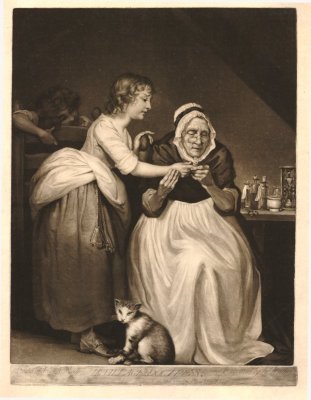
Period prints provided some guidance, and since widows took up the trade of ‘doctress’ often enough, some provided a glimpse not only of clothing, but also of the material culture of 18th century pharmaceutical practice. Fortunately, I had a gown-length remnant of black and white silk in the strategic fabric reserve, as well as a remnant of black silk for a mantelet.

Portrait of Mr. and Mrs. Thomas Mifflin (Sarah Morris). Oil on ticking by John Singleton Copley, 1773. Philadelphia Museum of Art, EW1999-45-1

When she married George Weed, Elizabeth had already lost one husband, so an English gown with robings seemed a reasonable choice. Mrs. Thomas Mifflin’s grey silk gown lurked in my memory as inspiration (or justification) for the style of gown, though not for the meaning.

In many ways, the material trappings of widowhood were the easiest part of this project. I’d done some research on late colonial and early Federal mourning customs in a previous life, and had a sense of what was expected of bereaved widows in the 18th century. Clothing and accessories would signal status, and guide the behaviour of others towards me (in this case, keeping Thomas Nevell at a respectable distance). I could have chosen a gown already in my wardrobe (grey wool, green wool, blue wool) but inhabiting the world of the widow from the skin was important to me as a means of fleshing out a real person for whom I had scant information.

Making an Impression

Trade card for Dorothy Mercier, Printseller and Stationer; Etching with engraved lettering below. Print by Jean Baptiste Chatelain after Gravelot. 1745-1770. British Museum, D,2.3396

Dorothy Mercier: widow of an artist (and a painter herself), Mercier went into business after the death of her husband, Philip, first as a printseller and stationer, and later as a purveyor of artists’ supplies. Some of what she sold is listed below the vignette of a shop, and includes ‘all Sorts of Papers for Drawing, &c./ The best Black Lead Pencils, Black, Red & White Chalk./ Variety of Water-Colours, and Camels Hair Pencils./…English, Dutch, & French Drawing Paper, Abortive Vellum for Drawing,/ Writing Vellum, the Silk Paper for Drawing.’ She also sold “Continental prints” and “paintings of flowers in her own hand,” a pursuit considered suitable for ladies in the mid-18th century.

Evidence of widows taking over a husband’s print shop in the American colonies in the 18th century is harder to come by–there seems to be less specialization of retail sales in the colonies, certainly compared to London, which is one factor–though printers’ widows did assume their trade in Newport and Williamsburg, among other places. If we imagine a print shop in the colonies, what would we find for sale?

Nicholas Brooks’ ad from the Pennsylvania Packet of June 21, 1773 provides an answer:

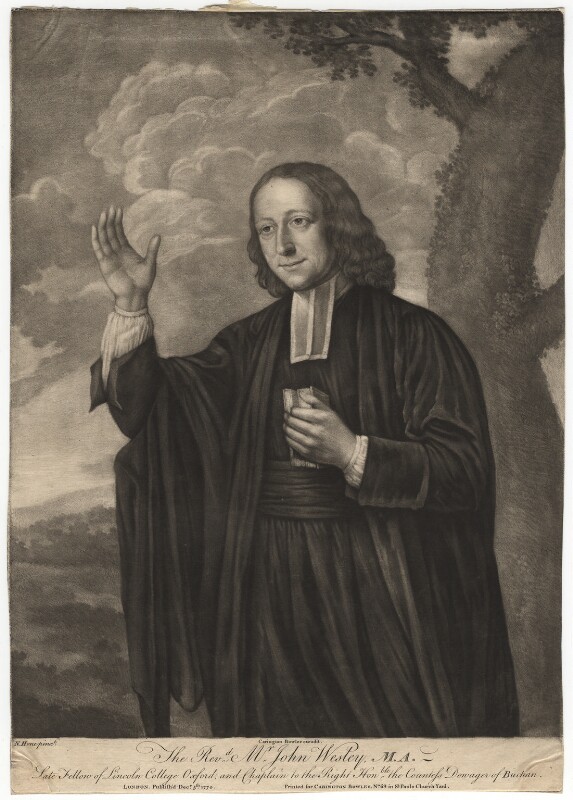
Mrs. Yates in the character of Electra; Venus blinding Cupid by Strange (that’s a print by Robert Strange after Titian, no matter what glorious oddity you may imagine), and portraits of George Whitefield, John Wesley, and other religious luminaries. Whitefield and Wesley were popular Methodist ministers: Whitefield, the peripatetic evangelist, was the primary force behind the Great Awakening, and Wesley, despite his loyalty to King and Church, was an inspiration to the Revolutionary movement in America.

John Wesley after Nathaniel Hone
mezzotint, published 1770
© National Portrait Gallery, London NPG D4740

This print of Wesley is one I have seen in person, in a period frame, with a period backboard inscribed “Capt. Wm Noyes 1st Conts” and to be fair, it is one I have spent some time researching, so the titles in that Nicholas Brooks ad– which I was reading for another purpose altogether– were exciting to find. When I think about visual or print culture in the Revolutionary era, I try to imagine the ways in which people encountered imagery, and how they understood it. Wesley– and print shops– are one way I begin to fill in a picture of the past.

Occupation as Liberation

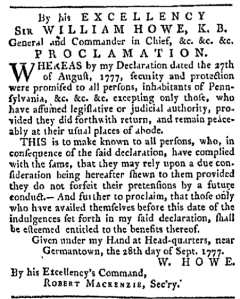
Philadelphia Ledger, October 10 1777

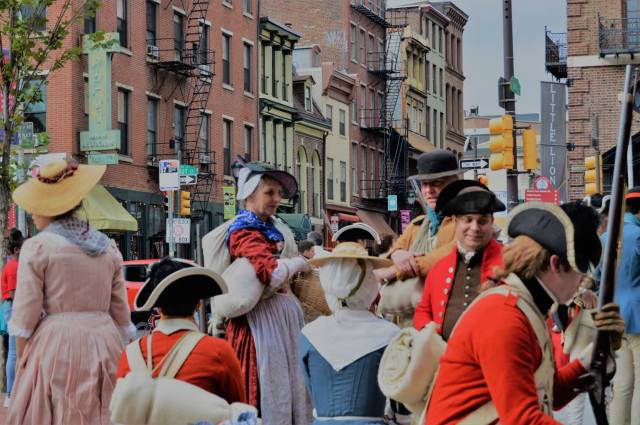
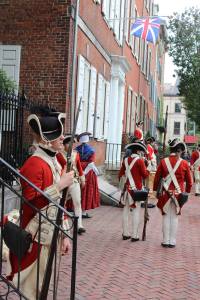
240 years ago, Philadelphia was occupied by British forces under the command of General Howe; the city was taken after a brutal campaign through the outskirts of the city, as you may recall from a few weeks ago— and this is after the Battle of Princeton, with the accompanying ravages upon the populace. This past weekend, interpreters at the Museum of the American Revolution brought the issues of occupation to life for visitors. But what struck me the most when we got home, was my cousin’s comment on this photo:

Hanging with the British and Citizens of Philadelphia

“I suppose you hang out with Confederates, too.”

Ouch, dude. That’s my partner you’re impugning.

Occupation of town/homes.

I understand that, in certain circles, British troops in North America during the American Revolution are equated with Nazis, and I understand that it’s easy to see the world in Manichaen terms (though my cousin usually does not), with good guys and bad guys. But after watching Ken Burns’ and Lynn Novick’s Vietnam War series, I am reminded how (grossly speaking) “one man’s terrorist is another man’s freedom fighter,” and while, as an America citizen, the “good” or “righteous” side should default to the Patriot/Whig cause, interpreting the other side offers room for people to question how they would have behaved in the past, and more importantly, to understand the actions of their country in the present.

There is no right answer.

Studying the past allows us to see the present through new eyes: Philadelphia in 1777 is occupied by a colonial power attempting (in part) to retain control of natural resources. Which side will you be on when the moment comes? Will you side with law and order, or will you side with natural freedoms and the rights of man (some exclusion apply; not all rights are right for you, and do not apply to African Americans, women, or American Indians, or non-property owning white men, etc. etc).

240 years later, what is the point of this hobby, these funny clothes, wandering around outside, talking to strangers? The point is that the past is always present. If we can understand the choices people faced in the past, we can understand our own predicaments better, and one hopes, analyze our options to choose better this time. We operate from a place of self-interest, even when we wish we could be idealistic, honorable. From the outside, actions aren’t always what they seem.

On Sunday (though I have found no photos thus far), I was arrested by the 17th for peddling a calico gown stolen from a room on Hamilton’s wharf, and alleged to be part of the Captain’s baggage. I tried to run, but was caught by two soldiers, and dragged away. From the outside, this looked like something bad: soldiers roughing up a woman. But I wasn’t innocent, and that’s the point: what looks like a bad thing may be a good thing. Costumed interpretation liberates us from the exhibit label, and allows us demonstrate a complicated past more quickly than a text panel can be read, and more engagingly.

When we assume that all Americans are “good,” we gloss over realities of people trying to get by when work, food, and money were scarce, and how “good” people do bad things. To play that well, you need both sides of the story. And that, dear cousin, is why I hang out with the Brits.