Women in Business


One of things I’ve struggled with in living history is reconciling my own life as a 21st century working woman and feminist with interpreting the lives of 18th century women.

Mrs. James Smith (Elizabeth Murray)
John Singleton Copley (American, 1738–1815) 1769

It takes a while– and a bunch of reading– to get past the notion that these women lack agency in their own lives. Sure, there are notable exceptions: Abigail Adams, Mercy Otis Warren, and Elizabeth Murray, but those wealthy Boston women aren’t the kinds of women I’m interested in portraying. What about more everyday women? What about the women more like me? They’ve proven harder to find, but not unfindable–though even they, by dint of being findable, are more exceptional than the vast majority of 18th century colonial American women.

Elizabeth Weed carried on her husband’s business as a pharmacist, noting that she “had been employed these several years past in preparing [his receipts] herself,” and was therefore well-equipped and trustworthy to carry on in his business. Rebecca Young advertised as a flag maker, and as a contractor, made flags, drum cases, cartridges and shirts for the Continental Army, thanks to her brother Benjamin Flower’s position as a Lieutenant Colonel.

In researching Elizabeth Weed, I read about other women running businesses in Philadelphia, and practicing as “doctoresses” in nearby New Jersey, demonstrating that Mrs. Weed operated in a context of other successful women, including some practicing medicine, or at least “medicinal arts.” What I would really like is to track down the records of a mantua maker or milliner in 18th century America, and not only because I make and sell gowns and bonnets, but because in doing so, I’m carrying on with the kind of work that my grandmother and great aunts did.
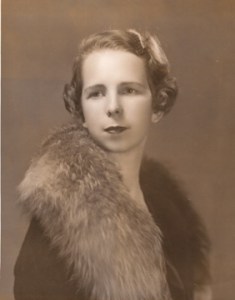
Elsa, Studio Portait ca 1935

For fifty years, my grandmother ran a dress shop in western New York state, dressing the women of Jamestown and the surrounding counties in fashionable and flattering clothes. My aunts made hats and accessories in their own shops, completing the look. I come from a family of makers (including a great-grandmother who made her own shoes), who care deeply about fit and helping people look and feel their best. My grandmother ran a successful shop for fifty years, until she sold it in the mid-1970s. I have many fond memories of sorting costume jewelry upstairs, and gift-wrapping boxes in the basement, with a rack of ribbons in all colors handy on the wall.

She was exceptional in her own way, though you will be hard-pressed to find much (if anything) about her on the interwebs, but maintaining a business through the Depression and World War II was challenging. She gave back, as a member of the YWCA and Women’s Hospital boards, recognizing the importance of sustaining the community you’re part of. When I portray Elizabeth Weed or Rebecca Young, or the Hawthorns of Salem, I think about my grandmother. Maybe it’s a step too far to say the living history work I do or the business I’ve started honors her and the other working women of my family, but I like to think that it helps make visible women who, though now forgotten, were as important to their own communities as she was.

In the Flag-Maker’s Shop

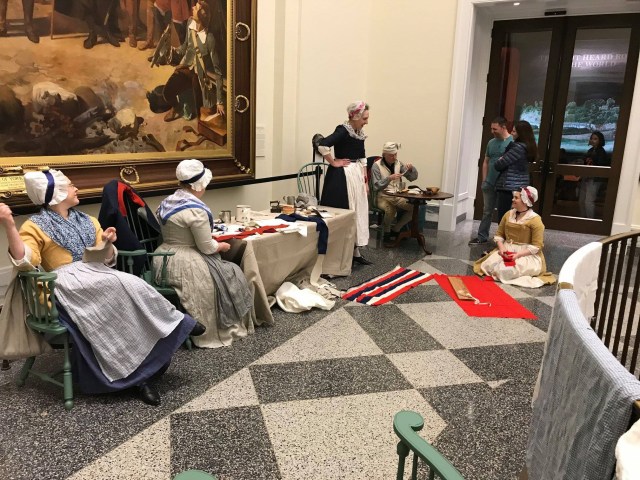
Saturday’s arrangement. Image courtesy of the Museum of the American Revolution

The biggest challenge in interpreting Rebecca Young and the shop she ran was not how flags were made (an appointment at the Cultural Resource Center of the National Museum of the American Indian answered that question*), but rather how to make sewing interesting, and how to create a more interactive experience for ourselves and for visitors. Some of my favorite living history experiences involve playing off other interpreters and the public, especially when trying to convince visitors to pick a side, carry a message, or share a secret. Saturday’s set up made that harder, with Rebecca’s shop of women behind a table (we wanted to be sure to be open to visitors, and not make the dreaded reenactor circle), and with Drunk Tailor rolling cartridges in a niche.

Nobody puts Drunk Tailor in a niche.

But what we saw on Saturday– a day with 800 visitors–was that boys between roughly six and 16 skipped from Drunk Tailor to the tailors, bypassing a table of women altogether. Older men (say, 45+) visiting alone also skipped our table, while the majority of our visitors were girls and women. This was not a surprise. Children begin to develop gender segregation around ages five to six, and sewing is often dismissed as “women’s work,” as the table of tailors experienced. These cultural biases were somewhat compounded by the nature of our work.

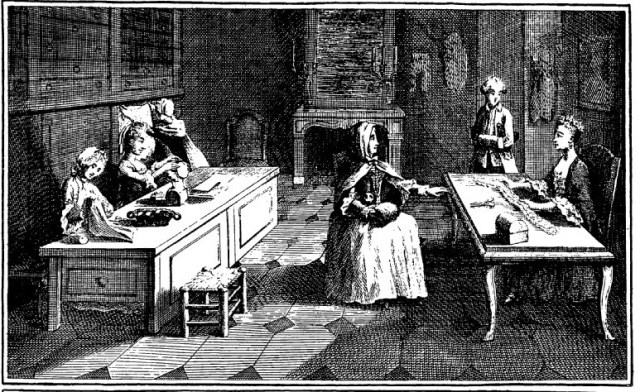
Tailor’s Art: Containing the men’s suits tailor, the skin breeches, the women & children’s body suit, the seamstress & the fashion merchant / by M. de Garsault, National Library of France
Sunday’s set up. Image courtesy of the Museum of the American Revolution

Sewing is one of those tasks that is downward-facing, internal, and meditative (until the thread tangles or snaps). It’s dull to watch, really; the exciting parts of sewing and making are draping, fitting, and cutting. Cutting. There’s something to that.

Combining the desire to interact more with our co-interpreters and the need to disrupt expectations of sewing, we rearranged the tables on Sunday, moving Drunk Tailor to our end of the atrium, postulating that his tea table and powder keg were in the yard of the townhouse, while we pushed our table closer to the tailors and against the railing, pulling our chairs to the side. We also draped shirts and fabric over the railing to display shirts and their component parts, along with bunting. While this “messed up” the atrium, it helped create a context for our work.

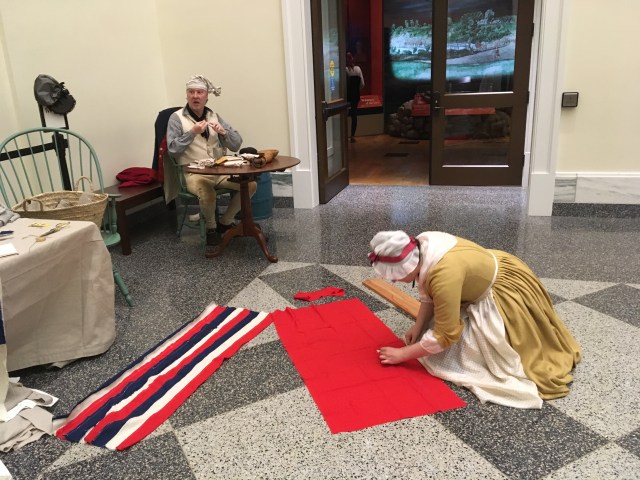
Sunday, workshops in a row (house). Image courtesy of the Museum of the American Revolution

But the best, most participatory change was Mistress V cutting flag strips on the floor, with the help of two young boys. This literally disruptive activity (you had to walk around her) changed perceptions of what we were doing, and helped people imagine assembling a large item (a Continental Standard) in a small rowhouse room.

If we take the Betsy Ross house** as an example of a Philadelphia rowhouse, , its exterior dimensions, roughly 16 x 25, yield an interior per-floor area of not more than 400 square feet. The Star-Spangled Banner was 30 x 42 feet; a second “storm” flag was 17 x 25 feet, large enough to cover the floor of a room in Betsy Ross house.

dark wooden drop leaf table with trifid feet
Dining Table (drop-leaf, gateleg table), probably Pennsylvania, 1750-1770. Walnut, oak. Philadelphia Museum of Art, 1994-20-60

While we do not know the exact dimensions of the flags Rebecca Young and her shop produced, it seems likely that any flag would have exceeded the size of a domestic table, since even drop-leaf dining tables of the period are not usually more than 52” x 41” or about 15 square feet (4.3 x 3.5 feet). The limited size of the table, and the need for multiple feet of cutting space makes it likely that flags larger than 3 x 5 feet were cut and pieced on the floor.

This combination of thought experiment and interpretive change up was reasonably successful, giving us greater understanding as we talked about assembling goods in pieces and working in a small shop while interrupting the visitor’s expectations.

*More on this another time.

**You have to start somewhere– and while I’m on #TeamYoung when it comes to flag making, Rebecca’s rented house has long been razed.


Research and primary source materials on Rebecca Flower Young were provided by Matthew Skic of the Museum of the American Revolution; compiled information used by gallery educators at the MoAR was compiled and provided by Katherine Becnel of the MoAR.

To Philadelphia, Again

Pennsylvania Packet (Philadelphia), June 28, 1781

This time, unoccupied. I’ll be representing Rebecca Flower Young at the Museum of the American Revolution’s Flower’s Artificers event this coming weekend, and to get ready, I’ve been reading research material generously shared by museum staff, as well as Marla Miller’s classic Betsy Ross and the Making of America, which mentions Rebecca Young in the context of the competitive world of Continental Army contractors in 1780s Philadelphia.

Rebecca Flower Young (1739-1819) was an older sister of Benjamin Flower (1748-1781), Lieutenant Colonel in the Continental Army. Before the war, she lived in Philadelphia with her husband, William Young, a goldsmith, and their five children. The family fled Philadelphia for Lebanon, PA in September 1777 as the British Army advanced to occupy the city; it would not have been safe for them, given their ardent Whig politics and relationship to Benjamin, commissary general of military stores. After William Young’s death in February, 1778, Colonel Flower secured a house for his sister on Walnut Street, and work as a contractor providing supplies for the Continental Army.


Rebecca made drum cases and shirts, cap linings and cartridges, and multiple Continental standards. From the quantities she produced– 500 cap linings for light horsemen– it is possible she hired assistants in addition to her children. Her 17-year-old son William made “five hundred dozen of Priming wires and brushes” in 1780, aiding the war effort through the supply chain rather than as a foot soldier, a condition that was likely a relief, given Rebecca’s status as a widow. She also let a room in the Walnut Street house, the boarder’s rent providing a relatively steady and reliable income.

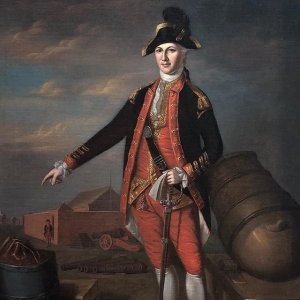
Col. Benjamin Flower, oil on canvas by Charles Willson Peale. Star-Spangled Banner House, Baltimore, MD.

We have no idea what Rebecca Young looked like, of course, though there is a portrait of her brother, Benjamin, in his uniform, as well as a portrait miniature sold at Freeman’s.

With only written sources about her work to guide me, I have waffled back and forth about Rebecca Young’s material world. In the end, I have made a much-needed new shift and cap for this weekend, as well as a gown (that, of this writing, requires only one cuff and the skirt hem). After reading Miller on Betsy Ross, I was of two minds: first, that the material world of these women was shabby and out-of-date, given the privations of the occupation and the war-driven inflation and second, that their status as contractors gave them an income that allowed them to afford new things. Still, with five children, new anything would have been a stretch, so I remain undecided and firmly ambivalent about the appropriateness of this gown. Scissors, needles, pins: those tools are much easier to understand than personal circumstances.

We approach representing the past with preconceptions that are hard to shake: the images we have in mind are dominated by representations of people at the far ends of the economic spectrum. It’s as if we had only the Saks Fifth Avenue and Old Navy websites to help us understand American clothing today. The wildly divergent economic and material situations tell us little about the people in the middle, who make up the vast majority of the population. 

Research and primary source materials on Rebecca Flower Young were provided by Matthew Skic of the Museum of the American Revolution; compiled information used by gallery educators at the MoAR was compiled and provided by Katherine Becnel of the MoAR.

Come Dancing

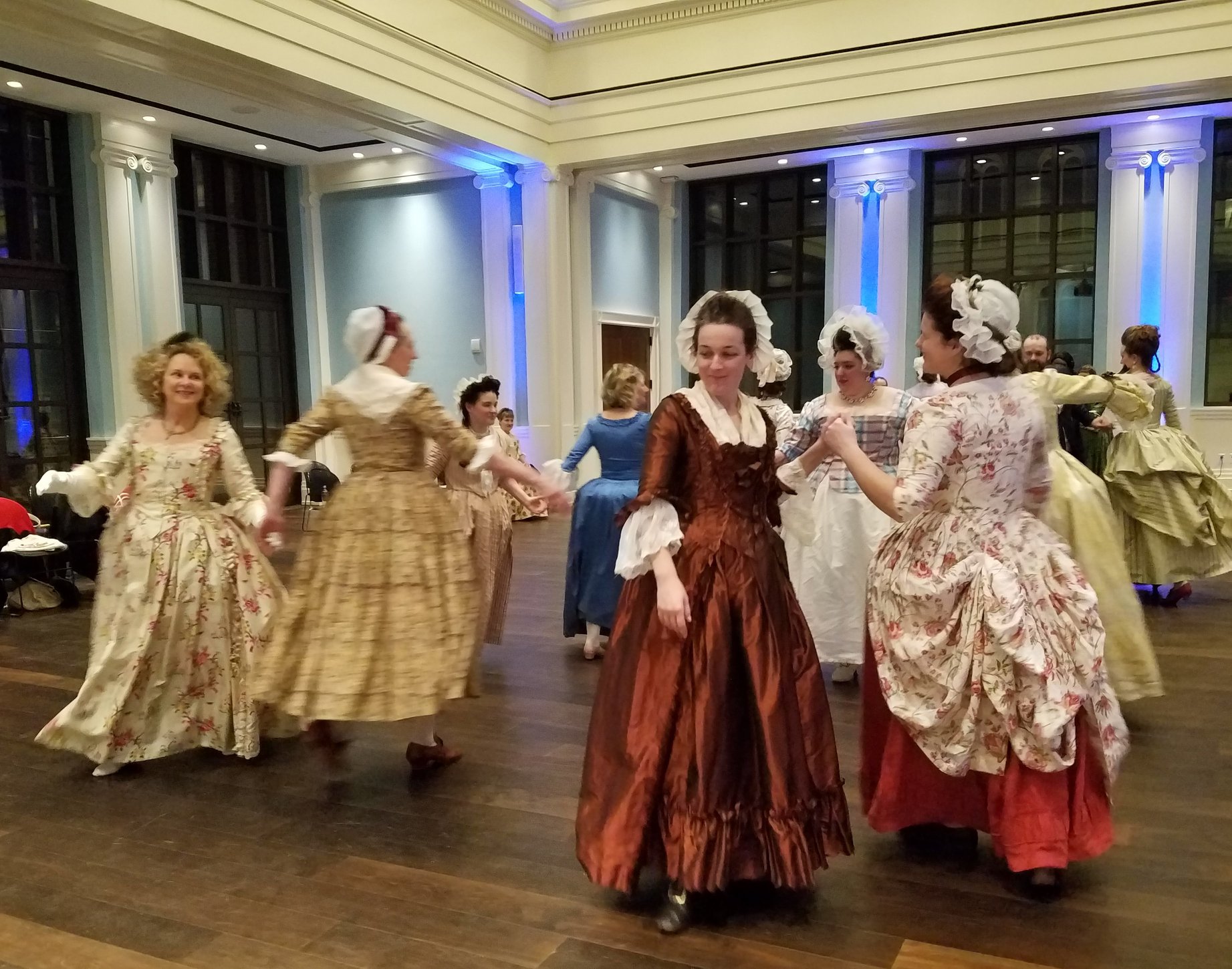
There haven’t been as many chances to dance as I’d like of late, so when I got the Museum of the American Revolution’s invitation to come dancing at their January History After Hours event, I said yes. Luckily, I had to be in Philadelphia for the next day anyway, so out came the 1780 appropriate dress and the fancier shoes, along with my resolve not to be a wallflower, and off I went. I very nearly made it on time, but I dressed as fast as I could, and managed to join the crowd with my dress pinned and my hair tamed.

As at past balls, I was rescued by a kind soul (and excellent dancer) who took me through the steps and saved me from my occasional pattern dyslexia. (Reversing can be tricky– they didn’t let me drive the forklift much in school because my brain sometimes struggles to process a mirror image.) But Miss V was a gracious partner, and reader, I confess: I greatly enjoyed myself.

One aspect of historical dancing that has always appealed to me is the relationship between classical ballet and traditional English country dances. While you won’t find tutus on Jane Austen’s dance floor, you will find balancé and glissade, and the use of positions. This connection between two things I love, and the way movement can connect us to the past, makes me enjoy these dances even more. Using steps I learned and practiced endlessly decades ago in a hobby I pursue today is a very personal reminder of the persistence of the past.

An evening of dancing, with the best dance caller and instructor I’ve yet had the pleasure to meet, was a welcome winter treat.


Many thanks to Miss G.J. for the use of the photos, and deep honours to Miss V.D. as a partner, and Mr. N.V d.M., dancing master.