Bending an Elbow at the Seven Stars

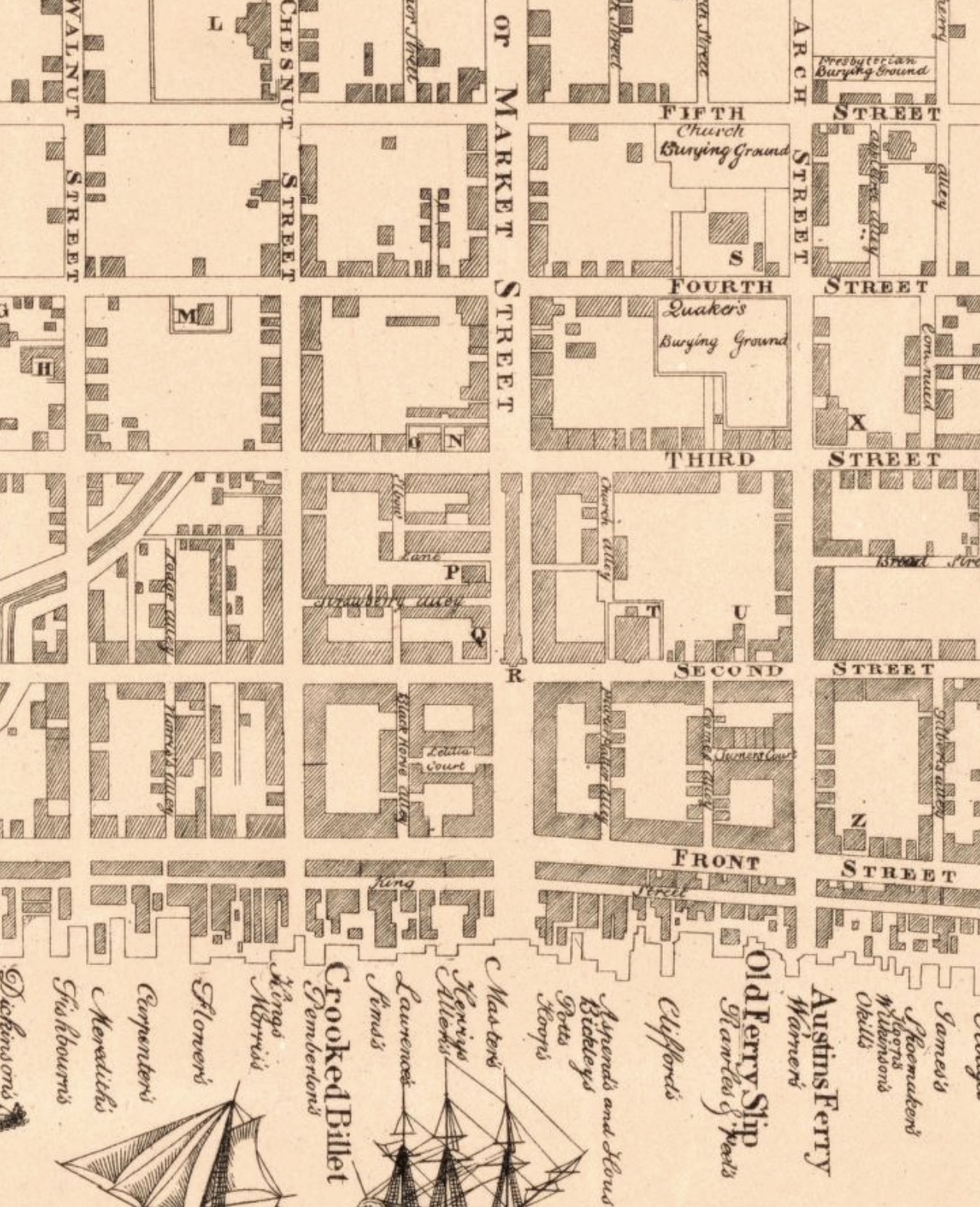
detail of an early map of Philadelphia
Detail, map of Philadelphia.

In 1769, Philadelphia had roughly one tavern for every 120 residents. They were clustered most densely in the area Chestnut and High (now Market) Streets, west from the Delaware River to what is now 5th Street. One of the oldest, the Crooked Billet, is called out on the 1762 map of the city by Nicholas Scull, reprinted and now at the Library of Congress. Run for decades by Rebecca Terry, the Crooked Billet primarily served the sailors and men in the maritime trades. Terry was not the only woman with a tavern license in the city—at least three other women, including Sarah Hayes, were long-time tavern keepers.

Sarah Davies Hayes owned two pieces of property on Elbow Lane and another on Chestnut Street; a Quaker, she married Richard Hayes in 1741. He seems to have been a shopkeeper, based on the probate inventory made after his death at the age of 34 in 1748. The inventory includes a side saddle, wearing apparel, a cradle, a fowling piece, and “remains of shop goods.” What kind of shop remains a mystery, as Hayes left no trace in newspaper advertisements beyond an ad placed by his executor in January 1749.  Sarah Hayes bought one piece of property on Elbow Lane in 1761, and the second in 1763; the Chestnut Street property was purchased in 1771. Hayes is listed in tavern license petitions for decades (see the Historical Society of Pennsylvania’s Tavern and Liquor License Records (1746-1863)) and appears in tax lists as an innkeeper or tavern keeper from the 1760s until at least 1780.

img_6337
A sign. It’s only 20″ x 12″ overall.

Tavern keeping was not an unusual occupation for a widow in the 18th century, even if she did not inherit the business from her husband. Some colonies, like Virginia, thought widows particularly well suited to the business, given their skills in household management and stereotype as sensible and moral (and not merry) matrons. In Philadelphia, licenses were issued annually (at a fee of £1/10) to those who successfully passed the scrutiny of the licensing board. (You can see a list of petitioners here.)

The history of the Seven Stars is hard to follow: Benjamin Randolph Boggs (HSP AM.3032) places it at 20 Bank Street, which the Mapping West Philadelphia Project gives as a calculated modern address for property owned by Sarah Hayes, which seems clear enough, though modern streets can be hard to map against historic property lines.* Tyler Putman dug into the history of this parcel and Elbow Lane in general. (Spoiler: there’s nothing to see at 20 Bank Street.) Here’s how Boggs starts his history of the Seven Stars:

                  “A short distance below the White Horse, also on the west side of the lane, at the spot now covered by the structure know as No. 20 Bank street, stood in very early times a small tavern known as the Sign of the Seven Stars, occupying a lot having fifteen frontage and a depth of fifty-six feet. John Eyre, or Eire, purchased the ground as a vacant lot from Ebenezer Large, currier, on September 19th, 1733 … Eyre was a joiner or carpenter by occupation, and upon his lot he erected a brick dwelling in which he kept a tavern, meanwhile working at his trade.”

After Eyre’s death, his widow, Mary, sold all the brick house and all his other property, as ordered in his will. Jacob Shoemaker purchased 20 Bank Street, lot and improvement and almost immediately re-sold the property to Mary Eyre, who continued to keep the tavern. Boggs describes a number of real estate transactions, concluding with the sale of the property and tavern to Thomas Rogers, “who succeeded her as proprietor.” How this squares with Mary Eyre’s appearance in the 1771 list of petitioners who received a tavern license is beyond me. Bogg’s data comes from Philadelphia Deed Books and newspaper advertisements, though he notes that the Seven Stars “may have been open down to the outbreak of the Revolution, but the newspapers of the period disclose nothing further about it.” (HSP AM.3032, Chapter 20, p. 498-499).

malone-1973-0561-frame
Settling the Affairs of the Nation. Winterthur Museum 1973.0561

Who kept the Seven Stars? Was it really at 20 Bank Street? Tax records and directories show a lot of taverns and inns on Elbow Lane, so even if the selection of Seven Stars as a name and Sarah Hayes as a proprietor is somewhat random, I know at least that Hayes, the Seven Stars, and the Lane were all real, existed together over three decades, and overlap in some possibly complicated way involving deeds, ground rents, insurance, and competition. Hayes will do to represent the archetype of the widowed tavern keeper of the Revolutionary City.**

img_5805
Tavern Interior, oil on panel, 1762, John S C Schaak. Sold by Bonhams.

The material world of taverns is much more satisfying to research and compile, though I did get hung up on which shape of bottle held which kind of alcohol, how beer was distributed from the brewery to the customer, and at what level of tavern one would find a Monteith bowl and a silver lemon strainer. The questions are legion: how many glasses? How many mugs? Were basins used on tables the way dishes were washed in early Federal New England? Prices posted or not when the Pennsylvania legislature and provisional government did fix prices in 1778? Some of these questions are answered in paintings from the Sea Captains in Surinam to the John S. C. Shaak Tavern Interior, others can only be guessed at until I find an inventory, if there is one to find.

Then, how do you communicate alcohol to visitors? They can’t taste anything so you can only let them smell the oleosacrum that’s the basis of punch, or the shrubs and cordials popular at the time. Happily, these come in beautiful colors and enhance a table display. My hope with a bench at the table was to invite visitors to sit at the tavern table, and with refinement, perhaps I can achieve that in the future. Reenactors, at least, can bend an elbow at the Seven Stars.

img_6368

*There’s a compelling argument that someone could untangle the confusion between Jacob Shoemaker’s lot, 20 Bank Street, the lot Sarah Hayes owned, and just who owned the Seven Stars, and where, exactly, it was, but I am not that someone.

**If you are thinking at this point that I have a problem with research and perhaps belabor a question, you are correct. My superpower is overthinking anything.

Objects and Time

IMG_5416
An assortment of old things.

The antiques I own stretch back in time, objects passed from hand to hand, connecting me to the past. It is particularly fine when they connect me to America, a place my people came to more than a century after these things were made. A paste shoe buckle. A chair. A portrait. There was once a fad for fake ancestors, buying a past you did not inherit, and the objects I collect are something like that, only less ostentatious– if only because the portrait is a miniature and not full size. 

Let’s start with the chair, the most expensive piece of furniture I’ve ever bought. (My bicycles cost more, and were, for a long time, the nicest and newest things I’d ever owned. It’s weird to talk about money and things, and what those things cost; we’re taught not to. That makes it even more important to be honest about context, even if I never tell you what I’ve paid.)

IMG_3069
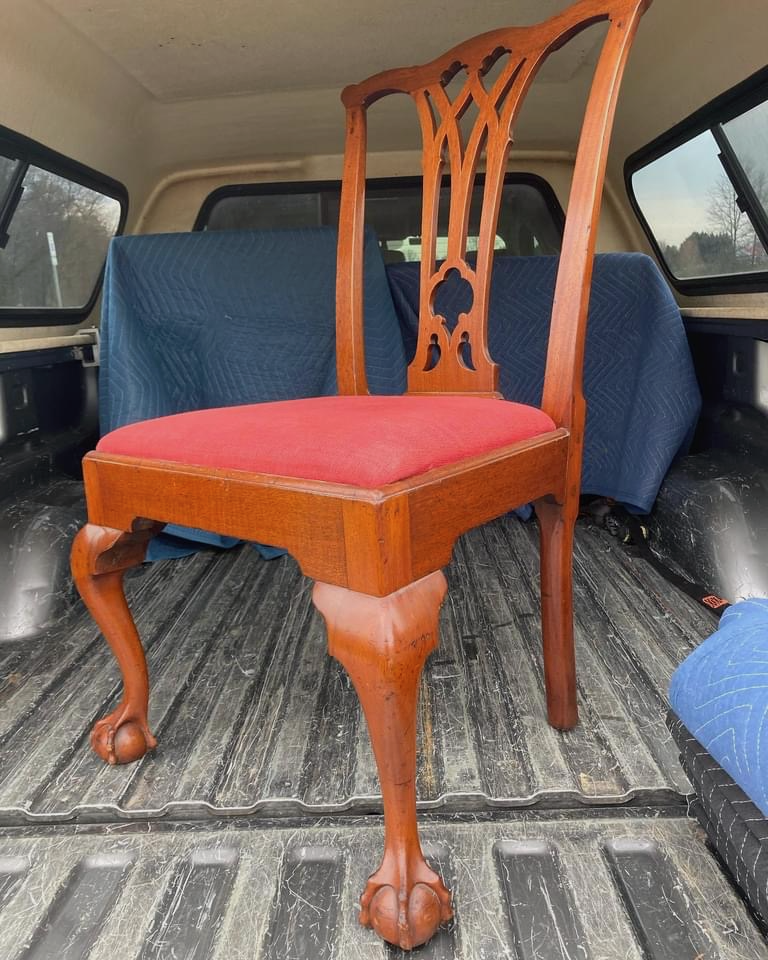
The chair as I first saw it.

The chair. 

I follow an antique dealer on Facebook, and in the spring of 2023, he posted a photo of a chair he’d just picked up from a collector in Delaware. It was a handsome chair, mahogany cabriole legs, ball-and-claw feet, shaped rear legs, pierced center splat, curved crest rail. It was marked on that crest rail: W. Hall. 

This was a Philadelphia chair, with classic signs in the shape and tension of the feet, the raised line around the arched piercings of the splat, the rhythm of the crest rail. It was simpler, plainer, cheaper, than a Thomas Affleck–the knees on those chairs— but the ogee (cyma) curves stepping down from seat rail to leg spoke of an eye for balance and for structure. There was elegance in the way that chair was built, an adherence to the style books but with a local flair. That was a Philadelphia chair. Delaware being close to Philadelphia, W. Hall was probably a Philadelphia man. 

There were not many candidates for W. Hall, despite the anodyne name. A few were laborers– they were unlikely to manage the fine, typographical incision on the crest rail, even if they’d once been able to afford a mahogany chair. Even less likely given that chairs like these were typically sold en suite, a set, two armchairs plus four or six or eight side chairs. Probably six; this wasn’t a Cadwalader-quality chair resplendent from the shop of Thomas Affleck with carving by James Reynolds and covers from the shop of Plunket Fleeson. 

So not a laborer’s chair. 

There was Richard Hall, a whitesmith, whose estate owned a lot on the east side of Second Street between Chestnut and Market Streets, on what was called Hall’s Alley, in 1777. There was Charles Hall, probably also a whitesmith, in Hall’s Alley, also in the Chestnut Ward. 

In the 1774 tax lists were James Hall, an innkeeper,  and John Hall, a tanner. 

DP104146The chair was probably made in the mid-1760s, a decade or so after the publication of Thomas Chippendale’s Gentleman and Cabinet-Maker’s Director . . . of Household Furniture in the Gothic, Chinese and Modern Taste

In the 1750s, Philadelphia high-style Chippendale chairs typically had exuberant carving– furry knees, complicated, twisted pretzel splats, shells positioned like merkins in the center of the seat rail, along with their ball-and-claw feet.  But makers knew there was a market for good-quality affordable seating, and William Savery filled that bill. Is that where this chair comes from? Is it the mid-market, aspiring merchant’s or artisan’s chair? 

1959.1332 A
William Strahan Hall, by William Williams, 1766. Winterthur Museum 1959.1332 A

Because there is another W. Hall, William Strahan Hall, the son of printer David Hall. If David Hall seems familiar, that is probably because he was Benjamin Franklin’s partner. Franklin hired Hall in 1743 as a journeyman printer; by 1748, Hall was Franklin’s partner. Hall bought Franklin’s portion of the business in 1766, and established Hall & Sellers with Wiliam Sellers. After David Hall’s death in 1772, his sons William Strahan and David Jr. assumed his part of the business, maintaining government contracts and printing, among other things, Continental currency

1766. The year David Hall bought Franklin’s portion of the business. The year David Hall commissioned portraits of all three of his children (William, David Jr., and Deborah) from William Williams. Was this flush, banner year when David also ordered a suite of chairs from a Philadelphia maker? Were the chairs then bequeathed to William, the eldest son, who inscribed one, claiming ownership? Maybe. Maybe this chair was someone else’s chair, some other W Hall somewhere among the years it traveled from Philadelphia to Delaware to Maryland to Baltimore.  

The story is the thing that makes the chair, however you imagine it. I know enough to know that calling this chair “in the style of William Savery, possibly from the family of David Hall, printer,” stretches every truth I know. But that sentence lifts the curtain on the past, on the webs of kinship and friendship that connected makers, buyers, and users in late-18th-century Philadelphia. David Hall, on Market Street near 2nd Street in the High Street Ward, was around the corner from William Savery on the east side of 2nd Street in the Chestnut Ward. These wards were packed with milliners, ship captains, merchants, and artisans, all aware of fashion and change, all aware of the ways that consumer goods expressed their refinement and sophistication, whether chairs, paintings, books, or bonnets. This is the story the chair can tell, populated with real people and places. 

A Milliner’s Wardrobe

Among the things I ponder about Anne Pearson Sparks is what she wore, and how much clothing she had. She would have seen the latest fashions and fabrics when she traveled to England to buy millinery goods. How did she translate those styles for her Philadelphia customers, like Mrs. Cadwalader, and how did she interpret them for herself? It’s largely unknowable since there are no known images of Anne. Probate inventories provide insights into the quantity and type of clothing women had in the 1770s. They skew higher income since people without wealth had so much less to leave, but given that Anne Pearson owned her own house, and had a £2700 marriage settlement, she certainly had means.

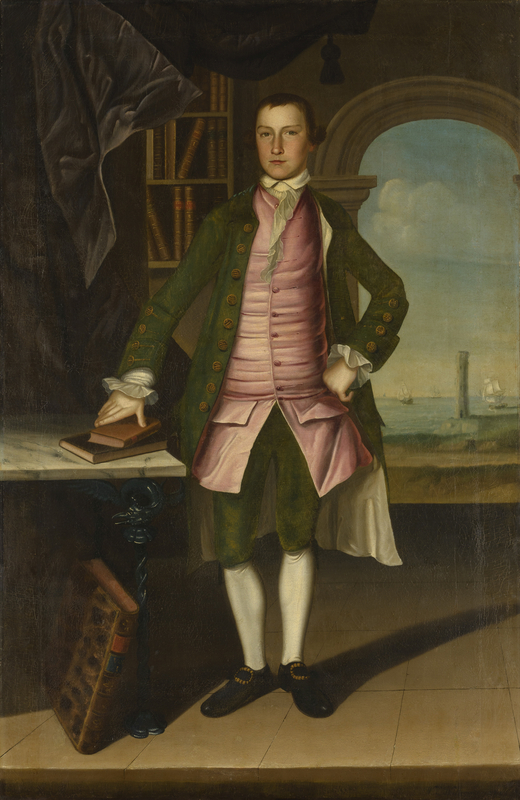
(Above right, Portrait of a woman by Charles Willson Peale, ca 1775. Metropolitan Museum of Art Accession Number: 26.129.2)

The February 1778 inventory of Mary Cooley’s estate, digitized by Colonial Williamsburg, provides an extensive list of clothing and other items owned by a York County (VA) midwife, including 10 gowns, 6 petticoats, 9 shifts, 5 pairs of shoes (4 leather and one black satin), 15 caps, 9 “chex” (checked) aprons, and 4 other aprons, presumably white. The type of gown is not specified, that is, they are not itemized as “nightgowns,” “sacks,” or “negligees,” though there is an additional wrapper. No bedgowns appear on the list, and there is only one pair of stays. Since only items with value (i.e. sale value) were listed, Mary Cooley’s total inventory probably included bedgowns. The clothing worn by the enslaved woman Bett and her child Peter was also probably not on the list. Bett and Peter appear at the end of the list after items typically found in a kitchen, where they probably worked, lived, and slept; it is likely their clothes were few and had no value.

What does Mary Cooley’s list suggest for Anne Pearson?

The gowns include:

  • 1 Brown damask Gown 60
  • 1 black Callimanco Gown 60
  • 1 Striped Holland Gown 70
  • 1 dark ground Callico Do. 70
  • 1 Callico Do. £5 
  • 1 flower’d Do. £7 
  • 1 India brown Persian Do. £3..10/
  • 1 Purple Do. £5 
  • 1 flower’d Crimson Sattin Do. £12
  • 1 Striped Holland Gown 70/

That gives us:

  • 2 Holland (fine linen) gowns suited to the hot, humid Tidewater.
  • 1 Calamanco (glazed woolen) gown, best for winter 
  • 1 Damask (probably silk, could be silk and wool) gown, worth 60 shillings ( £3), so less than the silks
  • 3 Calico (cotton, probably all printed, one with a dark ground), also suited to Tidewater 
  • 3 Silk gowns, in “India brown,” flowered crimson satin, and purple Persian. 
Woman’s Round Gown (Robe à l’anglaise) c. 1775-1780s. Striped cotton plain weave. Accession Number:
1959-113-1 Philadelphia Museum of Art

Linen, wool, silk. Living in Philadelphia, Anne Pearson probably had more wool than Mary Cooley; how many more? Would we swap one linen and cotton for two woolen (stuff or worsted or calamanco) gowns? Would we swap a cotton gown for a riding habit? Anne traveled back and forth between Philadelphia and London for years, and a riding habit or (and?) a Brunswick would make sense for travel. With appearance a key part of advertising her trade and reputation, Anne probably had more than 10 gowns, but call it 10 and add at least a riding habit.

Then we add petticoats. Petticoats expand a wardrobe by matching or contrasting with open robe gowns. Six petticoats! That’s a good number of options, but remember, they need to balance the seasons.

Mary Cooley has:

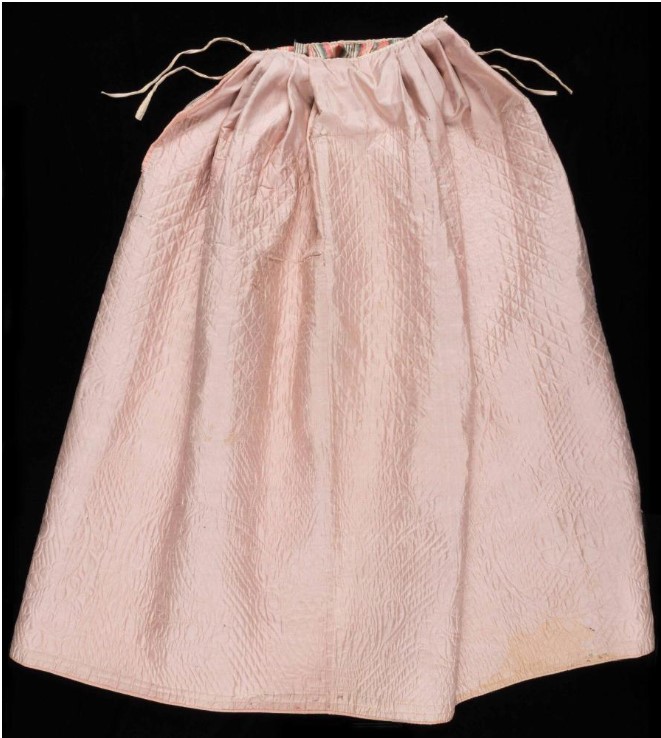
  • 1 Pink Persian Quilt
  • 1 Black Shalloon Petticoat
  • 1 Blue Callimanco Petticoat
  • 1 India Cotton Petticoat
  • 1 old striped Stuff Quilt
  • 1 blue Quilted Petticoat
Quilted Petticoat, 1770-1775. Colonial Williamsburg OBJECT NUMBER 1995-191

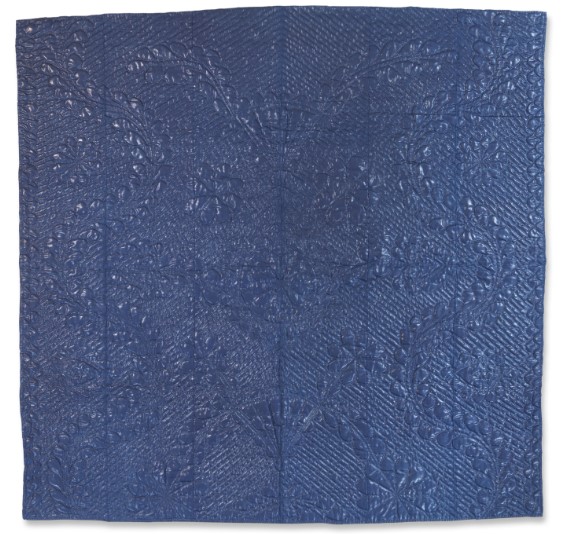
The pink Persian (silk) quilted petticoat certainly came from a milliner’s shop, and was likely made in England; it could easily be worn with those silk gowns. Having the color here helps us begin to imagine the combinations. Pink Persian and brown damask? Black shalloon and black calamanco? Black calamanco and blue calamanco? The India cotton petticoat was probably worn with one of the calico gowns, and we can contemplate striped stuff with a striped Holland gown. In any case, Mary Cooley’s two, possibly three, quilted petticoats helped her keep warm in silk, calico, or linen. The blue calamanco petticoat might also have been quilted; there are many calamanco whole-cloth quilts, and I like to imagine one as vibrant and shining as this quilt or perhaps this one. Quilted or not, under candlelight both gown and petticoat would glisten. 

Deep Indigo Glazed Calamanco Quilt, Probably New England, Late 18th Century

The Charm of the Third Time

One must keep up with the news (and the competition)

I’d call it “three times a lady,” but truly, I’ve only been a lady in Occupied Philadelphia twice. Last year and this year, I portrayed Elizabeth Weed, a widowed pharmacist living on Front Street in 1777 with her son, George. We don’t know why Elizabeth Weed didn’t leave the city along with nearly half the population. Was she a loyalist? Was her son too ill to travel? Or did she choose to stay to protect her property from the British– or the son of her late husband’s first marriage, who withheld a portion of the estate? Whatever the reason, remain she did, advertising her wares in the October 23 edition of the Pennsylvania Evening Post.

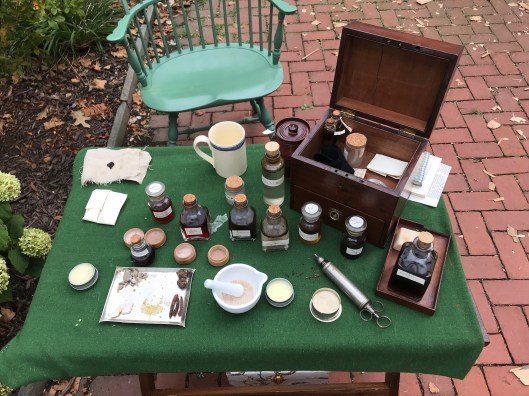
New remedies, new box, new ingredients: refining an idea

Last year, with Drunk Tailor’s assistance, I made a number of remedies using 18th century receipts, with some interesting and sometimes successful results. This year, we improved one– the yellow basilicum ointment– and added some new concoctions. The sulphur ointment for the itch (possibly scabies) worked well on the insect bites I got in the Carpenters Hall forecourt. A charcoal-oyster shell-cinchona bark-benzoin tooth powder was a new addition. I used the clove oil-scented pomatum to achieve the highest hair I’ve managed yet, but the truly satisfying work was recreating multiple recipes actually used by Elizabeth Weed.

As Drunk Tailor notes in his entry on this year’s event, we can never truly enter the 18th century mindset. Recreating the clothes, food, daily rhythms, and medicines help us experience the feel of the past, but we can never truly be those people. If you regularly cook 18th century meals, you’ll experience the palate of the past: aromatic, relying heavily on cloves, nutmeg, cinnamon, and allspice. This same range informs the aroma and flavor of the remedies from cough syrup to tooth powder.

Almost undoubtedly one of the ‘smells like Christmas, tastes like death’ tooth powders. Courtesy Jason R. Wickersty/Museum of the American Revolution

It’s a toss up which is less pleasant to the modern tongue, the Syrup of Balsam or the Syrup for the Flux. Both use the “paregoric elixir,” which some of you may recall from the medicine cabinets of old. Camphorated tincture of opium or anhydrous morphine has been used to treat diarrhea for centuries, and the ingredients for the modern version (anhydrous morphine) is remarkably similar to that for Weed’s paregoric elixir:

Weed’s Paregoric Elixir Anhydrous Morphine (Paregoric)
8 ounces opium Anhydrous Morphine, 2 mg
4 gallons spirits of wine, rectified Alcohol, 45%
1 ounce oil of anise seeds Anise oil
2 ounces Flor. Benzoin Benzoic acid
8 ounces camphor Glycerin
Purified water

There are some differences– most of us don’t want to ingest camphor, and “purified water” isn’t quite a thing in 1777– but the active ingredient makes these essentially the same compound. It’s an essential component of both Syrup of Balsam and Syrup for the Flux, so it had to be made first. Over the course of ten days, the elixir cleared from a yellow-orange slightly opaque liquid to a clear yellow liquid, with white sediment at the bottom of the jar (probably the benzoin).

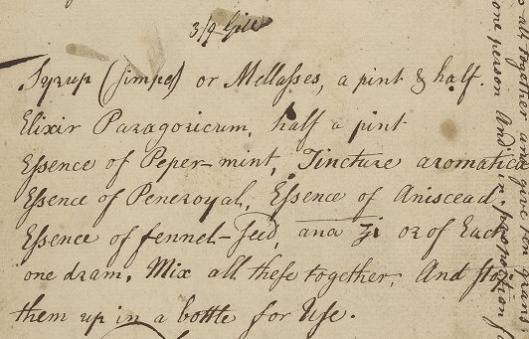
With that in hand, I was ready to tackle Weed’s most famous (and well-protected) remedy. It appears more than once in the daybook, but both listings use the same ingredients and proportions.

One of the original receipts for the syrup for the (Bloody) Flux. UPenn Ms. Codex 1049

Syrup for the Bloody Flux
1.5 pints, simple syrup or molasses
.5 pint, elixir paregoricum
1 drachm each:
Essence of peppermint
Essence of pennyroyal
Essence of anise seed
Essence of fennel seed
tincture aromatic

“Mix them all together, and stop them up in a bottle for life.” (Or, as the other receipt says, “Mix and Digest.”

The resulting mixture is probably meant to soothe the intestinal cramps (with anise, fennel, and peppermint) while the paregoric relieves the endless diarrhea. Licorice-flavored molasses with a peppermint tingle isn’t unpleasant so much as odd to the modern palate.

Syrup of Balsam defied expectations.

On the right: Syrup of Balsam: -10/10 would not taste again.

Syrup of Balsam
1 pint, simple syrup or molasses
.5 print, elixir parigoric
1 ounce each:
Essence of fennel
Essence of anise seed
Royal Balsam
Tincture of Balsam of Tolu

“These must be mixed together, and then put up for use.”

If I attempt this again– to be fair, I have enough ingredients and more knowledge– I’ll try to get the Balsam of Tolu to dissolve more fully into the main mixture, though I doubt the separation is why the taste is so unforgettable. While it did mellow after several days, the basic flavor remained licorice cough drops dissolved in corn liquor with an afterburn of turpentine. Fortunately, the dosage is not by the spoonful, but rather ten or more drops in a wine glass of water, depending on the constitution of the patient. As a “cure for the whooping cough,” the syrup with fennel and anise was probably intended to soothe the throat, and paregoric might have helped the pain of damaged lungs. Living in the post-DTaP era, I’ve never had whooping cough, or been around anyone who did, so it’s much harder for me to imagine treating it without antibiotics (or simply not getting it).

“No, really, no antibiotics!” Photo by Jason R. Wickersty/Museum of the American Revolution

That was really illuminating to some people: antibiotics weren’t invented until 1928 (in the case of penicillin) and were not available for civilian use until March, 1945. Until then, diseases like strep throat could be fatal. Often, the best medicine in the 18th century was to help a patient be comfortable, and ease their symptoms.