Bad, Mad Skillz: An Origin Story

Aragorn: one of many modified patterns

I’ve been sewing clothes off and on for while, and sewing pretty constantly since the 1990s—baby quilts, piped slipcovers for vintage chairs, knitting needle cases, costumes for the Giant, and sundry other items. Making calms me, and since I tend to operate at a pretty high RPM, I make a lot of things.

Historical clothing took off for me after the Giant decided he wanted in on the living history thing. Hunting frocks, overalls, and shirts gave way to stays, petticoats and gowns. I’m largely self-taught, and although workshops with Sharon Burnston and Henry Cooke helped immensely, much of what I learned about fitting and draping I learned by reading (books and tutorials, especially Koshka and Sabine) and by making mistakes.

The best way to succeed is to fail, and I am an accomplished failure —you have only to look through the archives here, and you will find waistcoats sewn by drunken, crack-addled monkeys , upside-down Spencer collars, and stays gone wrong. I’m okay with those mistakes, because they helped me (and, I hope, some of my readers) make progress towards better sewing.
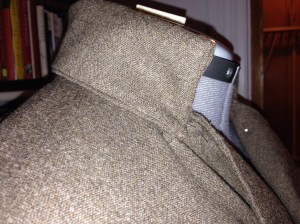
Really, I’m not sure how this happened. But there it is: upside down.

I’ve made things of late of which I am proud, or at least pleased with; I have taught myself new skills over the years from pad stitching (still working on that) to hand knotting (getting better) . I’ve gained patience (which is a skill itself) as I’ve learned new techniques, and that counts for a lot.

Hand-knotted lapis bead necklace: a new, slightly frustrating skill

Way back when (for the true origins), struggling through a design studio, I realized that the greatest frustration typically comes just before a breakthrough. That understanding is really the origin of my historical sewing: getting frustrated means you’re making progress. And what’s more frustrating that replicating a historical garment?
Fave Friday: Full-On Federal


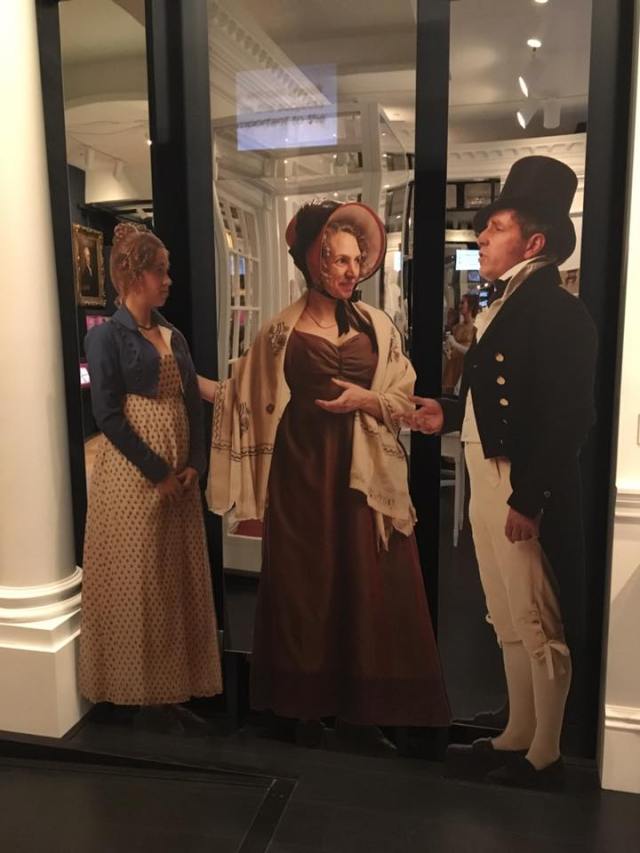
Favorite Era? Easy-peasy! Federal, of course. Whether furniture or fashion, the early Republic is my thing. I spend a fair amount of time in the 18th century, since there are so many events in that time period, and while I loved the story of the American Revolution as a child, the early Federal* period intrigues me more. Furniture, porcelain, wallpaper, and clothing from 1790-1820 all appeal to me, as well as the notion that women’s roles were in flux in the earliest decades of the United States.

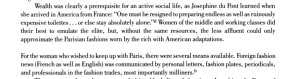
“American Women and French Fashion,” from The Age of Napoleon

I love the idea of women in mercantile businesses and trade, and the way that milliners provided access to fashion (and you can read more about that in The Age of Napoleon).

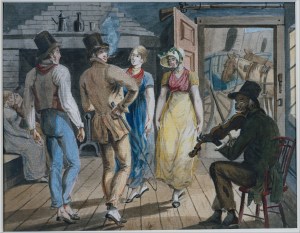
Merrymaking at a Wayside Inn, watercolor on paper by John Lewis Krimmel. 1811-1813. Metropolitan Museum of Art, 42.95.12

I also love the way that American women (and men) translated European high style into a vernacular, as seen in John Lewis Krimmel’s watercolors of Philadelphia and surrounding areas.

This is a time period I’m comfortable in (yes, the stays are part of that comfort) but aside from comfort and aesthetics, I think it’s also because for a brief time, women had slightly more freedom than they had previously.

It was short-lived, and Republican motherhood was confining in its own way before the “cult of womanhood” blossomed fully. But ideals of freedom and fashion very briefly aligned, and for that, I love the Federal– and vain creature that I am, I think it suits me.

*pre-Andy Jackson, amirite?

Driving Miss Lady

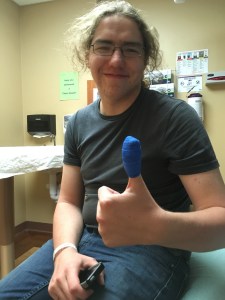
In the midst of loading the moving van, the Giant cut his thumb. 18th century pocket knives are no substitute for 21st century tools.

Or, where I’ve been, what I’ve been up to, and why I haven’t posted.

Six weeks ago, I left the museum where I’d worked since the Giant was a toddler, and the duplex I’d lived in for more than a decade. I spent the next two and half weeks packing up my possessions and pondering the benefits of minimalism.

Three weeks ago, I was southbound on I-95 with my ridiculous cats and an assortment of baggage (of which I have a great deal). It’s such an American act, “lighting out for the territories,” as Huck or Laurie Anderson might have it, setting off for someplace new, spurred by an itch similar to Pa Ingalls’.

After an 8 hour drive that culminated in extreme excitement and some confusion on the Beltway (Why do some Maryland drivers proceed at speed in a travel lane with their hazards on? Why did that truck think we could occupy the same space, when we both have a corporeal presence?), I arrived in different weather to a new home already occupied by two gentleman cats and Drunk Tailor.

After three weeks, I am nearly unpacked and nearly back to normal operations. I’ve missed a couple of events, including one in central New York I really hated to miss, and few I discovered at the last minute. Still, I am looking forward to reprising my lament for New England as I travel farther south to once again portray a terrible servant married to another terrible servant.

Summery plans to finish in between stitching for the shop

With any luck, the yarn I’ve ordered will arrive before we leave and I can begin the tedious work of tent stitching a wallet in a Rhode Island pattern to remind me of home.

Until I’m working full time, I’ll be making mitts, bonnets, and boxes both for a future millinery shop of the past and for Etsy. I’ve also got two gowns and two Spencers underway, at least one of which I’d like to have before August.

Staging Christmas

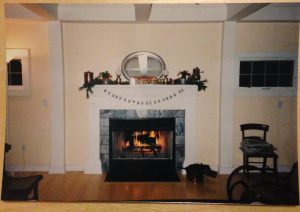
The house on High Street, Noank CT, 2000

It’s pretty stagey to begin with, isn’t it? Full of ritual, some so old we don’t know why we still perform them. What I like best is the food, not the cakes and cookies, delicious as they are, but savory meals and the warmth of a full table. Second to that, decorating.

The past year has given me opportunity to reflect on the tasks I love, and why, and the basis for the work I’m passionate about. Curiously, it began in high school, as the props mistress for drama productions, morphed into installations, performance art, and site specific sculpture in college, before metastasizing into exhibition development, installation, and historic house interpretation with a side line in living history because, you know, costumes. Things and I go way back, and thinking about that made getting ready for yet another Christmas more fun.

Providence, 2016
Providence, 2016

Embracing the staginess makes the sometimes uncomfortable family closeness easier; I have proposed celebrating by reenacting a Don Draper Christmas, as long as someone else does the driving. Adding a layer of actual performance somehow made it easier to understand, a phenomenon opposite to what happens when you write a word over and over until it makes no sense. It’s the same distance you feel when you really try to understand someone’s past, and how they think. It’s familiar, but somehow unrecognizable.

This is probably the last Christmas in this apartment, which adds a poignancy to the proceedings, and it’s the first interactions for some participants, so, as with What Cheer Day, I’ve set a stage and we’ll see what happens.

Christmas with Katie, Chicago.
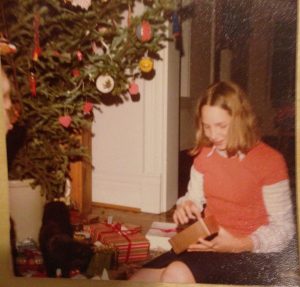
Christmas with Katie the Cat, Chicago, ca 1978

Every year, some things are the same: a balsam fir, candles, apples, cats. The characters and locations ebb and flow, with some consistency. Cats come and go, the boy grows. The love remains the same.