

The antiques I own stretch back in time, objects passed from hand to hand, connecting me to the past. It is particularly fine when they connect me to America, a place my people came to more than a century after these things were made. A paste shoe buckle. A chair. A portrait. There was once a fad for fake ancestors, buying a past you did not inherit, and the objects I collect are something like that, only less ostentatious– if only because the portrait is a miniature and not full size.
Let’s start with the chair, the most expensive piece of furniture I’ve ever bought. (My bicycles cost more, and were, for a long time, the nicest and newest things I’d ever owned. It’s weird to talk about money and things, and what those things cost; we’re taught not to. That makes it even more important to be honest about context, even if I never tell you what I’ve paid.)
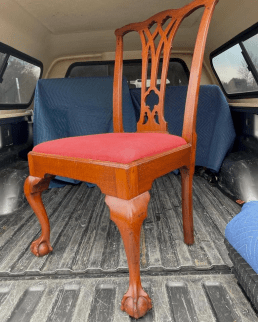
The chair.
I follow an antique dealer on Facebook, and in the spring of 2023, he posted a photo of a chair he’d just picked up from a collector in Delaware. It was a handsome chair, mahogany cabriole legs, ball-and-claw feet, shaped rear legs, pierced center splat, curved crest rail. It was marked on that crest rail: W. Hall.
This was a Philadelphia chair, with classic signs in the shape and tension of the feet, the raised line around the arched piercings of the splat, the rhythm of the crest rail. It was simpler, plainer, cheaper, than a Thomas Affleck–the knees on those chairs— but the ogee (cyma) curves stepping down from seat rail to leg spoke of an eye for balance and for structure. There was elegance in the way that chair was built, an adherence to the style books but with a local flair. That was a Philadelphia chair. Delaware being close to Philadelphia, W. Hall was probably a Philadelphia man.
There were not many candidates for W. Hall, despite the anodyne name. A few were laborers– they were unlikely to manage the fine, typographical incision on the crest rail, even if they’d once been able to afford a mahogany chair. Even less likely given that chairs like these were typically sold en suite, a set, two armchairs plus four or six or eight side chairs. Probably six; this wasn’t a Cadwalader-quality chair resplendent from the shop of Thomas Affleck with carving by James Reynolds and covers from the shop of Plunket Fleeson.
So not a laborer’s chair.
There was Richard Hall, a whitesmith, whose estate owned a lot on the east side of Second Street between Chestnut and Market Streets, on what was called Hall’s Alley, in 1777. There was Charles Hall, probably also a whitesmith, in Hall’s Alley, also in the Chestnut Ward.
In the 1774 tax lists were James Hall, an innkeeper, and John Hall, a tanner.
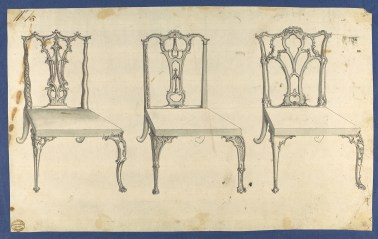 The chair was probably made in the mid-1760s, a decade or so after the publication of Thomas Chippendale’s Gentleman and Cabinet-Maker’s Director . . . of Household Furniture in the Gothic, Chinese and Modern Taste.
In the 1750s, Philadelphia high-style Chippendale chairs typically had exuberant carving– furry knees, complicated, twisted pretzel splats, shells positioned like merkins in the center of the seat rail, along with their ball-and-claw feet. But makers knew there was a market for good-quality affordable seating, and William Savery filled that bill. Is that where this chair comes from? Is it the mid-market, aspiring merchant’s or artisan’s chair?
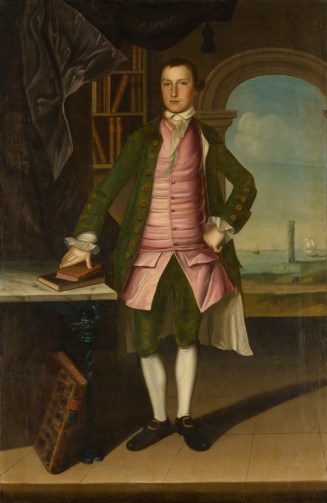
Because there is another W. Hall, William Strahan Hall, the son of printer David Hall. If David Hall seems familiar, that is probably because he was Benjamin Franklin’s partner. Franklin hired Hall in 1743 as a journeyman printer; by 1748, Hall was Franklin’s partner. Hall bought Franklin’s portion of the business in 1766, and established Hall & Sellers with Wiliam Sellers. After David Hall’s death in 1772, his sons William Strahan and David Jr. assumed his part of the business, maintaining government contracts and printing, among other things, Continental currency.
1766. The year David Hall bought Franklin’s portion of the business. The year David Hall commissioned portraits of all three of his children (William, David Jr., and Deborah) from William Williams. Was this flush, banner year when David also ordered a suite of chairs from a Philadelphia maker? Were the chairs then bequeathed to William, the eldest son, who inscribed one, claiming ownership? Maybe. Maybe this chair was someone else’s chair, some other W Hall somewhere among the years it traveled from Philadelphia to Delaware to Maryland to Baltimore.


The story is the thing that makes the chair, however you imagine it. I know enough to know that calling this chair “in the style of William Savery, possibly from the family of David Hall, printer,” stretches every truth I know. But that sentence lifts the curtain on the past, on the webs of kinship and friendship that connected makers, buyers, and users in late-18th-century Philadelphia. David Hall, on Market Street near 2nd Street in the High Street Ward, was around the corner from William Savery on the east side of 2nd Street in the Chestnut Ward. These wards were packed with milliners, ship captains, merchants, and artisans, all aware of fashion and change, all aware of the ways that consumer goods expressed their refinement and sophistication, whether chairs, paintings, books, or bonnets. This is the story the chair can tell, populated with real people and places.



 Kirsten Hammerstrom
You must be logged in to post a comment.