HSF # 26: Celebration Spencer

Cassandra in her new Spender.
Cassandra in her new Spencer.

This was supposed to be for #25: One Metre (yard) but things went awry. now it’s cause or #26, Celebration.

Make something that is celebration worthy, make something that celebrates the new skills you have learned this year, or just make something simple that celebrates the fact that you survived HSF ’13!

Heck, I survived the last two weeks of 2013, and that’s reason enough to celebrate. Water at work, relatives at home, high-stress holidays: if you can’t say anything nice, don’t say anything. So on to those pesky facts!

The Challenge: #26, Celebration! with a backward glance at #25, One Metre

Fabric: 34 inches of double-faced Italian wool, bought at Apple Annie Fabrics as a 50% off remnant after she found it in a pile. The collar is lined with black silk taffeta and interfaced with buckram. The sleeves are lined with black silk Persian from Wm Booth Draper, but I used taffeta on the bodice to give it more body. Technically, that’s almost two yards because it’s two kinds of fabric. Initially I didn’t plan to line this, but the edge did not hold as well as expected so I ended up breaking the rules in order to make a better garment. Celebrate rule breaking! Also, better sewing skills!

The pattern pieces on 34 inches of fabric. One cuff is pieced.

Pattern: My own, mostly. I started with the Sense & Sensibility pattern, and then modified it to make the first Spencer, working my way towards the double-breasted broadcloth of the Swedish Spencer. I first modified the lapels, and then, in order to match the arm scye to the sleeve correctly, modified the bodice at the side, and at the shoulder point. I used the Janet Arnold Spencer/riding habit as a reference, and then measured up the Leloir pattern to check my work. The two-part sleeves are borrowed from Henry Cooke’s 1770s man’s frock coat pattern taken from that extant suit; the collar and cuffs came from the same place.

Once I reshaped the sleeves from the elbow to the wrist (as I do not have a gentleman’s forearms of steel), I concentrated on adapting the bodice to make the seam sit properly on the shoulder line. Watching Mr Cooke manipulate Mr S’s garments made this a lot easier to do.
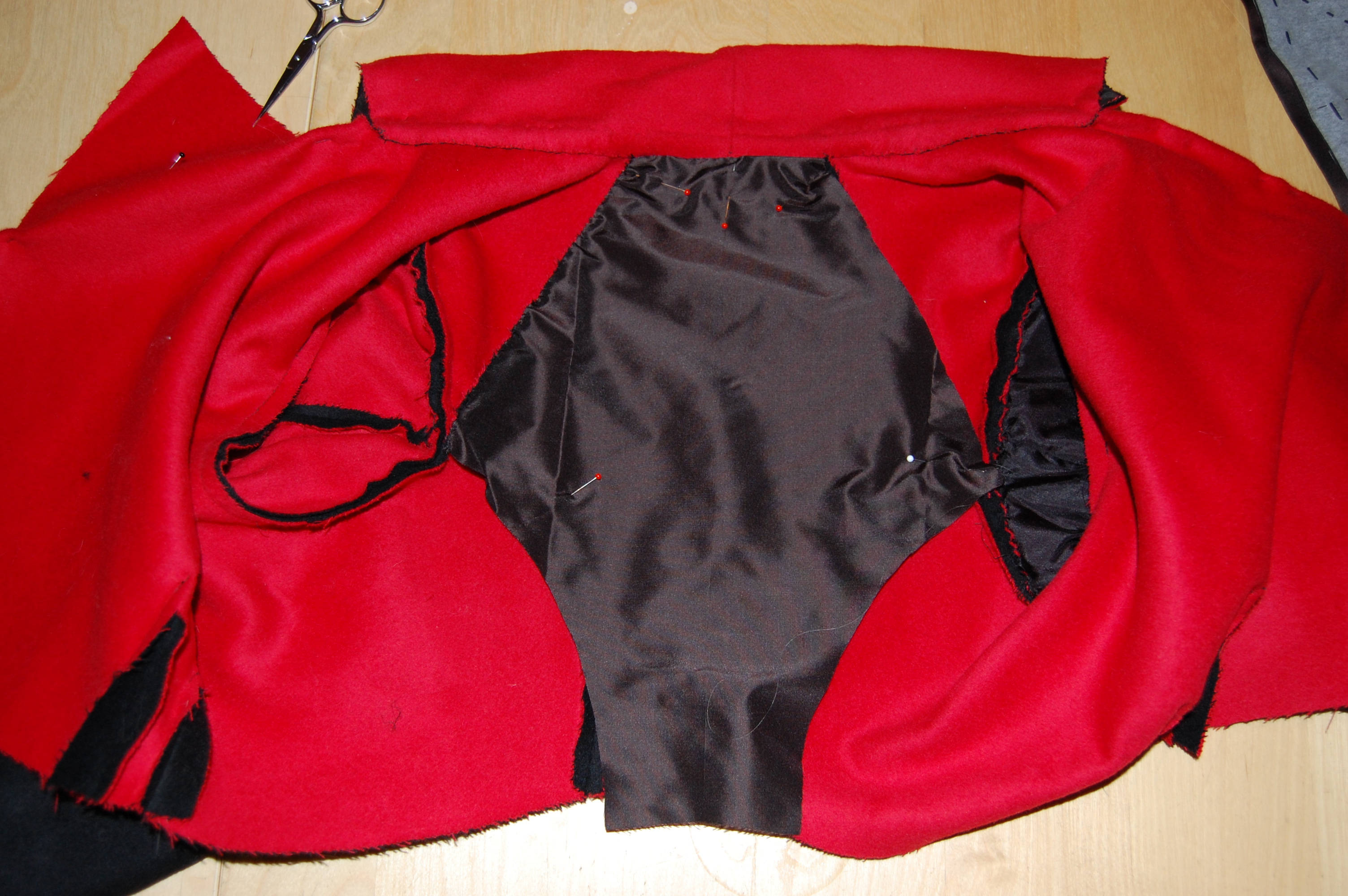
Inside view in progress.

My theory was that if you thought of a Spencer as a miniature frock coat, starting with a man’s pattern might be the way to go. I played with that in a theoretical way, but did not pursue it fully, as I was committed to the double-breasted look.

Year: 1797, if you take the Amazon as the inspiration and marker, which I do. This style, and even the revers, persists for a while, at least in fashion plates. 1797-1800 seems about right. (See the expanded Pinterest board for examples)

Notions: Thread counts, right? Also button molds. But that was it.

How historically accurate is it? This is always the toughest part! I have verified the revers, the style, the fit, and the pattern pieces. The garment is entirely hand-sewn of the most period-appropriate materials I could find. I found reference to a very similar example in a Danish museum; if I had possessed enough fabric for a cape, I would have made one. The inaccuracies will be in details of techniques and the lining materials, which were chosen to ameliorate the very snug fit. Is it 90%, with points off for not being able to time-travel back to buy my fabrics from Providence merchants in 1797? Aside from the Andes Candies coat, I think this is the most accurate and nicest thing I’ve made yet.

The shaped back piece.

Hours to complete: 12 to 18 for the pattern and muslins. Each sleeve took 30 minutes to pin and stitch into the armscye, but the long seams were more time consuming. 12 hours of sewing, perhaps? It seems like more than 30 hours, but once the pattern was done, parts of this moved quickly. (Personally, I love setting sleeves and sewing curvy back pieces.)

First worn: Not yet. As soon as I can talk Mr S into taking photos, I’ll wear it, but right now I have no firm plans for wearing it, which makes me sad. Wouldn’t it be a fun thing to ice skate in? Except for the very authentic way it pulls your shoulders back, which could compromise your balance.

Total cost: $15 for the wool, $6.50 for thread, and $2.80 for button molds; $8 for the amount of silk Persian for the sleeves, the taffeta was in the stash, so $24.30.

Bust darts from Hell

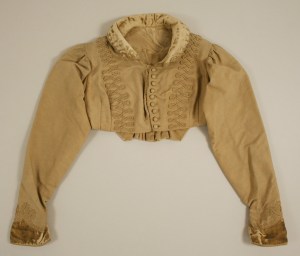
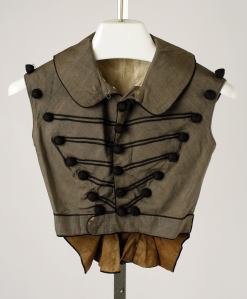
Spencer ca. 1800. MMS 1991.239.2

It all started out so well, in the muslin, but in the wool, not so much. I cut up a remnant, proving that a yard and a quarter of 60” fabric is enough for a Spencer, even for my arm length (but not less, thanks to that arm length and a respect for the grain).

The pattern I’m using has bust darts, which I haven’t sewn in years. They took some tweaking with the steam iron.

In 18th century clothing, one doesn’t see bust darts; there are some above the bust, shaping gowns at the robings, but for the most part they aren’t needed. Think cones, thanks to the stays. And later in the 18th century, a lot of work is done by gathers and drawstrings, as in the white and black  ca. 1800 French spencer at the Met.

Spencer ca. 1818-1819. MMA 1982.132.3

But if you’ve got an endowment of the non-fiscal kind, and you want your military-inspired garment to fit smoothly over your endowment, what do you do?

In this example, you hide the bust dart under braid and buttons. Check out that diagonal seam—and that the fabric appears to have been cut on the bias.
Brilliant, right? Gain ease by using the stretchy quality of the bias and hide the shaping under decorative elements.

Here’s an extreme detail.

Spencer, 1813. MMA C.I.39.13.48

In the garment below, of wool, three bust darts of the same length help shape the front. And again, decorative braid hides the shaping. 

It’s only cataloged as “wool,” with no weave given. There is a detail image of the darts and braid as well; I think that might be serge, and not superfine broadcloth. Still, three bust darts help achieve a smooth fit.

The Swedish Spencer at the museum in Lund has but one grainy photo: it’s hard to imagine that it doesn’t have bust darts, but the photo leaves much to the imagination.

The ‘Bigger’ Issues

What of those wardrobe issues?

1. The Cross-Barred Gown is Too Big. I will have to take it apart and make it smaller as it is too wide across the back in general and the shoulders. This is fairly simple.

2. The stays are Too Big. I can lift them up and do the shimmy inside them. Seriously. Eighteen months ago, when they were made, I had a two inch gap at the back and the front did not lace closed. Now I can lace them shut front and back.

Whether I have some body image issues or am just a crack-addled monkey can be debated among impolite company some other time, but to solve these problems, here’s the half-baked scheme plan I have in mind:

I re-cut and re-fit my bodice block for an open robe and made it smaller. (For the sacque, I need only trim the sides of the back because I haven’t gotten any farther than that, thank goodness! Now I have a better sense of the shoulder width I need to fill with pleats, also good.) For the Cross-Barred Gown, dis-assembly and re-construction can happen in the spring. Simple enough, and adjustable, too but…

Stay pattern mock-up, measured.

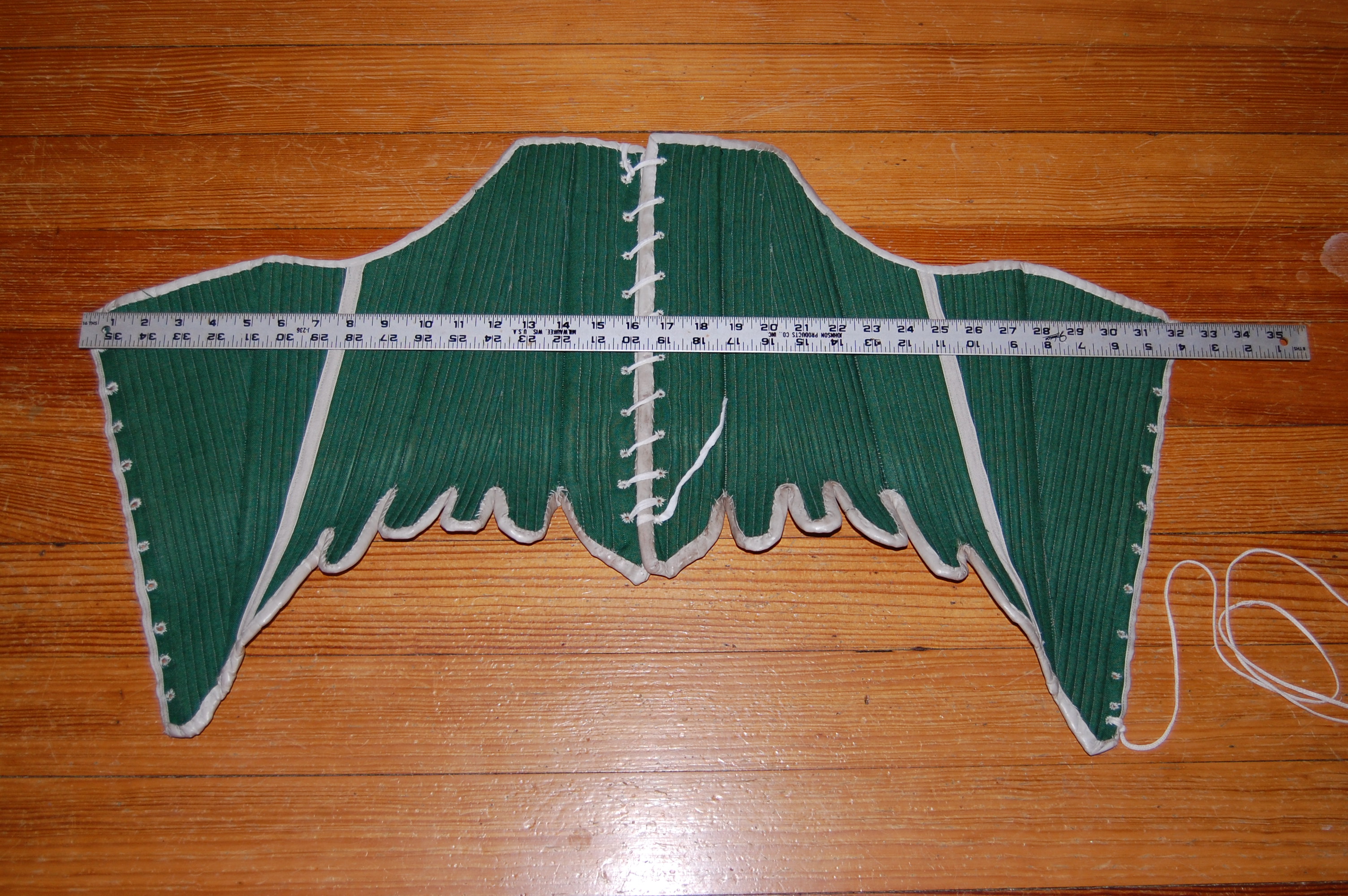
The stays are a little different, and much more serious. I’m not yet sure what to do. I could unstitch the binding and the panels and remove some bones, re-stitch the seams and re-apply the binding…or I could start all over, but make the stays a size smaller. The cardboard mockup measures 33 inches across. With a tape measure snugged up, I measure 37 inches around. Seems like all should be well, no? Two inches, front and back?

32 inches, but they don't fit.
32 inches, but they don’t fit.

It is not. Here you can see the green stays and the yard stick: 32 inches. I should have five inches altogether, right? No. These lace shut front and back (see the back lacing, kindly trust me on the fronts).

How did I not notice this before?
How did I not notice this drop before? (The pale line is the tide line of petticoat waistbands & ties)

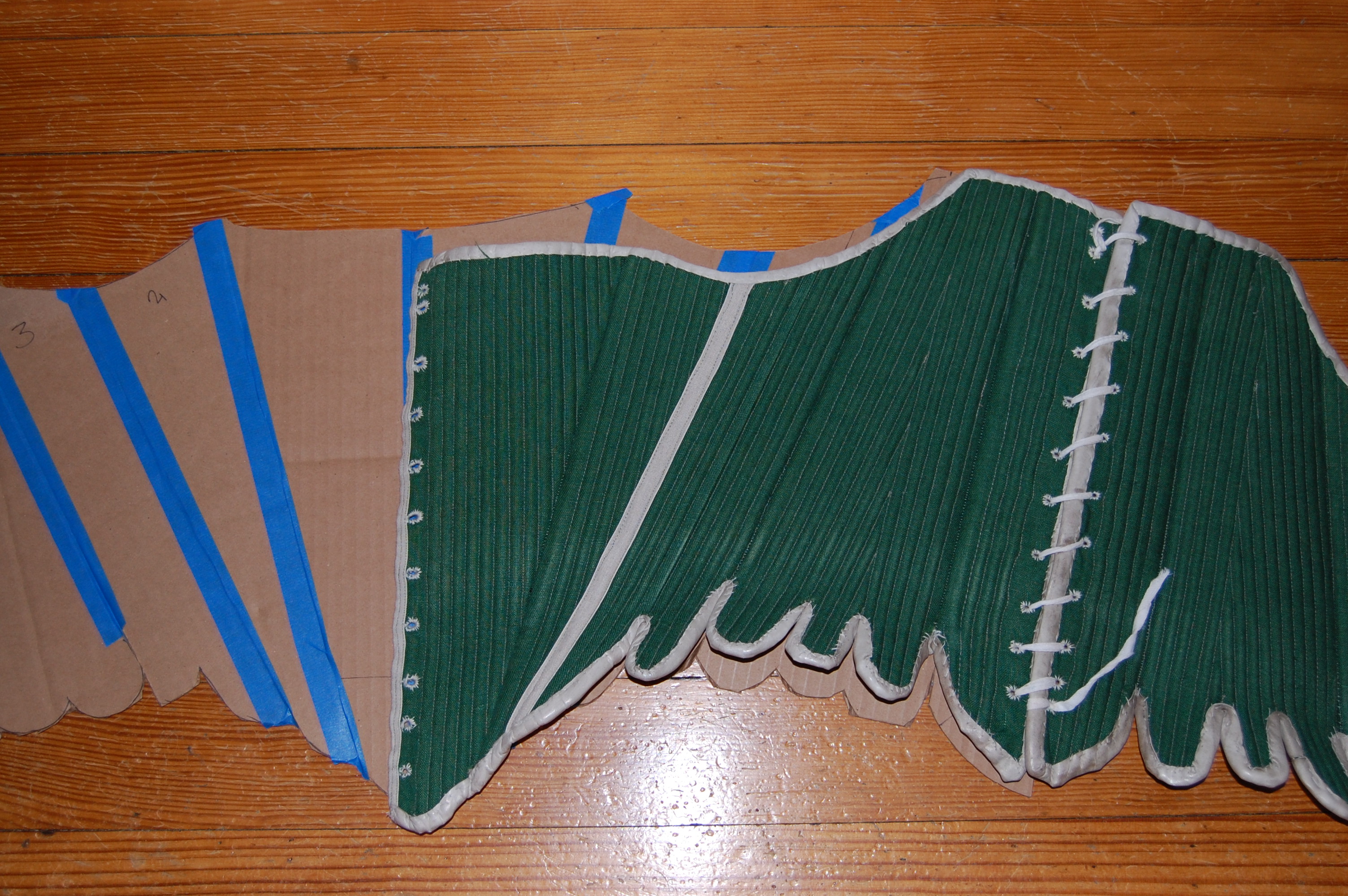
Then I compared the mock up and the stays. Curiouser and worser!

Somehow when I assembled this hot mess, I mis-aligned the pieces,and the fronts are lower than they should be. This explains much about the increasingly poor quality of fit as these slide down my ribcage…as you can imagine, the stays can’t do their job when they’re not in the right place to do their job.

If I am to reclaim these and my decorum, the first step will have to be dis-assembly simply to get the various panels into the their proper places. I think it would be fairly simple to do to the fronts, and then I could end some of the madness by sewing the front panels shut and converting these to back-lacing stays. It might be only a temporary fix, but that alone would be worth the effort. Fortunately, I won’t require these until November 23, and in the meantime, I know which gowns are too big, and need to be smaller. With open fronts, at least they’re pretty adjustable.

Getting My Mitts On: HSF #7

Mitts, 18th Century. MMA, C.I.44.8.9a, b

I got in a lather about not having mitts. I have been trying to knit a pair from the Mara Riley pattern for some time, as in well over a year. It’s just an unfortunate thing. I understand the pattern, I like the yarn I have, the needles are authentic enough for events, and yet: I cannot get these things done. As a result, I get cold. (I don’t mean that to sound whiny.)

There’s debate in some circles about whether or not knitted mitts were worn in New England, though there is a nice pair of black frame-knit mitts at the MFA, with a history of use in Lexington, MA. That’s a long way from what I can knit, a fair distance from what lower-middling Kitty would wear, and vastly unsuitable for a woman following the army. Still, I want mitts.

In the Fall, I tried to make myself a pair. It did not go well.

‘Camblet’ lined with linen, linen lined with cotton. More pix on flickr.

Fortunately I have developed more patience or bloody-mindedness since then. This allowed me to spend the time scaling up the pattern in Costume Close-Up. That’s where I started in the Fall, but things went better this time, and I actually have a pair of mitts.

Two pairs. I have problems, I try to solve them with sewing.

The Challenge: HSF # 7: Accessorize.

Fabric:
Left: Silk and wool “camblet,” lined with light-weight linen, both from Burnley & Trowbridge
Right: White linen from Fabric-Store.com, lined with printed cotton from Wm Booth Draper.

Pattern:
My own, scaled up from Costume Close-Up, available here for you if you have large hands,  print it at 100% on 11 x 17 paper. You will need to tweak the thumb placement. Make a muslin. Make two muslins. It’s worth the effort.

Year:
1750-1800. Narrower than that I cannot get, yet.

Notions:
None.

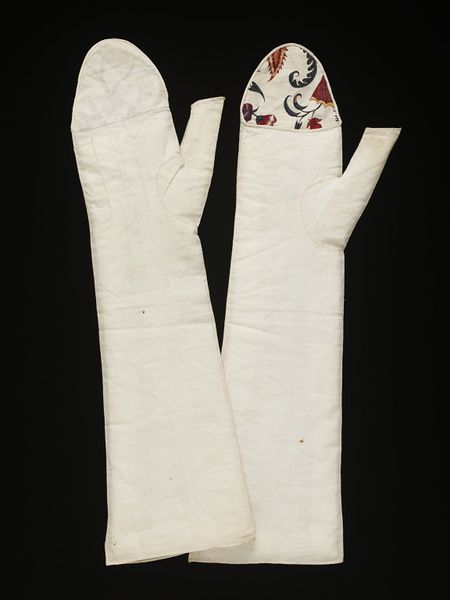
Mittens, 1790-1800. V&A,

How historically accurate is it?
Say 8/10, since I have never examined a pair and don’t know exactly how they were made. Yes, I’ve read the descriptions in Costume Close-Up and Fitting and Proper, but at this foggy insomniac moment, I couldn’t tell you much about those descriptions.

Hours to complete:
The bulk of the time was in the patterning, which took a couple of evenings and 4 muslins. But once you have a pattern that works for you, finishing a pair from cutting to wearing is about 3 hours all by hand. You could cut that significantly using a machine instead of hand back-stitching, and add decorative embroidery, which I really cannot do. Really. Photos to come.

First worn:
To be worn April 13…probably the white linen pair.

Total cost:
Nothing, really, as all fabric was left over in the stash. The pretty printed scraps came in handy.

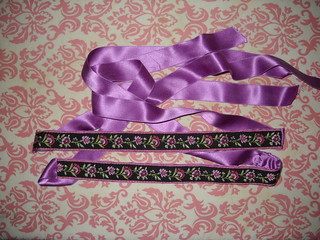
Garters! Jo-Ann plus Wm Booth Draper, but so far no implosion

Oh, I made some garters, too. Easy-peasy. Use the Pragmatic Costumer’s Ten Minute Tutorial. Completely makes up for whatever project you think you just screwed up. The main lilac ribbon is silk, the decorative ribbon is so not silk. These are better than no garters, but I expect my stockings will still droop around my ankles, as required by the laws of physics and reenacting.