To the Right Face!

Capt. John Clayton Cowell, 1st Battalion, 1st (or the Royal) Reg't of Foot, ca. 1796. NAM. 1963-11-133-1
Capt. John Clayton Cowell, 1st Battalion, 1st (or the Royal) Reg’t of Foot, ca. 1796. NAM. 1963-11-133-1

That’s Captain Cowell’s right, if you were wondering. You can learn more about his biography here, from the National Army Museum London website (where my very dear friend is lucky I have not begged, implored and entreated her to go, since she is vacationing in London, basically at the very instant you are reading this.)
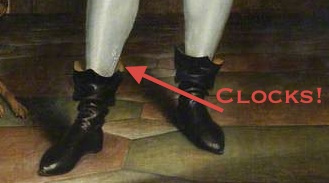
Clocks!
Clocks!

What I am interested in is what the painting shows us. Like The Drowsy Dame, there’s fun the details quite aside from the those slouchy boots. Inside those boots are silk stockings with clocks, a lovely detail that that shows you what class level should be wearing clocked silk stockings in perfect repair in the British Army. Anyone else not of the class that could afford a commission might want to think about having second-hand silk stockings…and, since we’re at the floor level, nice dog. I think he wants walkies, Captain.

The 18th-century fit is clear, too. Those arms may look sheathed in lycra, but they’re in wool; since the Captain served on St. Thomas, it is probably not just very fine but also lightweight. Portraits are idealized, so the Captain may not have been so very superman looking, but the fit of his breeches and coat probably served to accentuate, if not create, his graceful and refined form.  And then there’s the soldier.
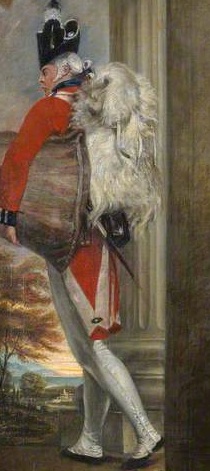
Detail of soldier, NAM. 1963-11-133-1

What caught my eye first on the soldier were his overalls, since I’m so frequently stuck with them in my sewing basket. These fit him closely, too, and are probably shaped much like these at the Met. There are six buttons on the placket at the ankle, and the strap under the instep is forward of the placket. The soldier’s feet look small (not unlike some regiments I know…) but the tongue of the overalls fits perfectly over his foot. It’s easier to do in paint than in linen, but I’ve seen them fitted this well, and the gentle cyma curve of the outseam is what you want.

On his back, the soldier has a knapsack that’s clearly made of a goat. I don’t know why they’re goatskin (this is not my army) but it’s startlingly goat-like. Other regiments carried them (see here for Troiani on the 33rd Reg’t of Foot), but I suppose the goatskin made a natural pouch shape and was water resistant (after you’d eaten the goat?). What you see on reenactors are mostly the square skin knapsacks, but when we go to Monmouth I will have to keep my eye out for the goat-shaped packs.

The large sack he’s carrying is also intriguing. The material looks to be striped, or woven with a purposeful variegation, which raises questions beyond linen-or-wool. Why trouble to die the material? Are the colors significant? On a practical level, the bag or sack probably contains any extra clothing and his blanket; it looks too light to contain much else. We can’t see his haversack,but we can see his cartridge box (the shiny black square under the goatskin) and his bayonet. But where’s his musket?

The more I look at and think about this painting, the more I wonder not just about the quotidian details we can pick up, but about the symbolism and the meaning. It has the look of “job well done, headed home” as the soldier carries his kit away, and the Captain sheaths his sword. Maybe that’s what we’re shown: tour of duty over, the Captain Cowell and troops head home, and the dog will finally get his walkies.

For a look at earlier British ‘dogs of war’ let slip in America, you might want to read Don Hagist at All Things Liberty, as well as Hugh T. Harrington, for dogs on the other side.


Mary Adams

Mary Adams, 1754, YCBA

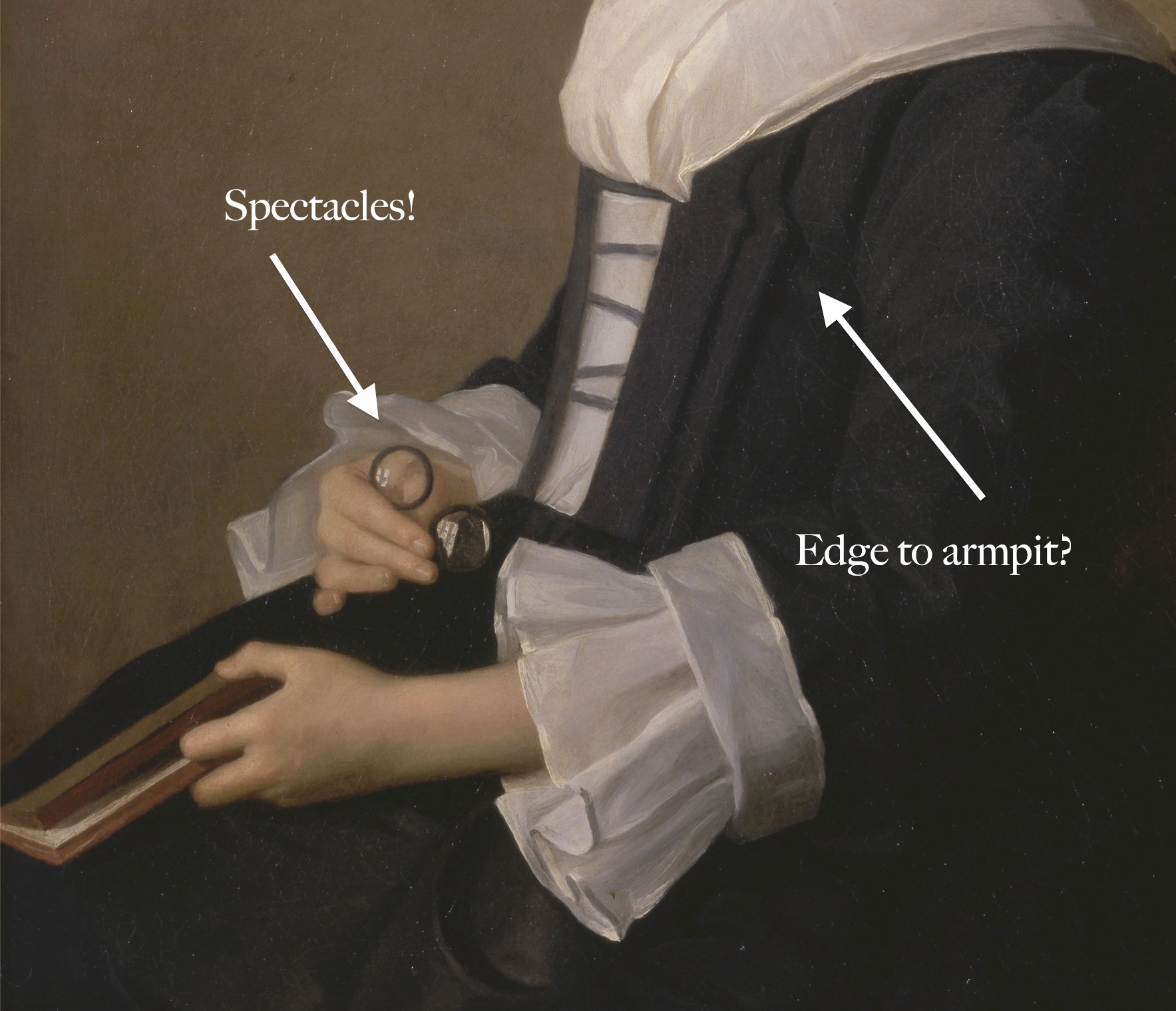
Meet Mary Adams, painted in 1754. She looks to be a certain age, does she not? But she’s still rocking some style. I like black, and wore black clothes almost exclusively for years from high school on, despite the relentless taunts of  feral sixth-grade boys. (My nickname was Boots. Costuming and living history is but another episode of dressing funny…)

But I digress.

Mary was a happy find this morning, because I knew I’d seen this little detail somewhere…and here it is:

Detail, Mary Adams, 1754,B1981.25.513, YCBA

Did you catch that? It looks remarkably like Mary has laced her gown over her kerchief, and not over a stomacher. I’m doing a little dance, thankyouverymuch, because that is how I roll. Or lace, as the case may be. Look, too, at the top of the lacing: her gown is pulling. Yes. Imperfections, how I adore thee.

Snark aside, it’s a kind of relief. Looking at Copley and Feke and all their sleek silken women is like flipping through Vogue in the doctor’s office waiting room: after a while, I start to feel woefully inadequate in all ways. From the Richard III gown’s wiggly seams to my inability to pin my dresses straight, and heck, the generally asymmetrical rumpled-ness of my presentations… you can get to feeling very low, as Thompson and Thomson observe in Prisoners of the Sun.

Details!
Details!

So among the things  I note in the painting is the depth of the pull at the top of the gown.  Hmm. I feel better about how my flesh and gown relate in the armpit area now.

But if the pull line starts over beyond the robings, that helps a costumer figure out where to put the lace holes and how to arrange the gown. I also like the asymmetry of blue lace zig-zagging down the kerchief. When I work that out on Richard III, and alter my red calico gown, I’ll use Mary’s portrait as a reference.

Finally, and perhaps best, of all, Mary can read. And she need spectacles. That wonderful pair in her hand look like they are cousins of this pair. All in all, a happy find this morning.

A Digression on Joy

dogleash
Dynamism of a Dog on a Leash- Albright-Knox, Buffalo, NY

I did not today have, or cause others to have, much joy. In fact, I was an actor in the kind of day that makes you want to take a second shower, get a haircut, sell your clothes, or move to another state (I considered each of these today).

No, I did not engage in any of the Deadly Sins. It was just a morning of the worst part of my job followed by an afternoon comprised in the majority of a part I don’t like, with an interlude in a smoke-filled house where I could hardly breathe. Fortunately, there was a lovely little West Highland Terrier in the house, and on my drive home I saw a small brown moppet-like dog on a leash, and smiled for the first time in hours.

This painting by Giacomo Balla is one of my favorites. It makes me laugh, my God, that’s what they look like! Watch–no, really, slow down and watch–a dog on a leash. That’s pure joy in motion, delight, movement, life.

It made me think about joy: there’s precious little of it going around, especially on a grey, gritty, dirty-snow-mound lined day when Rhode Island looks particularly poor (I was down in the residential neighborhoods by the airport). People are sad, people are worried: sequestration, budget cuts, global warming. It’s wretched, really, it is.

And then there’s the dog on the leash. From that swirling fur, I give you this:

Art still has meaning, take refuge there.

Art can be the art of dress, of dancing watched or performed; sewn or stewed, written or drawn. It can be silly, too.

 I sat there for hours. It's about the lines and triangles.
St George Killing the Dragon

Growing up in Chicago, I used to slip out of school and go to the Art Institute. I loved the Thorne Rooms, St. George Killing the Dragon,  and Mao. It’s so Ferris Bueller, isn’t it? But I hated high school, and loved the museum. When all else fails, there is beauty and meaning in art. I suppose that’s why I work in a museum. Objects gave me great comfort in their objective beauty. They showed me a world beyond the quotidian mess, a world behind the curtain, beyond the physical.

I find great joy in sewing and writing: this isn’t meant to be a dirge. I had a yucky day, but a dog cheered me up. When your days are icky and sad and long, find your dog on a leash, your dragon, your bliss: art helps us see the world beyond ourselves, and, I hope, our better selves.

Light & Night

Morland: Woman Reading by a Paper-Bell Shade: YCBA

Winter’s hard for me. I don’t like the lack of light, I don’t like the shortness of the days and how the sky is pale and stretched in these months. But this is a good time to think about basic needs, like light and heat and warm clothing.

The New York Times came to my rescue this morning with the article by Holland Cotter (and others) on “Artworks That Shine in New York Museums.” Cotter is one of my favorite critics and writers, and he, along with Karen Rosenberg, Roberta Smith, and other NYT critics, have selected some interesting pieces.

De La Tour: Penitent Magdalen, MMA

Ken Johnson leads with Georges De La Tour’s Penitent Magdalen. It’s earlier than my usual era but I was attracted to the image of the flame in the mirror; it’s not just a lighting device, of course, it’s a metaphor, but the rendering of the candlelight, and the use of the mirror to boost that light, tells us about how 17th and 18th century painters saw light, and how light was manipulated. We know from our simple experiments at work that mirrors really do amplify light, and that large stately rooms would only glitter with lots of candles and lots of mirrors. Light gives us a window on economy and wealth, as a precious commodity that cost money or labor to have.

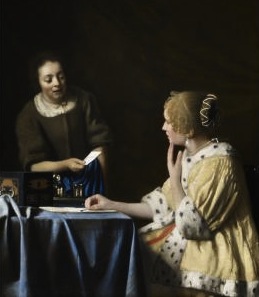
Vermeer: Mistress and Maid, The Frick

Cotter looks at Vermeer’s Mistress and Maid at the Frick, and notes the lack of obvious natural light or other light sources, and the overall dark mood of the scene. But Cotter’s writing shines, as he concludes the little essay: Whatever Vermeer’s anxious thoughts, light stayed on his mind. It scintillates in the pearls the woman wears in her hair and shines in the butter-yellow silk of her jacket. And the blacked-out space the women occupy turns out to have sunlit windows after all. We see them reflected in glassware on the writing table as tiny lozenges of light, far in the distance, as if at the end of a tunnel, but there.

Writing like that is its own kind of light, a joy to have in the daily newspaper on a cold, short day. In all, four critics look at five paintings each from a range of cultures and time periods. It’s enough to make one want to hop a train south.