The Romps, by William Redmore Biggs. (c) Leeds Museums and Galleries
What Cheer Day is around the corner, and while we won’t have the delight of the babies this time, when browsing the BBC’s Your Paintings site, I found this painting by William Redmore Biggs. It pretty well captures the level of activity I’d like to bring to the museum–or at least a level just short of spilled ink.
As always, I’m looking for what working women wore, and in this image, I think we see the mistress of a dame school with her charges, who have clearly been romping in earnest.
The details abound, from the portfolio on the mantle to the baize on the floor and the ink spots on the little girls apron. The room is simply furnished, but we get a sense of domestic and dress details. The shortest girl in the front trio is disheveled, her sash undone and her gown slipping from her shoulders. (What a romp they’ve had!)
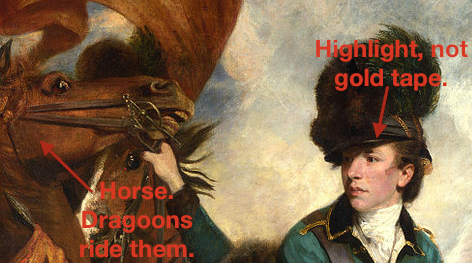
Portrait of Sir Banastre Tarleton (1754-1833) by Joshua Reynolds, 1782. National Gallery (UK) See update below!
By 9:00 on Sunday, I was asleep and missed “Turn,” which Mr S wasn’t even watching because, as he declared, “It’s just a bad show.” On Monday evening, I made it through the opening of the show and gave up for good. But those minutes made me think of the Banastre Tarleton portrait by Sir Joshua Reynolds, and the suggestion on Twitter that “Turn” had no historical consultant.
It occurred to me, as I stared at the rather curious headgear worn by Captain Tallmadge (I think it’s stretch lycra over a “Roman” gladiator costume helmet glued to a baseball cap visor and edge-taped with gold foil) that perhaps the people doing the costumes simply lacked visual literacy. This could explain the refugees from Fort Lee who looked like they stepped out of an Emma Lazarus poem, and it could explain the very unfortunate helmet.
Let us look at Banastre Tarleton, hunky bad boy of the British dragoons: he came to mind on Monday night, and what visual relief he is.
Note the light edge of the visor: this is a highlight. The leading edge of a polished surface will shine, and helmets, even of leather, will be reflective. Over time, the edges will polished by wear if not on purpose. I cannot speak to the helmet habits of the horse-mounted, but I know from paintings, and that edge is a highlight.
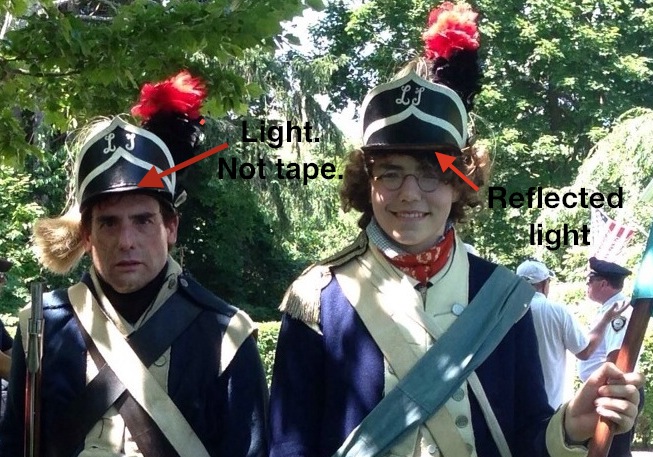
The Boys last July. Look, shiny, not-taped visor edges.
Reynolds painted what he saw, and just as the Young Mr’s cheekbones are reflecting light off the underside of his visor and Mr S’s helmet edge is shining in the direct light, so too is Colonel Tarleton’s helmet edge shining.
(Yes, there are both mounted and unmounted dragoons within a unit; but I just can’t help feeling that an officer would be mounted more often than he has appeared to be thus far.)
ETA: Heather has graciously pointed out a very nice blog on Turn, which is doing a far more even-handed and informed job of watching and commenting on the show. Thank you, Heather!
Benjamin West, 1738-1820, American, active in Britain (from 1763), Page Boy Asleep, undated, Brown wash with pen and brown ink on medium, slightly textured, cream laid paper, Yale Center for British Art, Paul Mellon Collection.B1975.4.786
Just because the Young Mr had a snow day and slept in didn’t mean the rest of us did. So what did we do?
We went to work, just as they would have in the 18th century. We joke that the streets in our town are better after ice and snow, because the potholes are filled in and the ride is smoother. You can see the principle at work here, in a watercolor by Benjamin Henry Latrobe. Sleighs and sleds will run more smoothly on snow-packed roads, and sometimes I think a sled would be better than a Subaru in the city of Providence.
Still, I’m grateful for furry boots and buckets of salt, central heat and an electric tea kettle. Every winter, one or more of us falls on the ice, and when I went out to salt the paths this morning, I could see where Mr S had slipped on snow-covered ice.
In the Morland below, the scene revolves around the central figures, a man who has fallen on the ice despite his stick, the woman, black bonnet thrown back, who has witnessed his fall. We haven’t reached this point yet, and snow has become sleet that will freeze later, with more snow to come, so our vista is not nearly as attractive. But it’s clear that we, as humans, have never enjoyed snow and ice very much, and I think the donkeys are unimpressed as well.
George Morland, 1763-1804, British, Winter Landscape with Figures, ca. 1785, Oil on canvas, Yale Center for British Art, Paul Mellon Collection, B1993.30.23
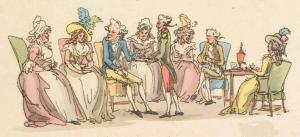
Detail, Picturesque studies and scenes of everyday life. Handcolored etching by Thomas Rowlandson, 1790. Royal Collection Trust. RCIN 810396
Hat tip to Jane Austen’s World for the image at left, which helped me start visualizing another program I’m involved with, this time ‘at home’ in Providence.
When we started reinterpreting the house museum, we began going back through primary sources to figure out how rooms might have been used, and furniture arranged (we don’t have inventories, so we read the house and diaries and letters– but that’s for another post).
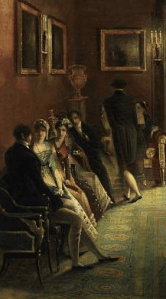
Detail, The Tea Party. Oil on canvas by Henry Sargent, 1824. MFA Boston, 19.12
One of the things I remember most vividly was the description of the uncomfortable tea parties Providence women gave, where the guests sat in chairs against the walls of the rooms, balancing a tea cup in one hand and plate in another. Several hard drives later, I’m not sure where that primary source is (the hunt begins tomorrow) but it conjured images of every hostess in Providence a Hyacinth Bucket, and every guest a quivering Elizabeth Next Door.
Detail, The Tea Party. Oil on Canvas by Henry Sargent, 1824. MFA Boston, 19.12
Surely that couldn’t be true? I thought I must be making it up, but then the Rowlandson turns up on the interwebs and there they are, in a row. More famously and closer to home, Henry Sargent’s painting of a Boston tea party in 1824. (The catalog description is rather nice.)
Here’s an 1824 tea party in Boston. While this is later than the tea party we’ve planned at work, it is still full of useful hints about how early, formal tea parties were conducted. We think– or I do, anyway– of ladies in frilly hats seated a tables with cakes heaped on stands and floral tea pots. I hear “tea party” and I think “doilies,” but this is not your grandmother’s tea party. It’s a different kind of social occasion, both more formal and more relaxed.
Detail, The Tea Party, oil on canvas by Henry Sargent, 1824. MFA Boston, 19.12
There’s not a central table to sit around, but instead chairs lined up against the wall, groups of guests, chatting. Others guests stand close to the fireplace, and a pair of ladies have taken a settee and a stool for their close conversation. We can just make out the tiny tea cup in the lady’s gloved hand.
In many ways, this depiction reminds me more of contemporary cocktail parties or open houses with the guests in small, changing groups, and no place to put your cup. Of course, most of us don’t have waiters (that’s who you see in the detail above with his back to us) or fabulous houses on the Tontine Crescent in Boston.
In so many ways, the social customs, habits and mores of the past are lost to us, and as we try to recreate them, the we excavate them from a combination of unlikely sources. Accounts, paintings, diaries, and etiquette manuals serve as sources, but it’s easier to recreate the economics of tea than the structure of a tea party. And once we do have an approximation, will it be a party anyone wants to go to?







 Kirsten Hammerstrom
You must be logged in to post a comment.