The Stamp Act Protest of 2014

Last Saturday, we stepped back in time to 1765 in Newport. I know: Newport always seems to be in a different time than gritty Providence, but this trip was truly different.
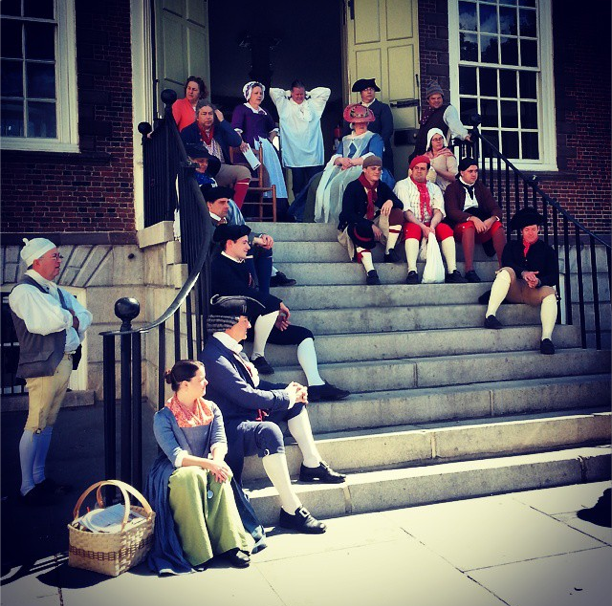
On the Colony House steps

We were headed across the Bay for a Stamp Act Protest (no rioting, per police request). In this effort, we joined a large group of recruits from New England and even beyond, to fill Washington Square and other sites in the city.

18th century sailors prepare to sew a sail
Preparing the ‘sails’ for stitching. I never really noticed the cars till I saw the photos!

Stationed around the square were sailors mending or making a sail*, an apprentice-less printer, a sleepy apprentice boy, a tailor and his journeyman, a milliner, and leading citizens, one of whom was kind enough to read the newspaper to the apple seller, who wonders what has become of her son.
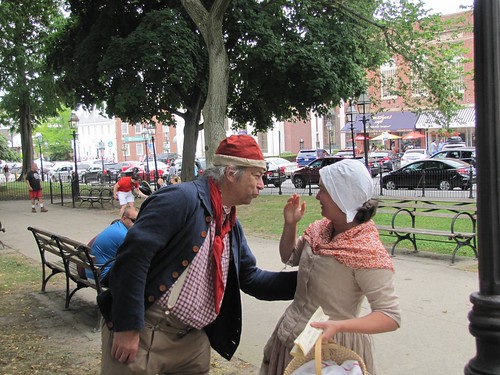
You must be very careful indeed around the sailors!

Up the street, some very fine ladies were having tea. Their refinement was evident in their appearance and dress, as well as in the elegant setting of their tables. They wanted none of my apples, as they had imported citrus fruits, far better than the apples the island’s trees produce. (Wasted on tea, truly: what one wants to do with a lemon is to find some rum and make a punch.)

18th century tea party in Newport
The Ladies’ Tea
Ladies at a tea table
Seated for tea
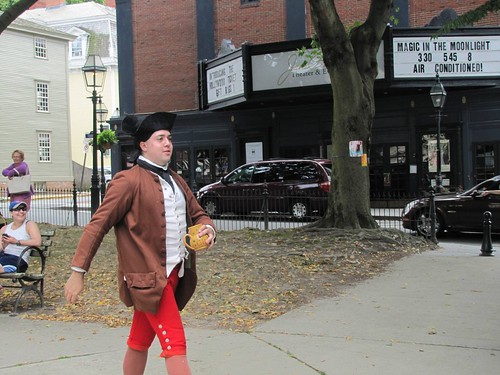
Mr Robinson marches forth

The news was very bad, and tempers flared in the square. Mistress Ellery told me that dinner parties had become impossible to hold: parties nearly come to blows over discussions of taxes, customs, stamps, and the oppressive policies of Mr Robinson, who insists on enforcing the very letter and penny of the law. (He was quite insulting on the quality of my apples, indeed, spitting one upon me even as he continued to eat it!)
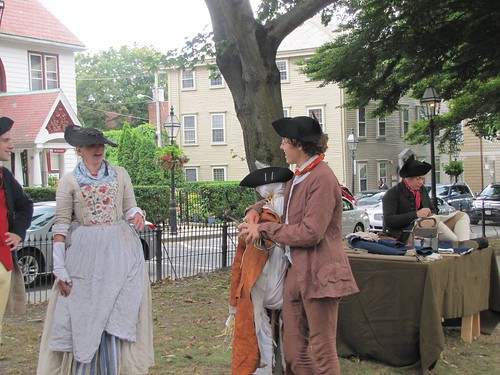
The apprentice boy had charge of the effigy; the tailor sewed on.

As the afternoon wore on, the debate grew more intense and the crowd more heated. And effigy of Mr Howard was made, paraded, and hung, and then the crowd of protesters dispersed to the White Horse Tavern.
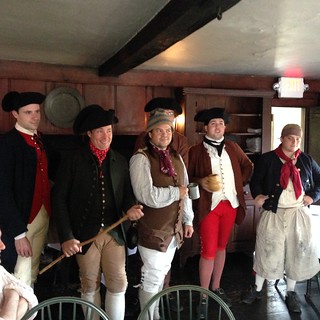
18th century men at the White Horse Tavern in Newport
Fortified!

Tensions seemed to dissipate, though when the runner came, the protesters– now fortified with ale, porter and cider–ran down the street to “plunder” Mr Howard’s house, played here by the Wanton-Lyman-Hazard House.

18th century people at Want-Lyman-Hazard House
Ignoring the mistress of the house, protesters dashed to the back.

Although the mistress of the house tried to reason with them, the crowd would not be dissuaded, convinced of their mission (and perhaps more fortified than you would expect after just one glass). They carried their loot to the front of the Colony House, and heaped it up, glorying in their success.

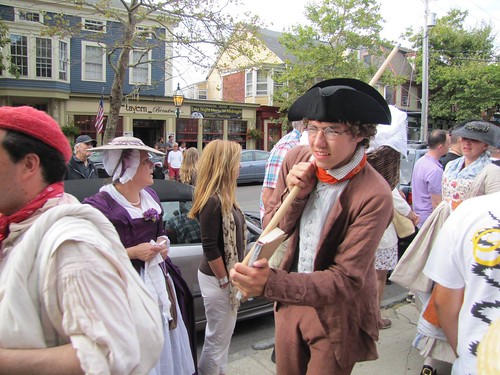
The goods!
More goods!

In the end, the house was not looted, tensions were dissipated, and the protesters dispersed into the afternoon. We were well-rewarded with cheese and ale at the Colony House, and enjoyed discussing the events of 1765 and 2014 with the public and Newport Historical Society staff members.

*Yes, Virginia, they do look like tents. That’s because they are tents. Someday, Light Infantry soldiers will sleep beneath that canvas. But for now, keep stitching!

The Society of Friends

Courtesy Newport Historical Society

Last Friday, I joined my friends in Newport for a program at the Newport Historical Society.

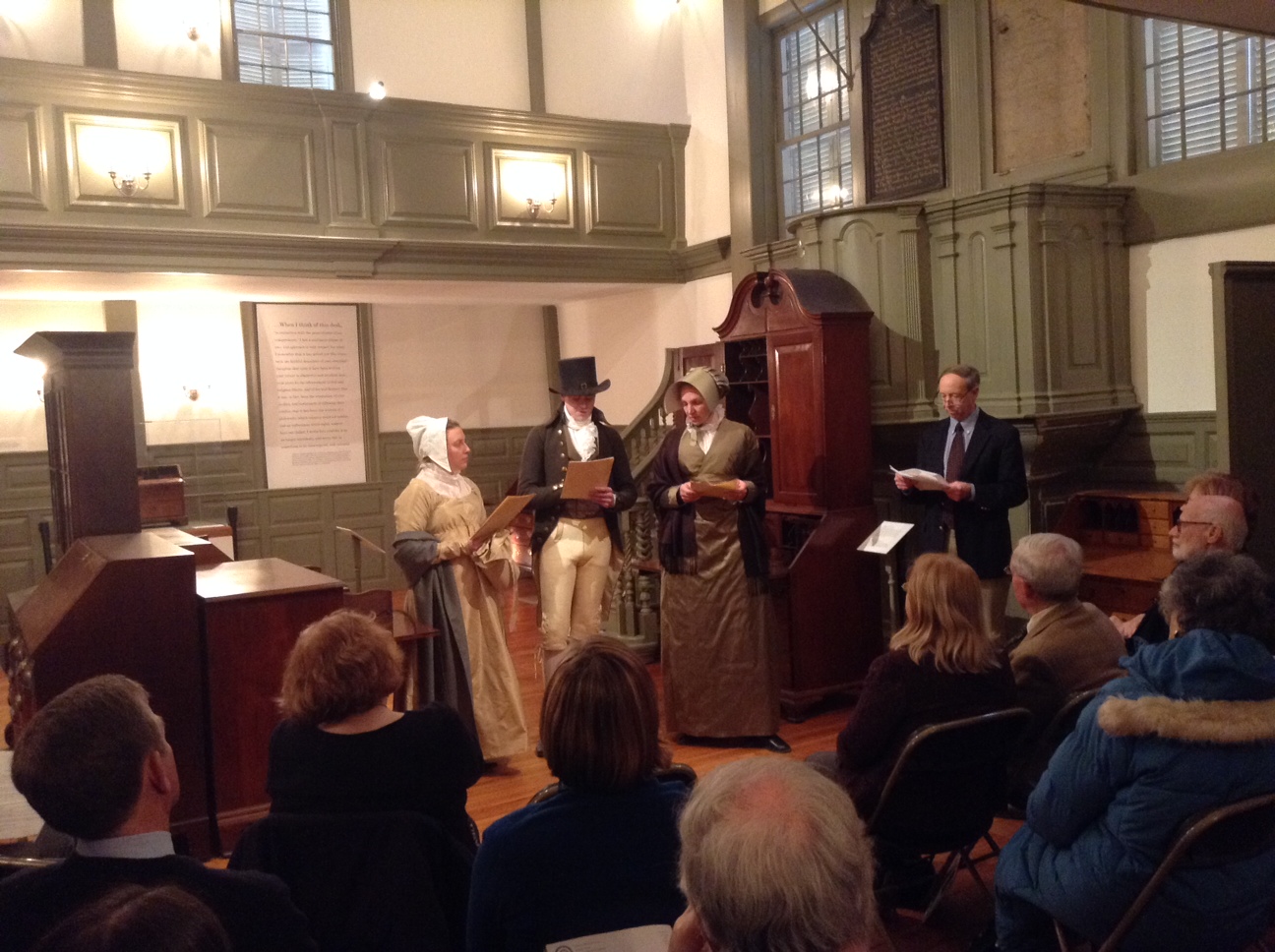
We stood in the Seventh Day Baptist Meeting House behind the NHS’s headquarters building and read excerpts of letters from the Williams Collection.

This is a simple, elegant concept for a program, and works incredibly well if the correspondence have the gift for expression that these people did. Even quotidian details–the price someone wants to get for their dining set, the likelihood of moving one’s mother, who must be carried ‘as carefully as a box of China’–take on humor when read aloud.

Courtesy Newport Historical Society

The best letter might well have been the last one, read by Sew 18th  Century. The latest of the selection, the writer described a visit to Newport around 1844, arriving at the dock to the bustle of wagons, walking streets and finding a barber who knew the old fish hawker, the enormous jaw bone of a whale on a street corner, and even lifting the latch to walk inside the Seventh Day Baptist Meeting House where we were standing.

It was a lovely way to end the program, resonant with details the audience could connect with.

My dress turned out all right, and I managed to get it on and keep it on, which seemed a small miracle requiring only two pins.

When I tried it on at home, the front panel didn’t wrinkle, so I think I pulled it too tightly around me on Friday. I kept my bonnet on because I didn’t have time to make a new cap, so made do with the housekeeper’s cap from last fall. The chemisette was made by Cassidy, and saved me from the migratory ‘charms’ of a kerchief. The ‘shawl’ was a gift  Christmas from my mother, who rightly saw it as a scarf, but those who wish to keep warm do not quibble when they cannot find exactly what they want. Before I wear the dress again, I have to attend to interior seams of the skirt and scoot the cuffs down to lengthen the sleeves. Four yards of 48-inch wide silk was just enough, but needs a little tweaking when you’re a tall as I am.

Criss Cross

Dolly Eyland, by Alexander Keith, 1808. (c) The New Art Gallery Walsall; Supplied by The Public Catalogue Foundation

I like Dolly. The colors, the textures, the style of her gown, shawl and cap all please me. She’s rocking some serious class for a woman headed towards a certain age. And she’s wearing a cross-front gown, which is what I settled on for my Quaker costume. 

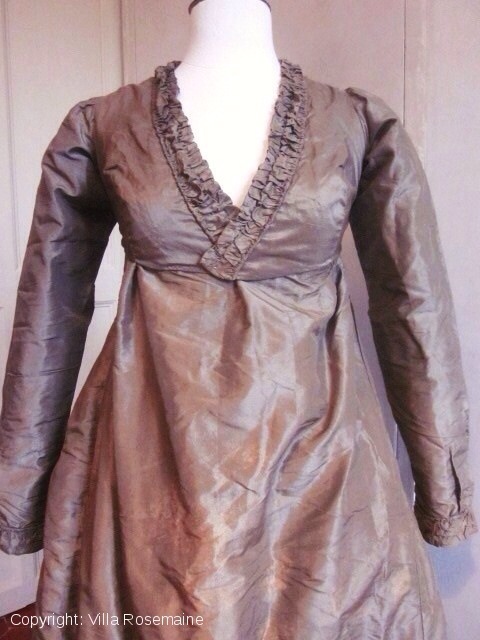
Taffeta dress, ca.1800-1810, Originally found on Villa Rosemaine site, where it does not appear now.

The trouble with making a gown based on an artistic sketch in a book is that you don’t have the most complete sense of what that garment looks like, or how it goes together.

Not to worry, I went ahead anyway, because this is as close to Everest as I will ever get.

But I wanted comparable garments to help guide me. Ages ago I found the gown at left on a French costume site. That’s helpful, in that it explains the trickiness of assembling and wearing this style of garment. Three pieces coming together in the front may be one piece too many. 

In making up my pattern, I used the pattern for the Spencer as a starting place because I knew that the set of the sleeves and arm scye were what I wanted. No reason to re-invent that process!

That left me with the luxury of concentrating on the neckline.

That took a few goes with the tracing paper and muslin:  I did lose count after a while. There may have been tears, there definitely was swearing. Mr S at one point made jokes about this process appearing on the Discovery Channel’s “How it’s Made” as “the Quaker dress.” He’s really very patient, and I do understand the selective deafness he’s had to develop as a defense against the dark arts of sewing historic clothing.

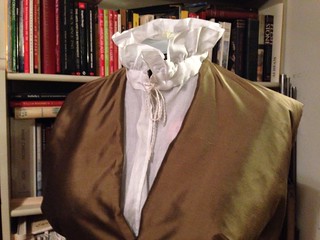
Thank you, Cassidy, for the chemisette!

Eventually, I had a decent lining and even some silk bodice fronts. I fiddled with the fronts, and settled on gathers instead of pleats, but couldn’t quite figure out where the casing went. Some days I can process drawings into objects, some days I can’t. I’d just about reached the point of cutting it all up into the gown I always make when I discovered that the excellent women of the 19th US had patterned the gown from the drawing, too. (If you don’t already use this site, I highly recommend it. Excellent work.) Those pattern pieces look like my pattern pieces, so I decided it was worth carrying on with what I have.