Working Weekend

https://i0.wp.com/farm9.staticflickr.com/8482/8239978492_81e339d5fe_n.jpgThis is the house at the farm museum where we went to work on Sunday. That bright orange under the window is squash. The part painted red is an office addition and not interpreted space.

This is the view from the site.https://i0.wp.com/farm9.staticflickr.com/8062/8238909459_f9165ff136_n.jpg It is not exactly what the tenant farmers would have seen, even discounting the power lines and road surface.   But even with the caveats of constant change in mind, I do not have access to a better lab for understanding the past. There are times when even the smart and sophisticated among us cannot come up with a better (just between us) interpretation than, “1799 sucked. And it was greasy.”
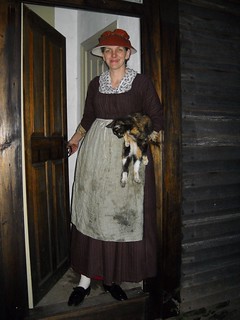
https://i0.wp.com/farm9.staticflickr.com/8210/8238912881_454a7e8b67_n.jpgThat’s not what we want the visitor to learn (everything in the past was hard) though sometimes I fear that is all they take away. Callie, seen here swearing in my hand, was trying to take away leftover chicken and so was taken away herself.

The more time I spend stooping to reach a vat of tallow, or tearing a chicken carcass apart with my hands and a dull, greasy knife, the more I think that what we fail to grasp is not that people thought differently in the past. It’s why they thought differently.

Lives could be a great deal smaller: tasks were hard and all-consuming. Even as I realized that work would be faster with greater familiarity, I also saw that repetition would not breed enlightenment, because increased speed would only make the next task come more quickly.

My House Stinks

I said to the B&G guy at work, “My house smells funny.”

He asked, “Funny good, or funny call the police?”

“Like black powder and wood smoke,” I said.

“Oh, call the police!” and we had a good laugh. Ed is a black powder hunter and camper, but not (yet) a reenactor.

We spent the weekend at the BAR event at the Nathan Hale Homestead in Coventry, CT, about 1.5 hours from Providence. It’s Route 6 all the way, twists and hills, lovely in the fall colors, but pokey.

I did get several apologies from the Captain of the Bail-Out British, so visited no mischief upon them. To be honest, I think they were into mischief enough themselves, judging by the aroma of the liquid in their mugs.

Saturday started foggy and party cloudy in Rhode Island, mist hanging over the reservoir in Scituate, framed by gold and red leaves. It was warmer and clearer in Connecticut, and lucky me, Sew 18th Century was there, too! She was cooking in the house, and I was in camp.

On Sunday, the Young Mr came out, too. Through machinations on Saturday, he was convinced to drum on Sunday, though he has been much afraid to since Fort Lee last year, and the SOI. He did just fine for a novice musician, and perhaps most importantly, learned he was wanted, needed, and would not die if he drummed in public.

And yes, I wore another gown.The fit, or perhaps the position of my stays, or both, need tweaking. I lay awake early this morning obsessing about the fit and whether i would need to move the sleeves, and should I undo it all now, and how all my fitted patterns were wrong, when I realized I had gone down the dangerous road of Dressmaking Doom.

I will lace up again, and try the gown again, at least once, before officially freaking out. Does this mean I need to put a wool gown on hold? Perhaps. The better time investment might be in a second wool petticoat and a short cloak for greater maneuverability. Also, some long underwear for the boys who wear linen. There’s no way a regimental for any regiment is getting made by November…and now there will be more than one. Who says men aren’t into clothes? Mine are, as long as they’re complicated styles of several centuries ago.

More pictures on Flickr.

Some hat!

I was looking for something else, and found instead Sally Sanford Pert, 1790. That is surely a fantastic hat, but the painting itself is quite interesting, too.  I was chasing Sanford Mason, which is how Sally came up in my search, though she was painted by Reuben Moulthrop (1763-1814).

She’s on display at the Met right now, and if I had the time, I’d get on the Acela and see her myself. Is she really that blue? Does her hair really look like she made a wig from a grenadier’s cap? What exactly is happening with the gown? And who, oh who, is shown in the portrait miniature she proffers? I’d guess her child, perhaps deceased, but it is only a guess. If you click through to the Met’s catalog record, you can zoom in on the portrait. The neck of the gown seems to be edged in printed or embroidered fabric different from that of the gown itself. It isn’t really a zone gown, and the “flaps” or “lapels” remind me of the robings of earlier gowns, or even a robe volant typical of the early 18th century.

Atop this all sits the hat, with its corkscrew ribbon ringlet, the whole thing looking like it was made of paper. In a way the painting raises more questions than it answers, about dress, painting style, the artist, and who Sally was. The best projects seem to start with a question. I don’t know where Sally might lead, but I’m glad I found her.

Roller Print Doll

20120717-180141.jpg

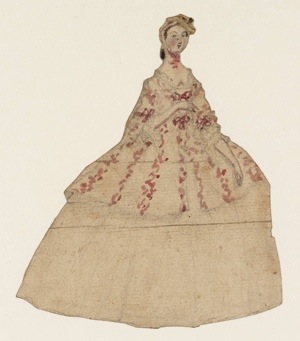
Cruising the Tate’s catalog, I found this, a cutout doll by Susanna Duncombe, no date, but clearly 18th century, since Susanna Dumcombe’s dates are 1725 -1812. I had to double check, but yes, she was 87 when she died.

There are fabulous bonnet drawings, and more of these wonderful cut outs. This one struck me, though, because the “jacket” and the petticoat do not match. Conventional wisdom is that patterned jackets and petticoats were always worn together. The title notes it is unfinished, so the petticoat might have matched if Susanna had finished the doll. There is clear line for a jacket hem, though, so it is at least a two-piece garment,

I think we might not know the “always” and “never” rules. And, too, I think that “always” and “never” are likely to be different depending on the status of the wearer. Plenty of runaways took off in calico jackets and short gowns worn with striped petticoats. (The 18th century was probably much more colorful than we credit.)

The fabric looks a lot like a roller print Burnley & Trowbridge had last spring. I wonder about its cut, too; it looks like a pet en l’air, as the loose-pleated kind of saque-back short garments are known. And that reminded me of the caracos fashion plates mimic-of-modes investigated.

Again, I draw no conclusions. But here is a fantastic serendipitous find, a period paper doll in what looks like a roller-printed garment. Too fancy for who I am in camp, but what a lovely garment to make, and then have to plan a picnic to wear to.