Can it!

Jar. Paul Cushman, 1805-1833. Stoneware. 20032.475

Or, how do you keep your pickles?

At work, we have found that the road to history is paved with unexpected documents. As often happens, while looking for something completely different, m’colleague and I found two documents that might help illuminate the question of food preservation and storage in the 18th century.

Probate inventories: I read all the way through and had one of those d’oh! moments. Why? Because at the end, there’s all the kitchen stuff. Andirons, warming pans, roasting pans, kettles, firkins, kneading trays, piggins, barrels, casks, bottles. This is the stuff of cooking and keeping food.

There are clues in the receipts (recipes): Amelia Simmons gives a hint in the final instructions “To pickle or make Mangoes of Melons.”

“put all these proportionably into the melons, filling them up with mustard-seeds; then lay them in an earthen pot with the slit upwards, and take one part of mustard and two parts or vinegar, enough to cover them, pouring it upon them scalding hot and keep them close stopped.”

To pickle Barberries ends thusly:

“let it stand to cool and settle, then pour it clear into the glasses; in a little of the pickle, boil a little fennel; when cold, put a little bit at the top of the pot or glass, and cover it close with a bladder or leather.”

Jar, Thomas Commeraw.1797-1819. Stoneware. 18.95.13

To pickle cucumbers:

“put them into jars, stive them down close, and when cold, tie on a bladder and leather.”

To keep Green Peas till Christmas:

“have your bottles ready, fill them, cover the them with mutton suet fat when it is a little soft; fill the necks almost to the top, cork them, tie a bladder and a leather over them and set them in a dry cool place.”

If we tease these apart, we come up with some basics: preservation is done with pickling and “putting up” foodstuffs in pots, jars, bottles, and glasses. These are sealed with bladders, which are tied on; there is a sense in the first receipt that “close stopped” might imply corkage, but the repetition of bladders in the following receipts suggests otherwise for most of these; the entry for Emptins does state “will keep well cork’d in a bottle five or six weeks.”

Covered jar, Connecticut. Earthenware, 1800-1830. 18.27.1a, b

The other key? You’ve probably come across food packages that require storage in a “cool dry place,” and as we have cupboards in our kitchens, or perhaps in our pantries, early cooks also had pantries or butteries (say it but-trees). How’d they do it?
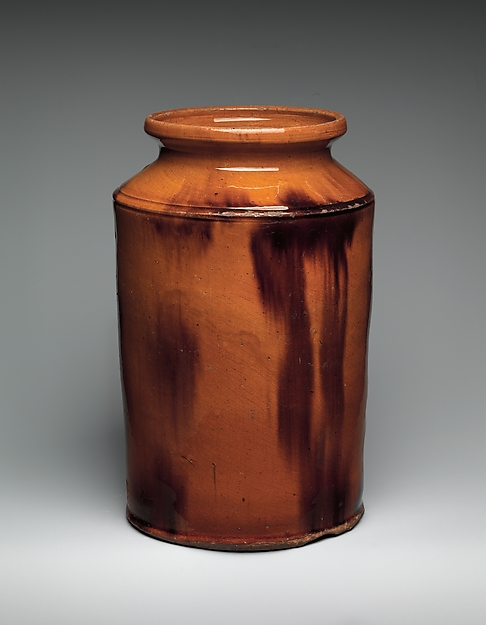
Jar,. Earthenware, 1800-1900. 18.95.11

The 18th century house was not centrally heated. 18th century Providence residents recorded temperatures of 48 and 58 degrees indoors in the winter, in rooms with fireplaces. An unheated room or cellar would be cool, too; here in the Ocean State, maintaining dry conditions could be the bigger challenge.

What did those jars and pots look like? As you can see in this post, the Met has a few– fortunately, these appealed to collectors and wound up in museums. Closer to home for the original question, the Missouri History Museum has a collection with a number of jars. A cursory look showed dates in the 1830-1860 range, but the shares are consistent with those seen at the Met.

I’m not a food historian, and I don’t pretend to be, but as I think about answering a question, these are the steps I take. Recipes, collections, and then more looking. I just hadn’t remembered that probate inventories would list everything, so one might get a sense of a household’s contents and thus its eating and storage habits.

Frivolous Friday: A-Spalling Behaviour

Mr. Turner, out now on iTunes and elsewhere, won’t be for everyone: M’damsel isn’t treated very well– artists are, you know, often narcissistic, driven users– but the landscapes thrill.

We talk sometimes about going to the antique store in historical clothing and asking why our chattel is for sale. I toy with similar naughty thoughts about visiting historic house and other museums, but Mr Turner inspires a dream of a simpler pleasure: dressing in period clothes to visit a period gallery.

Classic Mr Turner in the salon

Possibly my companion would grunt as Turner does, but we might also unnerve guards by pointing walking sticks at salon-hung still lifes or reacting with disgust at the sight of an Impressionist work. (Might as well take it all the way.)

Everybody’s a critic

No takers yet for this diversion, which is just as well. I expect it would be a quick way to meet security and police staff if you didn’t coordinate with the museum/gallery in advance. Still: what a stunt. Someday I’ll pull it off.

Feeling Materialistic

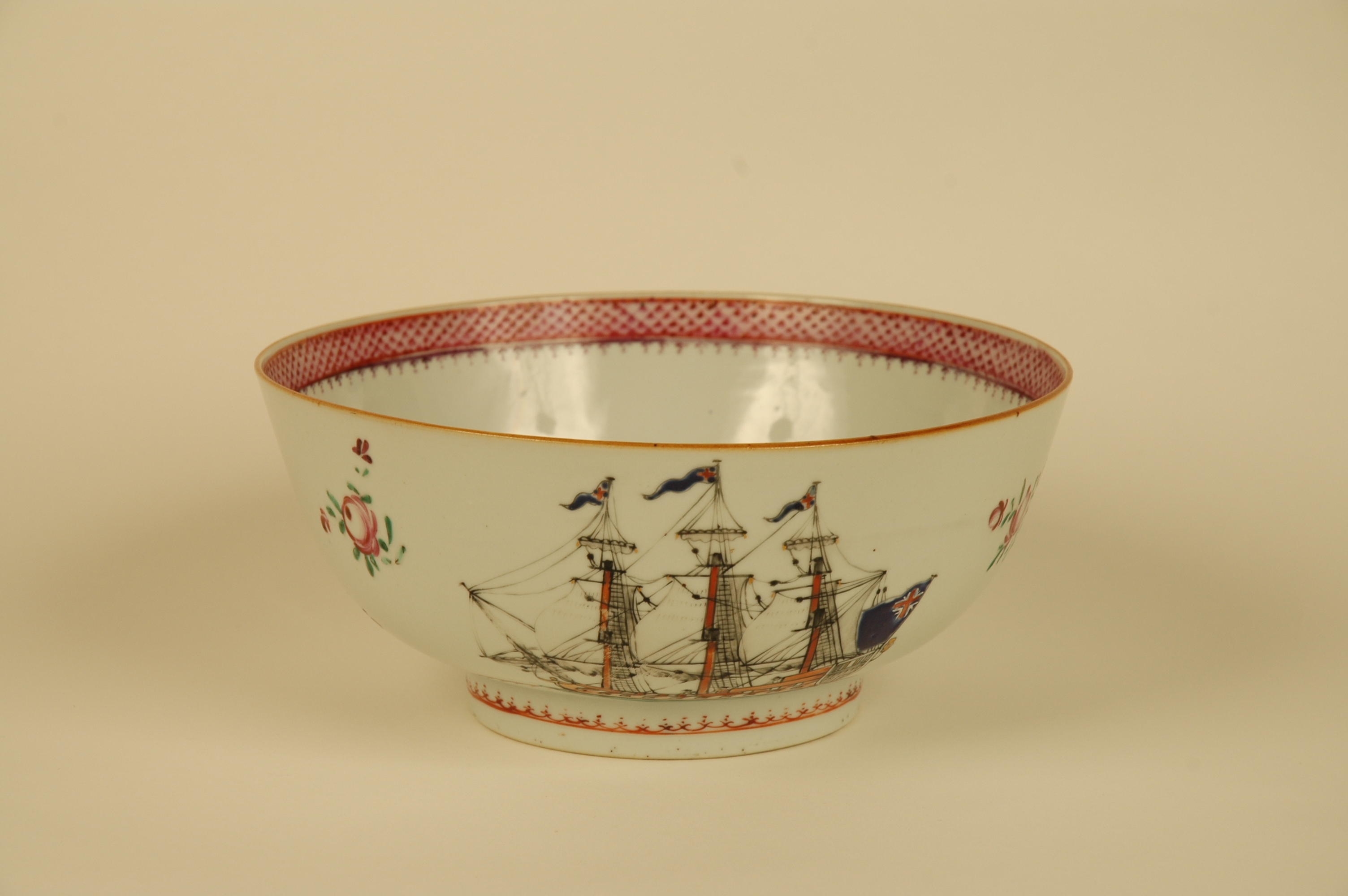
Chinese Export Porcelain bowl for the American market, 1790-1810. RIHS collection

I went to Newport yesterday for a History Space program on material culture. I don’t know why I  was nervous, really, because I love stuff. I try not to accumulate too much stuff in my own life, and to be a careful curator, but really: beautiful objects make me really happy, and I love talking about “the thingness of things.”

Living history is fun for me for a lot of reasons, some esoteric and personal. I spent a lot of time in school thinking about images of America, and what they meant (it was the age of semiotics and Derrida) so creating living history personae and clothes and based on images and research is a way of making art of history, or else dressing up in funny clothes and enjoying loud noises.

Historical research is most fun when it asks questions– the journey is as good as the destination–and there are good questions to ask the things you carry with you or use in living history. (They’re probably good to ask if you’re in a mood to downsize at home, too.)

  • What is it?
  • When was it made?
  • Who made it?
  • What is it made of? Where did the materials come from?
  • Where did you get it? When did you get it?
  • How does it work, what does it do?
  • What does it mean to you?

If you can answer those questions, you’ll be a lot closer to knowing the why of what you have.

It’s the stories we tell about our objects that give them meaning: sometimes it’s who made or used a thing, sometimes the story has a meaning that you can’t tell from the object itself.

Think of this: I crossed the Pell bridge last night to come home, the road climbing into a storm cloud, the car lashed with rain and wind on a road surface daguerrotype-reflective and hard to read. The buffeting gusts on the car reminded me of the carpenter who didn’t like crossing the bridge to work in Portsmouth. Still, he told a story about crossing the bridge in storm on a motorcycle, with a girl riding behind him. The wind would rise, you’d both get scared, and she’d squeeze closer. He shivered inside his t-shirt as he told the story, with a tiny smile, and you knew he’d gone to Newport in that weather, on that bike, with that girl, on purpose.

You’d never get that story just from a jacket, a helmet, or a bike, but somewhere, there’s a object tied to that story.