2020 Vision

Rebecca Young at the Museum of the American Revolution. Always a good experience.

We made it: another turn around the sun, another year, a time of resolutions and reflection. 2019 was the year I had three jobs, invented a job, and qualified for Medicaid. It was a year I spent wondering who I was, and what my experience meant, if anything. I developed a new chronic condition (can you have too many?) and continued struggling to manage the old ones. I applied to, was waitlisted by, and ultimately rejected by a prestigious graduate program. I applied and interviewed for five jobs and got two. The one I have now, though a short-term contract, uses all the skills I honed over three decades working in museums. I expanded the repertoire of 18th-century women I represent, learned about flag making, and increased the number and accuracy of remedies in my medical box. I even journeyed further back in time to represent a Lost Colonist of Roanoke.
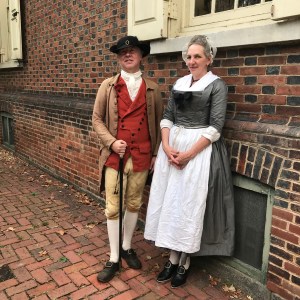
Together in multiple centuries, despite the bumps. Photo by Aaron Walker

Still, six months of working all weekend every weekend at job number two put me so far from my friends and habits that despite the pleasure of representing Rebecca Young and Elizabeth Weed, I still feel uncomfortable with living history and costuming. Those months certainly strained my relationship with Drunk Tailor, and with my own identity. Twenty nineteen is year I would revisit only in select details.

Mrs. Wainwright, Miss White and Miss Baker going into the Supreme Court to hear the decision on the Ohio ratification of the suffrage amendment, 1920.

For this coming year, I know only a few things. My contract expires at the end of March. I still love things and order, but I don’t know if I want to work full-time in a museum again. In a bit of perfection, I’m working as the de facto collections and project manager to transfer the library, archival, and object collections of the National Woman’s Party (NWP)  to the Library of Congress and the National Park Service, effectively closing the NWP as a cultural organization (the house is now preserved as a national monument).

I took this contract before my Kickstarter succeeded and admit I am ambivalent about it. Kitty Calash as a business is a little too small to sustain me with a kid in college, but museum work, aside from the work of establishing ownership and provenance, remains difficult for me. I wonder about the accumulations of objects, their meaning, and relevance for the future. I was a curator for a long time, but now I wonder what my role will be, in the evidence locker of history.

Like “curator,” “reenactor” no longer feels like it fits, even though I love history and clothes and dressing up. Perhaps this is too many weeks where dressing up was not an option, too many events missed, the habit lost. Perhaps it’s fear of succeeding, of striking out on my own and doing well, and instead of jumping, hesitating at precisely the wrong moment. Suddenly, it all seems so silly in the face of elections, climate change, and the instability of the gig economy.

Purveying ideas and goods as a milliner is a lot like being a curator.

I wrestled with this in 2017 and 2013,  winters when things seemed hopeless for reasons large and small. Three years ago, I found my refuge in art. Even a year ago, art and aesthetics felt like solace. This year, the New York Times’ Culture Therapist addressed a reader’s question, or problem, that echoed with my own sense of perturbation.

The core of the issue was this: “What happens when we no longer fit our own context?” The answers were varied, and to me, seemed like long shots (too many uncontrollable factors) but this struck me: It will require risking compassion to create an expanded and possibly destabilizing relationship to visual culture.

In 2019, I learned the key to most successful endeavors is vulnerability. I spent a lifetime building walls to protect myself that now box me in. Razing those walls is what I think of when I read “risking compassion,” though it’s hard to say exactly what a destabilizing relationship to visual culture (or history, or costume, or fashion) might be. It may be understanding how little one knows about the past, accepting new aesthetics, or trying something completely new. Even as I contemplate a possible grant-funded costumed interpretation program, clothes from 1919 don’t feel “new” enough to me; they are not different enough. I don’t know what will be, but I do know that unless I’m emotionally uncomfortable, I’m not learning.

For all the angst and tears and anger of 2019, all the feelings I do not want to feel again, this year taught me to trust myself, to try, to fail, and to succeed. We learn as much from our failures as our successes, and while some of us more easily recall painful memories, it is worth remembering they can lead to our happiest moments. For this coming year, I will try to hold onto hope, that thing with feathers, and plan to learn new skills, improve the ones I have, and continue to find joy in the everyday.
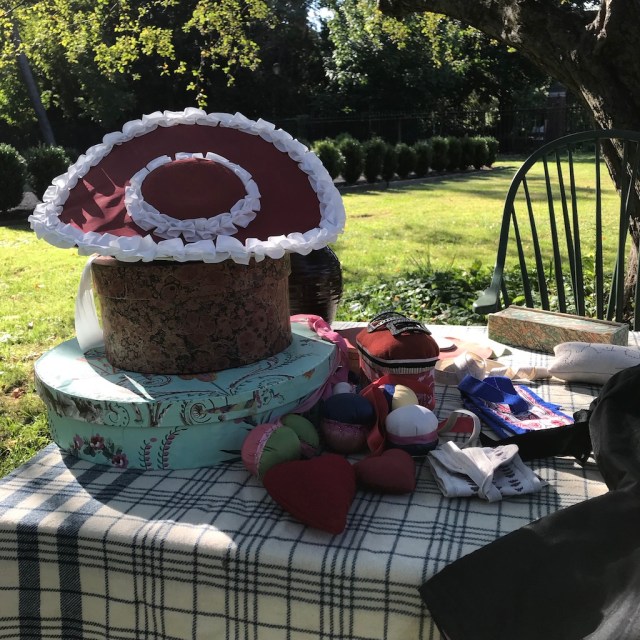
Saturday Afternoon in the Park with Kitty

The strawberries and cream hat, with pinballs and pincushions

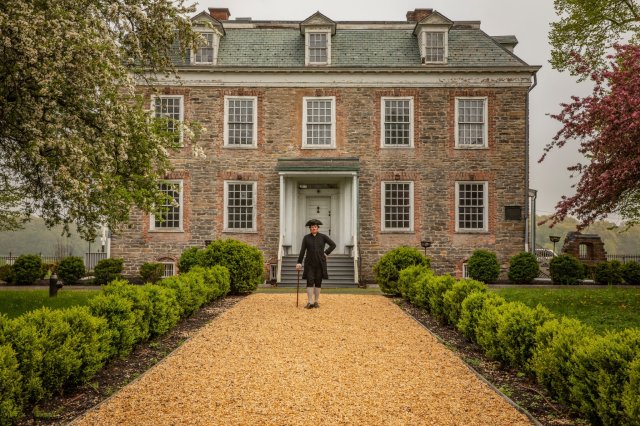
Last Saturday, I enjoyed a beautiful late summer afternoon on the lawn at Van Cortlandt House Museum in the Bronx. Built in 1748 for Frederick Van Cortlandt and his family, the house served as Washington’s headquarters in 1776, and again in 1783.

was  The Van Cortlandt House, dating from 1748, is the oldest building in the Bronx.CreditTony Cenicola/The New York Times

It’s an idyllic site, and waking up to the sound of cricket bats and Canada geese, a visitor could be fooled into thinking you were not in the Bronx at all. Mist rose above the cricket pitch when I woke up, a large flock of geese picking at the grass. It was Netherland come to life, men beating bats on their cleats and laughing. I’m really grateful to Mrs M. for the place to sleep and chance for adventure.

This trip was a remarkable cultural experience for me, and one I really needed. Growing up on the north side of Chicago, I was used to urban density and scale, so after two years in Northern Virginia suburbs, a dose of urban life was welcome. It was all the more welcome because instead of spending my time judged by cats, I got to play with dogs (and earned a sore bicep for all the stick and giraffe throwing I did for one). The trip to Stew Leonard’s was remarkable, after the tame mercantile experiences of tiny Rhode Island, and even Wegman’s paled in comparison. It was a good set up for thinking about mercantile enterprises, impulse purchases, and the ways merchants (including milliners) and shop owners needed to keep customers coming back, tempting them with new goods. (Or, in the case of Stew Leonard’s, singing cows and/or milk cartons.)

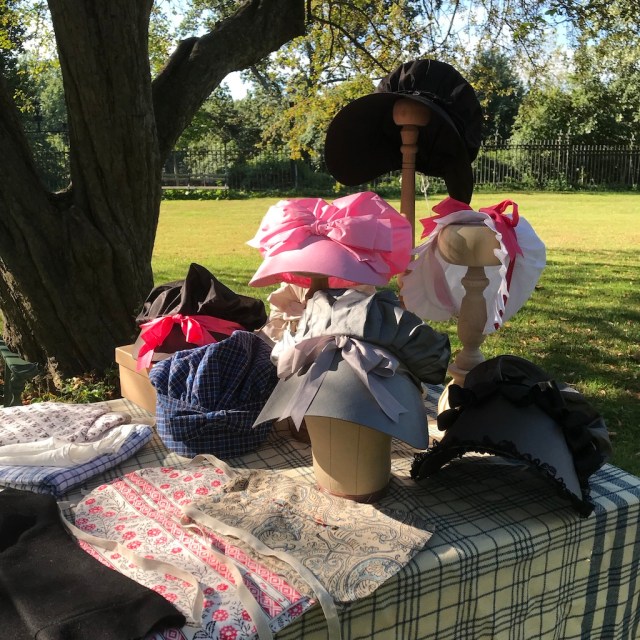
More bonnets, most of which are available on Etsy

I managed, somehow, to finish a red silk satin quilted petticoat in time (lined with red “stuff” from Burley and Trowbridge, it was not too bed-covering like until the late afternoon) to dress up the Nancy Dawson dress. I didn’t manage to locate my sleeve ruffles in time ( stitched on a garment ) but in other regards, I was pleased with how this turned out.

Bathroom selfie, but you can see that sweet silk petticoat

Dressing my clothes up– that is, moving them up the social ladder– can be a challenge, but good accessories make a big difference. Eventually I will get a finer apron made, one with a ruffle, but for now, that has to wait.

With Lark, perhaps the sweetest little rescue pup I’ve ever met.

I have a trip to Philadelphia to make, bottles to label, and receipts to write. Elizabeth Weed returns to Carpenters Hall this weekend as part of the Occupied Philadelphia programming.

Museum Monday: GWU & Textile Museum

Friday I found myself in Foggy Bottom with time to spare on a parking meter in Alexandria, so I cast about for someplace to explore. For the first wearing of my favorite boots this season, the Mall seemed too far, so I chose the George Washington University Museum and The Textile Museum. Once upon a time, the Textile Museum had its own home, but as with so many museums, it could not support itself, and found a new home within a university. GWU is also home to the Albert H. Small Center for National Capital Area Studies, which collects Washingtonia, documenting the evolution of the District of Columbia’s landscape and built environment.

University museums make me a little nervous the same way museums associated with private hereditary-based membership organizations do– there’s an increased level of exclusivity beyond the usual white marble stairs and bronzed glass doors. Is the museum for the public, or only for the students? How well does the museum integrate with the community around it? That’s not much of a concern for the GWU Museum, given that it is embedded in a neighborhood primarily comprised of college students, but the hands-on lab is clearly oriented towards school groups of all ages, and school groups have their own (slightly half-hearted) page.  Still, it’s not like Penn’s Museum, which is embedded in a very different kind of neighborhood.

Still, the front desk staff were friendly helpful, suggesting two ways to see the museum (basement up, via the stairs or top down, via elevator). I chose the stairs. The basement level featured selections from the Textile Museum Collection, Textiles 101 and Faig Ahmed: Nonvisual Language. It’s a good thing I’ve got years of museum training because Ahmed’s work is really tactile. I wanted to plunge my hands into the first piece I saw, a luscious red wall hanging. Really: you want to get your hands in it.

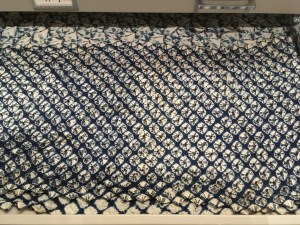
Shibori in a drawer in Textiles 101

Textiles 101 provided the chance to touch, a welcome relief after looking. There were drawers to open, and a large explanation of the types of weave structures that make up textiles. A very helpful security guard recommended (insisted) that I watch the video on the 2017 Maryland Sheep to Shawl Contest,  which I did enjoy. As the only person in the galleries, my heels echoed and I attracted quite a bit of (friendly) attention.

On the second floor, I found the Alfred Small Collection of Washingtonian’s Eye of the Bird: Visions and Views of D.C.’s Past which I found incredibly helpful in understanding the evolution of the city, and in orienting myself when on the ground. The diagonal streets and circles are confusing to someone  familiar with grids, or cowpaths, or grids laid over cowpaths, so I need all the orientation I can get. An unexpected treat was a lovely 1830s dress with whitework pelerine, illustrating resident dressed for one of my favorite eras.

The Basics:

Admission:
Free (suggested donation, $8; front desk staff waved me in when I brought up AAM)

Hours:
Monday and Friday: 11 AM–5 PM
Tuesday: Closed
Wednesday–Thursday: 11 AM–7 PM
Saturday: 10 AM–5 PM
Sunday: 1–5 PM

Closest Metro: Foggy Bottom (Blue, Orange, and Silver Lines)

Under the Green Umbrella

May, 1802. Gift of Woodman Thompson, Costume Institute Fashion Plates, Metropolitan Museum of Art

How do you like this gentleman? He’s from the Met’s online collection of fashion plates, in Men’s Wear 1790-1829, Plate 032.

I know a gentleman with a similar waistcoat and a similar smirk who needs only the umbrella and spy glass to complete this picture.

In case you’re wondering, the Hull Museum (UK) has a page devoted to a brief history of the umbrella. While classically and stereotypically British, it certainly rains enough here to justify carrying one. The British Museum has 46 trade cards that include umbrellas, with a few pre-1800 examples.