

This time, unoccupied. I’ll be representing Rebecca Flower Young at the Museum of the American Revolution’s Flower’s Artificers event this coming weekend, and to get ready, I’ve been reading research material generously shared by museum staff, as well as Marla Miller’s classic Betsy Ross and the Making of America, which mentions Rebecca Young in the context of the competitive world of Continental Army contractors in 1780s Philadelphia.
Rebecca Flower Young (1739-1819) was an older sister of Benjamin Flower (1748-1781), Lieutenant Colonel in the Continental Army. Before the war, she lived in Philadelphia with her husband, William Young, a goldsmith, and their five children. The family fled Philadelphia for Lebanon, PA in September 1777 as the British Army advanced to occupy the city; it would not have been safe for them, given their ardent Whig politics and relationship to Benjamin, commissary general of military stores. After William Young’s death in February, 1778, Colonel Flower secured a house for his sister on Walnut Street, and work as a contractor providing supplies for the Continental Army.

Rebecca made drum cases and shirts, cap linings and cartridges, and multiple Continental standards. From the quantities she produced– 500 cap linings for light horsemen– it is possible she hired assistants in addition to her children. Her 17-year-old son William made “five hundred dozen of Priming wires and brushes” in 1780, aiding the war effort through the supply chain rather than as a foot soldier, a condition that was likely a relief, given Rebecca’s status as a widow. She also let a room in the Walnut Street house, the boarder’s rent providing a relatively steady and reliable income.
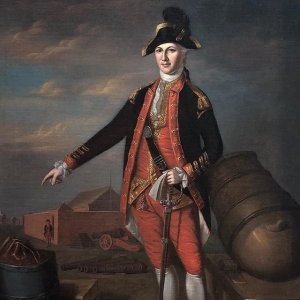 Col. Benjamin Flower, oil on canvas by Charles Willson Peale. Star-Spangled Banner House, Baltimore, MD.
We have no idea what Rebecca Young looked like, of course, though there is a portrait of her brother, Benjamin, in his uniform, as well as a portrait miniature sold at Freeman’s.
With only written sources about her work to guide me, I have waffled back and forth about Rebecca Young’s material world. In the end, I have made a much-needed new shift and cap for this weekend, as well as a gown (that, of this writing, requires only one cuff and the skirt hem). After reading Miller on Betsy Ross, I was of two minds: first, that the material world of these women was shabby and out-of-date, given the privations of the occupation and the war-driven inflation and second, that their status as contractors gave them an income that allowed them to afford new things. Still, with five children, new anything would have been a stretch, so I remain undecided and firmly ambivalent about the appropriateness of this gown. Scissors, needles, pins: those tools are much easier to understand than personal circumstances.
We approach representing the past with preconceptions that are hard to shake: the images we have in mind are dominated by representations of people at the far ends of the economic spectrum. It’s as if we had only the Saks Fifth Avenue and Old Navy websites to help us understand American clothing today. The wildly divergent economic and material situations tell us little about the people in the middle, who make up the vast majority of the population.
Research and primary source materials on Rebecca Flower Young were provided by Matthew Skic of the Museum of the American Revolution; compiled information used by gallery educators at the MoAR was compiled and provided by Katherine Becnel of the MoAR.


 Kirsten Hammerstrom
You must be logged in to post a comment.