Taking Tea

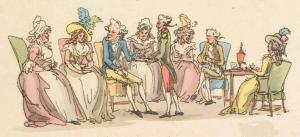
Detail, Picturesque studies and scenes of everyday life watercolor by Thomas Rowlandson, 1790. Royal Collection Trust. RCIN 810396
Detail, Picturesque studies and scenes of everyday life. Handcolored etching by Thomas Rowlandson, 1790. Royal Collection Trust. RCIN 810396

Hat tip to Jane Austen’s World for the image at left, which helped me start visualizing another program I’m involved with, this time ‘at home’ in Providence.

When we started reinterpreting the house museum, we began going back through primary sources to figure out how rooms might have been used, and furniture arranged (we don’t have inventories, so we read the house and diaries and letters– but that’s for another post).

Detail, The Tea Party. Oil on canvas by Henry Sargent, 1824. MFA Boston, 19.12

One of the things I remember most vividly was the description of the uncomfortable tea parties Providence women gave, where the guests sat in chairs against the walls of the rooms, balancing a tea cup in one hand and plate in another. Several hard drives later, I’m not sure where that primary source is (the hunt begins tomorrow) but it conjured images of every hostess in Providence a Hyacinth Bucket, and every guest a quivering Elizabeth Next Door.
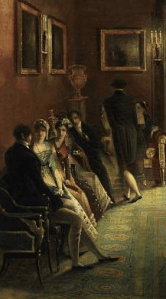
Detail, The Tea Party. Oil on Canvas by Henry Sargent, 1824. MFA Boston, 19.12

Surely that couldn’t be true? I thought I must be making it up, but then the Rowlandson turns up on the interwebs and there they are, in a row. More famously and closer to home, Henry Sargent’s painting of a Boston tea party in 1824. (The catalog description is rather nice.)

Here’s an 1824 tea party in Boston. While this is later than the tea party we’ve planned at work, it is still full of useful hints about how early, formal tea parties were conducted. We think– or I do, anyway– of ladies in frilly hats seated a tables with cakes heaped on stands and floral tea pots. I hear “tea party” and I think “doilies,” but this is not your grandmother’s tea party. It’s a different kind of social occasion, both more formal and more relaxed.

Detail, The Tea Party, oil on canvas by Henry Sargent, 1824. MFA Boston, 19.12

There’s not a central table to sit around, but instead chairs lined up against the wall, groups of guests, chatting. Others guests stand close to the fireplace, and a pair of ladies have taken a settee and a stool for their close conversation. We can just make out the tiny tea cup in the lady’s gloved hand.

In many ways, this depiction reminds me more of contemporary cocktail parties or open houses with the guests in small, changing groups, and no place to put your cup. Of course, most of us don’t have waiters (that’s who you see in the detail above with his back to us) or fabulous houses on the Tontine Crescent in Boston.

In so many ways, the social customs, habits and mores of the past are lost to us, and as we try to recreate them, the we excavate them from a combination of unlikely sources. Accounts, paintings, diaries, and etiquette manuals serve as sources, but it’s easier to recreate the economics of tea than the structure of a tea party. And once we do have an approximation, will it be a party anyone wants to go to?
Museum Madness and Things to Make

After a day at the Met on Friday, I went to work at my own museum on Monday. We moved paintings, rounded up miniatures for photography, and packed an ax for transport.

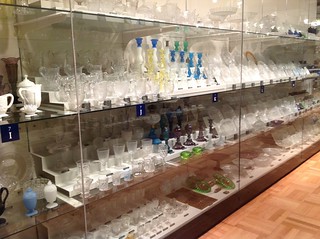
Glass at the Met. I hate this stuff.

On Tuesday, I took the MBTA up to Boston to deliver the ax (tomahawk, throwing ax, ax comma belt in Chenhall) to another museum, at the Old State House. I think this show will be very nice, and I had the pleasure of meeting someone whose wife I know through the interwebs: behold the power of the interwebs, and the small size of the reenacting community. Also, my state.)

Then, because I cannot get enough of this stuff, I took the Green line over to the MFA. By now you’re thinking, Kitty, really? How many museums do you need to visit in five days? Should we get you help? But the thing is, objects get me really stoked. Paintings, sculpture, heck, even glass– and I hate glass– make me pretty happy.

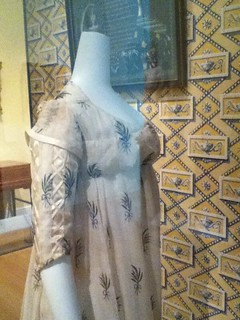
1998.96, overdress or tunic. MFA Boston

I’d just been to the MFA in July, so this trip was to visit some friends among the Copleys and Greenwoods and Blackburns. But I also know that the textiles have to rotate often, and there are dedicated mannequins in the Art of the Americas Wing.  My reward for a return trip? This lovely over dress or tunic.

I love the fabric, and thought immediately of Quinn’s Tree Gown. Hmm. As you can imagine, I will be hot on the trail of something like this fabric as soon as I am done with the menswear on my list. (There is a lot of menswear, but that doesn’t mean I can’t do some real thinking and research in preparation for this tunic…which is all I can do for now.)

It does cross over in the front, and the floral motifs line up across the layers.

There are more photos of the overdress in the MFA set on flickr, and I have a lot more thinking to do about this tunic. It does have a cross-over front, which I like, but the lacing is really striking. This may take another trip to the MFA with a better camera.

Oversleeves, cross front, lacing, diamond-shape piece in the back like a keystone…there’s a lot of detail, and lot to love (and eventually curse while making) in this tunic.

Way Finding & the Social Museum

open storage at the Met Museum
Open Storage: Luce Center at the Met

I can’t say this enough: museums are best when they are social experiences. The happiest moment of my day came early, when I was in the Ipswich room of the American wing. Another iPad toting guy and I talked about the lowness of the ceiling, the large fireplace, the bed, and how cozy the room was. (I told him to go to Plimoth if he got a chance.) but it was exciting to talk and share: that’s the best part of discovery, and that’s what museums are about. They’re about finding things, or yourself, or ideas.

The Luce Center was nearly empty of people. A school passed through on their way to someplace else, but I had it pretty much to my self. None of the computers were being used. I saw very few of any screened devices used in the Museum, aside from personal devices.

baby rattle at the Met
Late 17th-early 18th century rattle. Appears to be missing its coral

The Met collection is astounding, no doubt. But I was pleased to see that there are some finer pieces in Rhode Island storerooms and museum rooms. And I think that the way finding could use some real attention. The MFA, last time I was there, had it down: interns, stationed throughout the galleries, to ask if you needed directions whenever you looked lost. NY, not so friendly but maybe more necessary. Also, the galley number for one show I wanted to see was not even included in its web listing. That was a serious annoyance, but I was able to find it eventually.

Replica furniture at the MFA Boston
American Wing at the MFA Boston

The installations are excellent, though standard and in some cases unimaginative. I know: I just dissed the Met. And I’m sticking with that. The exploded chest in the Luce storage wing was one of the best items spotted. I’d say that when it comes to furniture, American furniture, the MFA bests the Mets installation. And I like some other period rooms just as well. Like my own. They just need to be cleaner. What’s wrong with those housemaids? Oh, right. One’s in England, and the other one’s exhausted from her trip back from New York.