What Pinterest Can Do, or, Asher Durand

BRM-Landscape, Wood Scene

At the Brandywine River Museum, I saw an Asher B. Durand landscape and said, “I haven’t thought about Asher Durand in a long time.” My mother, ever the realist, muttered just-loud-enough, “Well, why would you?!” She studied art history for real, me, I only went to art school. It’s a wonder I can even feed myself.

Getting my stimulating-image fix last night on Pinterest: lo and behold, Asher B. Durand! Buddy! Good to see you! Even better, the side of Asher Durand you never get in those American Art History classes taught by a disheartened adjunct on a three-year contract trying to beat Manifest Destiny into you.

If you’re like me, Asher Durand’s the original Jersey Boy member of the Hudson River School, all Thanatopsis and metaphors, machine-in-the-garden, acolyte of Thomas Cole. But it’s better than that–he’s also Mr. Awesome Portrait.

MMA-Mrs Winfield Scott

Thanks to Cassidy, Mrs. Winfield Scott gazed calmly from the screen last night, lovely in her golden silk gown with fine silk over sleeves not even as heavy as butterfly wings. Lovely Mrs. Scott, against a backdrop of a…finely painted river scene, highly detailed and with a looming cloud… That painter guy seems to know what he’s doing, why, Asher B. Durand, you scamp! You worked landscape magic into the background of that money-making, pay-the-bills portrait.

Grey Collection-Summer Afternoon

Cows won’t pay for portraits of themselves, so the history and landscape painters of the past generally had to shill the portraits (G.C. Bingham did it, but without Asher B’s grace). Lucky for us, they were good at people, too, though I think you can tell their first love is landscape.

PAFA-Creek & Rocks
PAFA-Creek & Rocks

Art History Secrets Revealed: I have a friend who paints rocks in streams (and other things), but Ken’s paintings of rocks are incredibly beautiful. He studied at the Pennsylvania Academy of the Fine Arts, which is home to…did you guess? Asher B. Durand’s painting of rocks in a stream.

So while Pinterest can be home to horrors (go see for yourself, I’m not looking), it can lead you to places you didn’t expect to go, or back to things you’d forgotten about, like Asher B. Durand. He was useful to know about when I worked in the Midwest, photo editing a history journal.  I’m glad I’ve met him again.

Portrait of a Waistcoat

RIHS-Robert Jenkins

Meet Mr. Jenkins. There are references to a Robert Jenkins, Vestryman of Christ Church, Boston and merchant of Salem, MA and Newport, RI. A Robert Jenkins married Elizabeth Champlin of Newport, and we have a pendant portrait of Betsey Jenkins, suggesting stronger ties to Newport. The records are confusing, but one thing is clear: that’s his waistcoat and he’s happy to have you see it.

This 1748 portrait by John Greenwood shows a man associated with a port city, perhaps connected with shipping and mercantile trade (see the ships in the background), and who has made enough money to a) commission a portrait and b) either own that sweet silk velvet waistcoat or to have one painted. It is entirely possible that he owned it.

Met-Waistcoat

And it probably looked a lot like this 1750-1755 one from the Met, but without the sleeves. There is fragment (two fronts) of one very like this in the collection at work. It’s not Robert Jenkins’, but it is Rhode Island, so we know these kind of garments were available and worn. The last piece to track down would be an account book, to get some idea of what this might have cost.

What I like in particular about the Met’s waistcoat is the cuff detail. The sleeve, which would be heavy if fully made of velvet, is not. Only the cuff is the velvet, while the sleeve itself is lighter weight silk.

Caps and Randomness

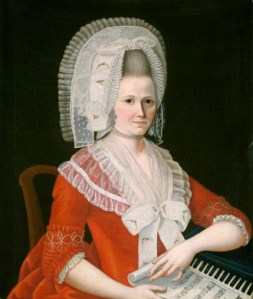
NGA- Lady Wearing a Large White Cap

Sweet cap, right? It all started because it’s cold this morning here in RI and I thought about skating when I went out to get the Times, and that led to Gilbert Stuart, which led to the National Gallery.

They have a fun search option, similar to the Tate Britain’s subject-search, but not quite as elegant.
You can start with a subject search, and then add a sub category. Results (stability not guaranteed) show you things you would not have otherwise expected, and that’s one more reason to love online catalogs & databases.

NGA Screenshot
NGA Screenshot

The results give you little unexpected galleries, and the juxtaposition or similarities of the thumbnails help you see the work differently. Black dresses and white collars are prevalent on this page: why? Is this fashion alone, or are these mourning garments? they’re earlier than the Civil War, but maybe it’s time to re-read This Republic of Suffering.

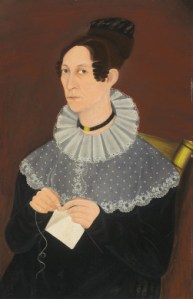
NGA- Sarah Cook Arnold knitting

But wait–who is this? It’s Probably Sarah Cook Arnold, Knitting. (Probably is not her name, smartypants, it’s an adverb.)

She’s knitting in the round, by the way, on three incredibly tiny pins from an invisible ball of yarn, possibly swallowed by the cat hidden in her skirts. (I know a woman who can knit with these skinny quadruple-ought pins, but they are a hazard in my hands.)

I would not have found Sarah Cook Arnold knitting without using the random subject search, nor would I have found Fabulous Cap at the top. Sometimes you need to enjoy the journey as much as the destination.

Linings, perhaps not Silver

MMA, 2011.104a–c, Silk & linen suit, 1780-1790

The house is cleaned up for Christmas, which means all the sewing things have been put away, which is rather sad. Cassandra is banished to the basement, fabric stashed and stacked. It’s only ten days: better if I don’t count all that lost time when I could be pleating! Better to finish up some portable plain sewing, like shift and shirt.

On Friday, I spent part of the morning in the Cave of Wonders known as Textile Storage with a historical costume expert who specializes in men’s clothing. He had already promised to leave and sworn not move in before I opened the door, and that was probably a good thing. But I got a chance to ask some questions and here are the answers.

The frock coat tail linings of calendered linen: Nancy wanted to know if they didn’t stick to men’s breeches, linen catching on broadcloth, in the plainer suits. No, my source says, because the linings were slick. That was the point of the glazing. When it was new and fresh, it was much slicker than it is now. After 220+ years, slickness will fade. Calendered fabric has been pressed and heated, and that process makes it slick. If you’ve ever pressed a wool dress with too hot an iron, you might have achieved a glossy, slick finish that you weren’t expecting. Calendering is similar, but on purpose.

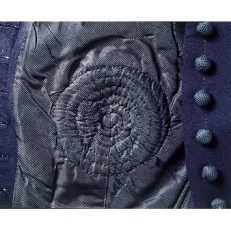
Incroyable-No3-detAnd then there’s padding. Sabine made an amazingly beautiful jacket based on an original. The lining is really interesting, because it is padded. Well, that padding is about style. In the plate at left, the shoulder line of the jacket is high, and the collar rises up as well. The chest is rounded, as we can see along the side. The way to achieve that look is through tailoring, including the use of padding.

The militia jackets in the collection at work include one with some pretty intense (several inches thick) padding in the front. That was for line, not repelling bullets, or even so much for warmth. The padding we find in men’s and women’s tailored clothes is about style, and maintaining a line. You’ll see this often in women’s riding habits or “Amazones.”

V&A T.158-1962
V&A T.158-1962
V&A, T.158-1962, overview

On pages 160-161 of Nineteenth-Century Fashion in Detail, there are two examples of padding used to shape garments. The first is a riding habit, seen here in detail and in overview. (Click for the record & larger views.) The padding here has been used to create the smooth, conical silhouette.